

34 Application and Research of Acoustic Emission …
401
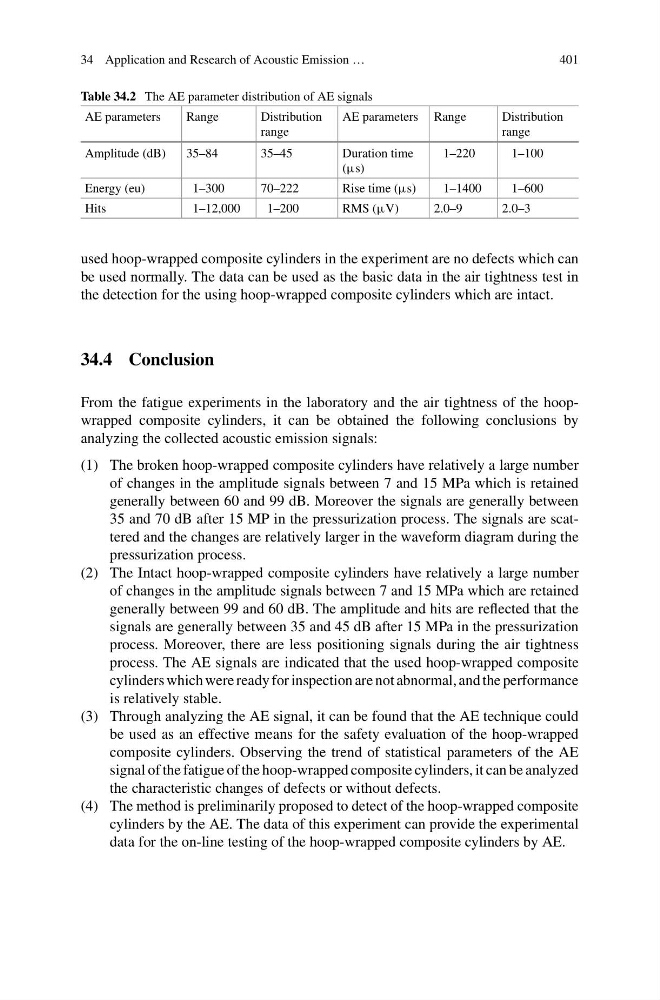
Table 34.2 The AE parameter distribution of AE signals
AE parameters
Range
Distribution
range
AE parameters Range
Distribution
range
Amplitude (dB)
35–84
35–45
Duration time
(µs)
1–220
1–100
Energy (eu)
1–300
70–222
Rise time (µs)
1–1400
1–600
Hits
1–12,000
1–200
RMS (µV)
2.0–9
2.0–3
used hoop-wrapped composite cylinders in the experiment are no defects which can
be used normally. The data can be used as the basic data in the air tightness test in
the detection for the using hoop-wrapped composite cylinders which are intact.
34.4 Conclusion
From the fatigue experiments in the laboratory and the air tightness of the hoopwrapped composite cylinders, it can be obtained the following conclusions by
analyzing the collected acoustic emission signals:
(1) The broken hoop-wrapped composite cylinders have relatively a large number
of changes in the amplitude signals between 7 and 15 MPa which is retained
generally between 60 and 99 dB. Moreover the signals are generally between
35 and 70 dB after 15 MP in the pressurization process. The signals are scattered and the changes are relatively larger in the waveform diagram during the
pressurization process.
(2) The Intact hoop-wrapped composite cylinders have relatively a large number
of changes in the amplitude signals between 7 and 15 MPa which are retained
generally between 99 and 60 dB. The amplitude and hits are reflected that the
signals are generally between 35 and 45 dB after 15 MPa in the pressurization
process. Moreover, there are less positioning signals during the air tightness
process. The AE signals are indicated that the used hoop-wrapped composite
cylinders which were ready for inspection are not abnormal, and the performance
is relatively stable.
(3) Through analyzing the AE signal, it can be found that the AE technique could
be used as an effective means for the safety evaluation of the hoop-wrapped
composite cylinders. Observing the trend of statistical parameters of the AE
signal of the fatigue of the hoop-wrapped composite cylinders, it can be analyzed
the characteristic changes of defects or without defects.
(4) The method is preliminarily proposed to detect of the hoop-wrapped composite
cylinders by the AE. The data of this experiment can provide the experimental
data for the on-line testing of the hoop-wrapped composite cylinders by AE.
401
Table 34.2 The AE parameter distribution of AE signals
AE parameters
Range
Distribution
range
AE parameters Range
Distribution
range
Amplitude (dB)
35–84
35–45
Duration time
(µs)
1–220
1–100
Energy (eu)
1–300
70–222
Rise time (µs)
1–1400
1–600
Hits
1–12,000
1–200
RMS (µV)
2.0–9
2.0–3
used hoop-wrapped composite cylinders in the experiment are no defects which can
be used normally. The data can be used as the basic data in the air tightness test in
the detection for the using hoop-wrapped composite cylinders which are intact.
34.4 Conclusion
From the fatigue experiments in the laboratory and the air tightness of the hoopwrapped composite cylinders, it can be obtained the following conclusions by
analyzing the collected acoustic emission signals:
(1) The broken hoop-wrapped composite cylinders have relatively a large number
of changes in the amplitude signals between 7 and 15 MPa which is retained
generally between 60 and 99 dB. Moreover the signals are generally between
35 and 70 dB after 15 MP in the pressurization process. The signals are scattered and the changes are relatively larger in the waveform diagram during the
pressurization process.
(2) The Intact hoop-wrapped composite cylinders have relatively a large number
of changes in the amplitude signals between 7 and 15 MPa which are retained
generally between 99 and 60 dB. The amplitude and hits are reflected that the
signals are generally between 35 and 45 dB after 15 MPa in the pressurization
process. Moreover, there are less positioning signals during the air tightness
process. The AE signals are indicated that the used hoop-wrapped composite
cylinders which were ready for inspection are not abnormal, and the performance
is relatively stable.
(3) Through analyzing the AE signal, it can be found that the AE technique could
be used as an effective means for the safety evaluation of the hoop-wrapped
composite cylinders. Observing the trend of statistical parameters of the AE
signal of the fatigue of the hoop-wrapped composite cylinders, it can be analyzed
the characteristic changes of defects or without defects.
(4) The method is preliminarily proposed to detect of the hoop-wrapped composite
cylinders by the AE. The data of this experiment can provide the experimental
data for the on-line testing of the hoop-wrapped composite cylinders by AE.