

34 Application and Research of Acoustic Emission …
397
34.3 Air Tightness Experiment
According to the standard GB 24162–2009 “Periodic inspection and evaluation
of hoop wrapped fibre reinforced composite gas cylinders with metal liners of
compressed natural gas for automotive vehicles”, the fiber-wound gas cylinders for
vehicles are mandatory to be inspected once every five years. The experiment of
the hoop-wrapped composite cylinders was carried out in accordance with the two
experimental standards: GB/T 9252-2001 “Method for cycling test of gas cylinders”
and GB 24160-2009 “Hoop-wrapped Composite Cylinders with Steel Liner for the
On-board Storage of Compressed Natural Gas As A Fuel for Automotive Vehicles”.
In the air tightness experiment, the sensors received the changes in the signals
of the hoop-wrapped composite cylinders, and then analyzed the signals. Through
the air tightness experiment, it is possible to monitor the germination micro cracks
in the inner liner or hoop-wrapped composite layer by the acoustic emission [4, 5].
In this paper, the acoustic emission is experimented of a large number of the gas
hoop-wrapped composite cylinders for the automotive vehicles.
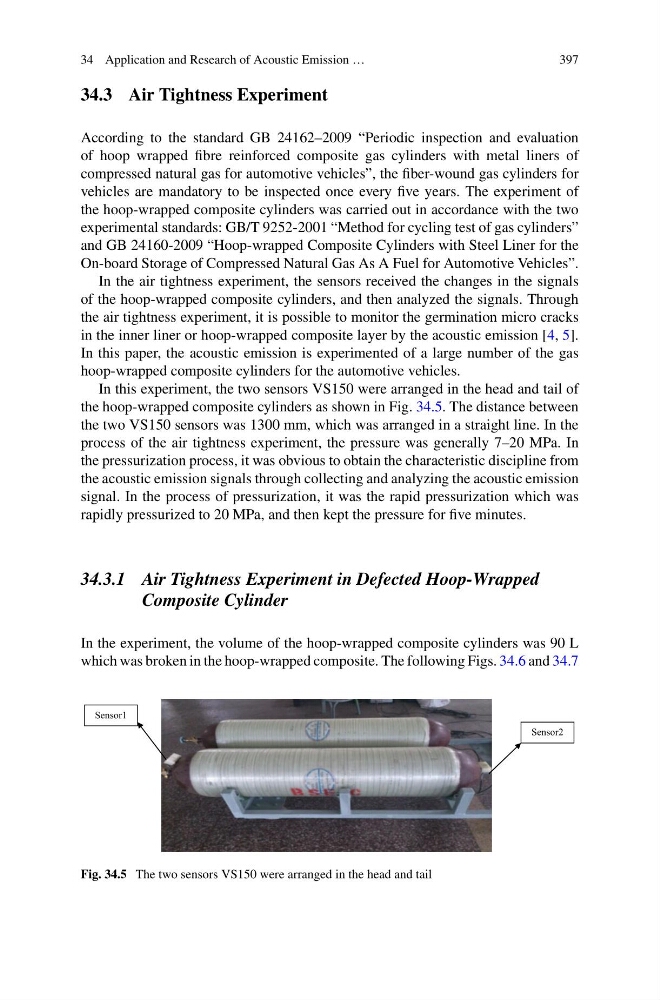
In this experiment, the two sensors VS150 were arranged in the head and tail of
the hoop-wrapped composite cylinders as shown in Fig. 34.5. The distance between
the two VS150 sensors was 1300 mm, which was arranged in a straight line. In the
process of the air tightness experiment, the pressure was generally 7–20 MPa. In
the pressurization process, it was obvious to obtain the characteristic discipline from
the acoustic emission signals through collecting and analyzing the acoustic emission
signal. In the process of pressurization, it was the rapid pressurization which was
rapidly pressurized to 20 MPa, and then kept the pressure for five minutes.
34.3.1 Air Tightness Experiment in Defected Hoop-Wrapped
Composite Cylinder
In the experiment, the volume of the hoop-wrapped composite cylinders was 90 L
which was broken in the hoop-wrapped composite. The following Figs. 34.6 and 34.7
Sensor1
Sensor2
Fig. 34.5 The two sensors VS150 were arranged in the head and tail
397
34.3 Air Tightness Experiment
According to the standard GB 24162–2009 “Periodic inspection and evaluation
of hoop wrapped fibre reinforced composite gas cylinders with metal liners of
compressed natural gas for automotive vehicles”, the fiber-wound gas cylinders for
vehicles are mandatory to be inspected once every five years. The experiment of
the hoop-wrapped composite cylinders was carried out in accordance with the two
experimental standards: GB/T 9252-2001 “Method for cycling test of gas cylinders”
and GB 24160-2009 “Hoop-wrapped Composite Cylinders with Steel Liner for the
On-board Storage of Compressed Natural Gas As A Fuel for Automotive Vehicles”.
In the air tightness experiment, the sensors received the changes in the signals
of the hoop-wrapped composite cylinders, and then analyzed the signals. Through
the air tightness experiment, it is possible to monitor the germination micro cracks
in the inner liner or hoop-wrapped composite layer by the acoustic emission [4, 5].
In this paper, the acoustic emission is experimented of a large number of the gas
hoop-wrapped composite cylinders for the automotive vehicles.
In this experiment, the two sensors VS150 were arranged in the head and tail of
the hoop-wrapped composite cylinders as shown in Fig. 34.5. The distance between
the two VS150 sensors was 1300 mm, which was arranged in a straight line. In the
process of the air tightness experiment, the pressure was generally 7–20 MPa. In
the pressurization process, it was obvious to obtain the characteristic discipline from
the acoustic emission signals through collecting and analyzing the acoustic emission
signal. In the process of pressurization, it was the rapid pressurization which was
rapidly pressurized to 20 MPa, and then kept the pressure for five minutes.
34.3.1 Air Tightness Experiment in Defected Hoop-Wrapped
Composite Cylinder
In the experiment, the volume of the hoop-wrapped composite cylinders was 90 L
which was broken in the hoop-wrapped composite. The following Figs. 34.6 and 34.7
Sensor1
Sensor2
Fig. 34.5 The two sensors VS150 were arranged in the head and tail