

20 Experiment Research on Tensile Process of Glass…
233
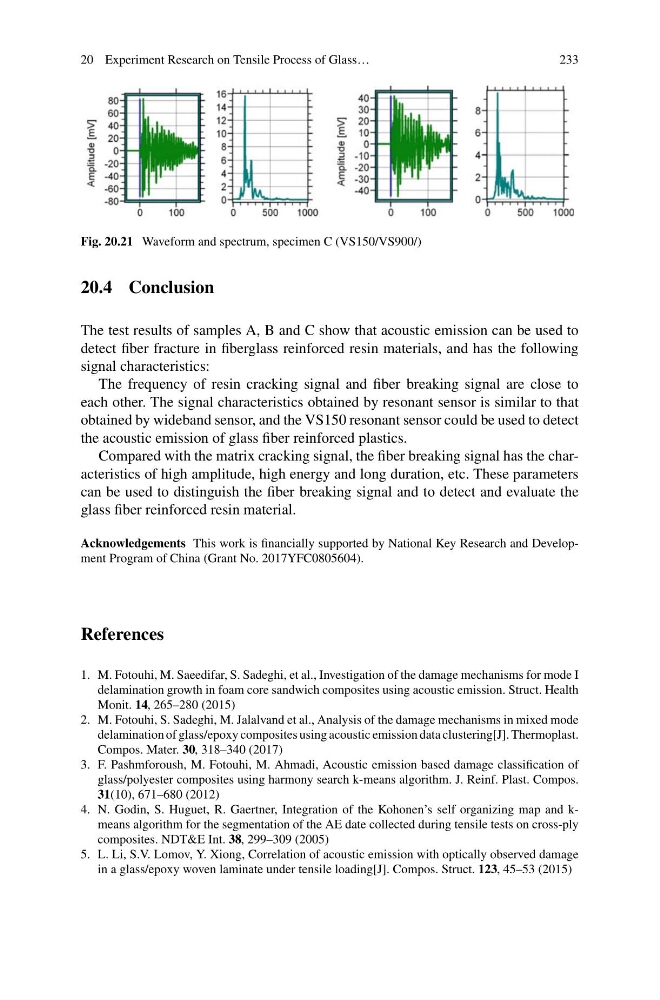
Fig. 20.21 Waveform and spectrum, specimen C (VS150/VS900/)
20.4 Conclusion
The test results of samples A, B and C show that acoustic emission can be used to
detect fiber fracture in fiberglass reinforced resin materials, and has the following
signal characteristics:
The frequency of resin cracking signal and fiber breaking signal are close to
each other. The signal characteristics obtained by resonant sensor is similar to that
obtained by wideband sensor, and the VS150 resonant sensor could be used to detect
the acoustic emission of glass fiber reinforced plastics.
Compared with the matrix cracking signal, the fiber breaking signal has the characteristics of high amplitude, high energy and long duration, etc. These parameters
can be used to distinguish the fiber breaking signal and to detect and evaluate the
glass fiber reinforced resin material.
Acknowledgements This work is financially supported by National Key Research and Development Program of China (Grant No. 2017YFC0805604).
References
1. M. Fotouhi, M. Saeedifar, S. Sadeghi, et al., Investigation of the damage mechanisms for mode I
delamination growth in foam core sandwich composites using acoustic emission. Struct. Health
Monit. 14, 265–280 (2015)
2. M. Fotouhi, S. Sadeghi, M. Jalalvand et al., Analysis of the damage mechanisms in mixed mode
delamination of glass/epoxy composites using acoustic emission data clustering[J]. Thermoplast.
Compos. Mater. 30, 318–340 (2017)
3. F. Pashmforoush, M. Fotouhi, M. Ahmadi, Acoustic emission based damage classification of
glass/polyester composites using harmony search k-means algorithm. J. Reinf. Plast. Compos.
31(10), 671–680 (2012)
4. N. Godin, S. Huguet, R. Gaertner, Integration of the Kohonen’s self organizing map and kmeans algorithm for the segmentation of the AE date collected during tensile tests on cross-ply
composites. NDT&E Int. 38, 299–309 (2005)
5. L. Li, S.V. Lomov, Y. Xiong, Correlation of acoustic emission with optically observed damage
in a glass/epoxy woven laminate under tensile loading[J]. Compos. Struct. 123, 45–53 (2015)
233
Fig. 20.21 Waveform and spectrum, specimen C (VS150/VS900/)
20.4 Conclusion
The test results of samples A, B and C show that acoustic emission can be used to
detect fiber fracture in fiberglass reinforced resin materials, and has the following
signal characteristics:
The frequency of resin cracking signal and fiber breaking signal are close to
each other. The signal characteristics obtained by resonant sensor is similar to that
obtained by wideband sensor, and the VS150 resonant sensor could be used to detect
the acoustic emission of glass fiber reinforced plastics.
Compared with the matrix cracking signal, the fiber breaking signal has the characteristics of high amplitude, high energy and long duration, etc. These parameters
can be used to distinguish the fiber breaking signal and to detect and evaluate the
glass fiber reinforced resin material.
Acknowledgements This work is financially supported by National Key Research and Development Program of China (Grant No. 2017YFC0805604).
References
1. M. Fotouhi, M. Saeedifar, S. Sadeghi, et al., Investigation of the damage mechanisms for mode I
delamination growth in foam core sandwich composites using acoustic emission. Struct. Health
Monit. 14, 265–280 (2015)
2. M. Fotouhi, S. Sadeghi, M. Jalalvand et al., Analysis of the damage mechanisms in mixed mode
delamination of glass/epoxy composites using acoustic emission data clustering[J]. Thermoplast.
Compos. Mater. 30, 318–340 (2017)
3. F. Pashmforoush, M. Fotouhi, M. Ahmadi, Acoustic emission based damage classification of
glass/polyester composites using harmony search k-means algorithm. J. Reinf. Plast. Compos.
31(10), 671–680 (2012)
4. N. Godin, S. Huguet, R. Gaertner, Integration of the Kohonen’s self organizing map and kmeans algorithm for the segmentation of the AE date collected during tensile tests on cross-ply
composites. NDT&E Int. 38, 299–309 (2005)
5. L. Li, S.V. Lomov, Y. Xiong, Correlation of acoustic emission with optically observed damage
in a glass/epoxy woven laminate under tensile loading[J]. Compos. Struct. 123, 45–53 (2015)