

18 Investigation of Flexural Progressive …
209
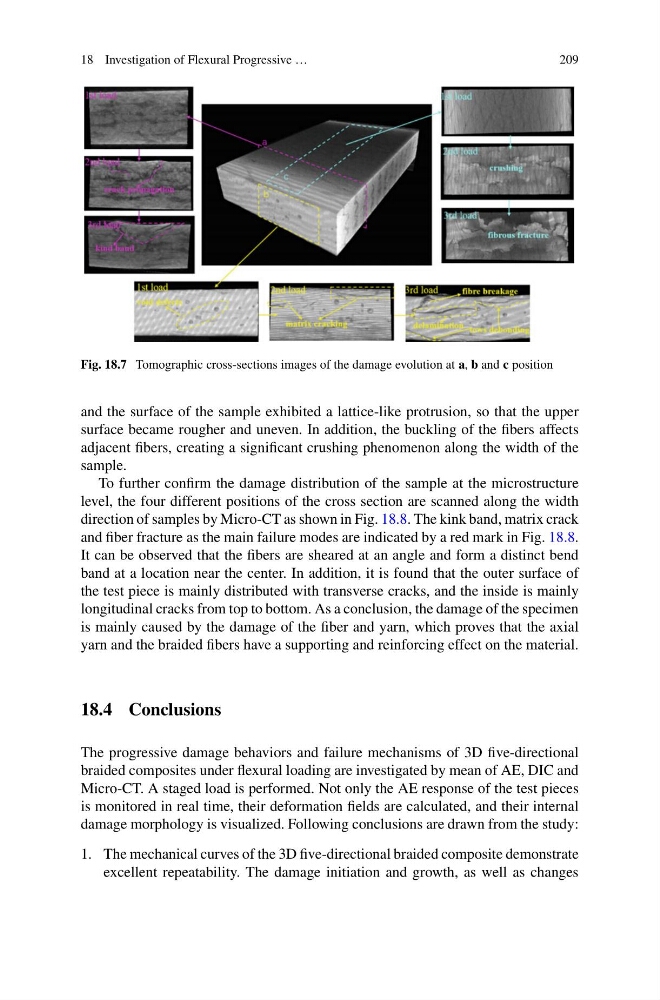
Fig. 18.7 Tomographic cross-sections images of the damage evolution at a, b and c position
and the surface of the sample exhibited a lattice-like protrusion, so that the upper
surface became rougher and uneven. In addition, the buckling of the fibers affects
adjacent fibers, creating a significant crushing phenomenon along the width of the
sample.
To further confirm the damage distribution of the sample at the microstructure
level, the four different positions of the cross section are scanned along the width
direction of samples by Micro-CT as shown in Fig. 18.8. The kink band, matrix crack
and fiber fracture as the main failure modes are indicated by a red mark in Fig. 18.8.
It can be observed that the fibers are sheared at an angle and form a distinct bend
band at a location near the center. In addition, it is found that the outer surface of
the test piece is mainly distributed with transverse cracks, and the inside is mainly
longitudinal cracks from top to bottom. As a conclusion, the damage of the specimen
is mainly caused by the damage of the fiber and yarn, which proves that the axial
yarn and the braided fibers have a supporting and reinforcing effect on the material.
18.4 Conclusions
The progressive damage behaviors and failure mechanisms of 3D five-directional
braided composites under flexural loading are investigated by mean of AE, DIC and
Micro-CT. A staged load is performed. Not only the AE response of the test pieces
is monitored in real time, their deformation fields are calculated, and their internal
damage morphology is visualized. Following conclusions are drawn from the study:
1. The mechanical curves of the 3D five-directional braided composite demonstrate
excellent repeatability. The damage initiation and growth, as well as changes
209
Fig. 18.7 Tomographic cross-sections images of the damage evolution at a, b and c position
and the surface of the sample exhibited a lattice-like protrusion, so that the upper
surface became rougher and uneven. In addition, the buckling of the fibers affects
adjacent fibers, creating a significant crushing phenomenon along the width of the
sample.
To further confirm the damage distribution of the sample at the microstructure
level, the four different positions of the cross section are scanned along the width
direction of samples by Micro-CT as shown in Fig. 18.8. The kink band, matrix crack
and fiber fracture as the main failure modes are indicated by a red mark in Fig. 18.8.
It can be observed that the fibers are sheared at an angle and form a distinct bend
band at a location near the center. In addition, it is found that the outer surface of
the test piece is mainly distributed with transverse cracks, and the inside is mainly
longitudinal cracks from top to bottom. As a conclusion, the damage of the specimen
is mainly caused by the damage of the fiber and yarn, which proves that the axial
yarn and the braided fibers have a supporting and reinforcing effect on the material.
18.4 Conclusions
The progressive damage behaviors and failure mechanisms of 3D five-directional
braided composites under flexural loading are investigated by mean of AE, DIC and
Micro-CT. A staged load is performed. Not only the AE response of the test pieces
is monitored in real time, their deformation fields are calculated, and their internal
damage morphology is visualized. Following conclusions are drawn from the study:
1. The mechanical curves of the 3D five-directional braided composite demonstrate
excellent repeatability. The damage initiation and growth, as well as changes