

9 Burst Analysis for Multi-Level Leakage Detection in Water-Filled Pipeline …
97
from the random noise component, the envelope analysis is employed to increase
the energy of the leak signal. Thus, the AE burst is searched from the envelope
of the signal. The process starts with an AE burst detecting using a Hilbert-Huang
transform and the envelope detector. The Hilbert-Huang transform is responsible
for converting a sequence of real value signal into a complex signal (analytic form).
Then, the envelope detector calculates the modulus from the complex signal to get the
envelope signal. Hence, the bursts are then detected from the output of the envelope
detector. Burst events, which are the result of an instant change in fluid pressure such
as turbulent, produce consecutively transient peaks that are overlapping together.
Depend on the number of transient peaks, the burst events have various lengths.
Transients in the acoustic emission signals from leakage are often hard to isolate using
the conventional threshold approaches. These transients have a different frequency,
strength, shape, and duration, etc. In consequence, since the complexity inside the
acquired signal increases, the advanced analyzing methods are enforced to separate
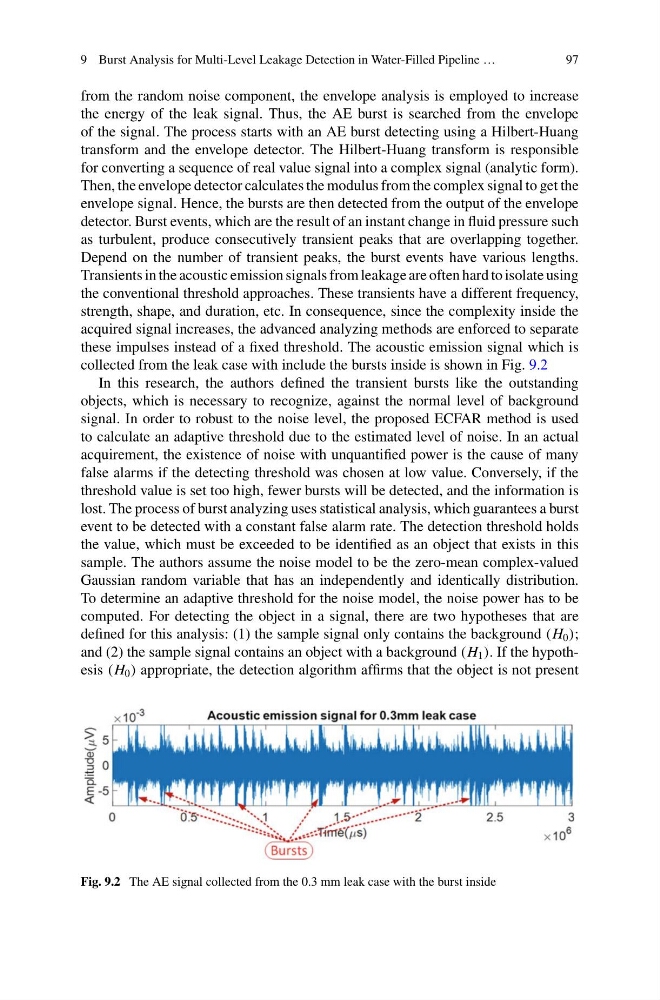
these impulses instead of a fixed threshold. The acoustic emission signal which is
collected from the leak case with include the bursts inside is shown in Fig. 9.2
In this research, the authors defined the transient bursts like the outstanding
objects, which is necessary to recognize, against the normal level of background
signal. In order to robust to the noise level, the proposed ECFAR method is used
to calculate an adaptive threshold due to the estimated level of noise. In an actual
acquirement, the existence of noise with unquantified power is the cause of many
false alarms if the detecting threshold was chosen at low value. Conversely, if the
threshold value is set too high, fewer bursts will be detected, and the information is
lost. The process of burst analyzing uses statistical analysis, which guarantees a burst
event to be detected with a constant false alarm rate. The detection threshold holds
the value, which must be exceeded to be identified as an object that exists in this
sample. The authors assume the noise model to be the zero-mean complex-valued
Gaussian random variable that has an independently and identically distribution.
To determine an adaptive threshold for the noise model, the noise power has to be
computed. For detecting the object in a signal, there are two hypotheses that are
defined for this analysis: (1) the sample signal only contains the background (H 0 );
and (2) the sample signal contains an object with a background (H 1 ). If the hypothesis (H 0 ) appropriate, the detection algorithm affirms that the object is not present
Fig. 9.2 The AE signal collected from the 0.3 mm leak case with the burst inside
97
from the random noise component, the envelope analysis is employed to increase
the energy of the leak signal. Thus, the AE burst is searched from the envelope
of the signal. The process starts with an AE burst detecting using a Hilbert-Huang
transform and the envelope detector. The Hilbert-Huang transform is responsible
for converting a sequence of real value signal into a complex signal (analytic form).
Then, the envelope detector calculates the modulus from the complex signal to get the
envelope signal. Hence, the bursts are then detected from the output of the envelope
detector. Burst events, which are the result of an instant change in fluid pressure such
as turbulent, produce consecutively transient peaks that are overlapping together.
Depend on the number of transient peaks, the burst events have various lengths.
Transients in the acoustic emission signals from leakage are often hard to isolate using
the conventional threshold approaches. These transients have a different frequency,
strength, shape, and duration, etc. In consequence, since the complexity inside the
acquired signal increases, the advanced analyzing methods are enforced to separate
these impulses instead of a fixed threshold. The acoustic emission signal which is
collected from the leak case with include the bursts inside is shown in Fig. 9.2
In this research, the authors defined the transient bursts like the outstanding
objects, which is necessary to recognize, against the normal level of background
signal. In order to robust to the noise level, the proposed ECFAR method is used
to calculate an adaptive threshold due to the estimated level of noise. In an actual
acquirement, the existence of noise with unquantified power is the cause of many
false alarms if the detecting threshold was chosen at low value. Conversely, if the
threshold value is set too high, fewer bursts will be detected, and the information is
lost. The process of burst analyzing uses statistical analysis, which guarantees a burst
event to be detected with a constant false alarm rate. The detection threshold holds
the value, which must be exceeded to be identified as an object that exists in this
sample. The authors assume the noise model to be the zero-mean complex-valued
Gaussian random variable that has an independently and identically distribution.
To determine an adaptive threshold for the noise model, the noise power has to be
computed. For detecting the object in a signal, there are two hypotheses that are
defined for this analysis: (1) the sample signal only contains the background (H 0 );
and (2) the sample signal contains an object with a background (H 1 ). If the hypothesis (H 0 ) appropriate, the detection algorithm affirms that the object is not present
Fig. 9.2 The AE signal collected from the 0.3 mm leak case with the burst inside