

96
B. P. Duong et al.
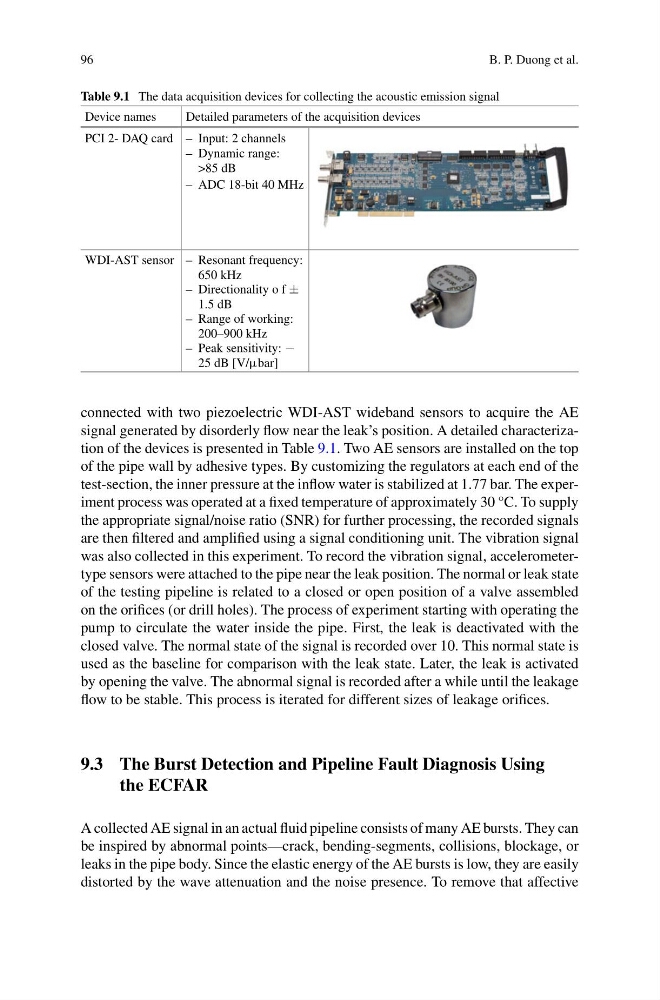
Table 9.1 The data acquisition devices for collecting the acoustic emission signal
Device names
Detailed parameters of the acquisition devices
PCI 2- DAQ card – Input: 2 channels
– Dynamic range:
>85 dB
– ADC 18-bit 40 MHz
WDI-AST sensor – Resonant frequency:
650 kHz
– Directionality o f ±
1.5 dB
– Range of working:
200–900 kHz
– Peak sensitivity: −
25 dB [V/µbar]
connected with two piezoelectric WDI-AST wideband sensors to acquire the AE
signal generated by disorderly flow near the leak’s position. A detailed characterization of the devices is presented in Table 9.1. Two AE sensors are installed on the top
of the pipe wall by adhesive types. By customizing the regulators at each end of the
test-section, the inner pressure at the inflow water is stabilized at 1.77 bar. The experiment process was operated at a fixed temperature of approximately 30 °C. To supply
the appropriate signal/noise ratio (SNR) for further processing, the recorded signals
are then filtered and amplified using a signal conditioning unit. The vibration signal
was also collected in this experiment. To record the vibration signal, accelerometertype sensors were attached to the pipe near the leak position. The normal or leak state
of the testing pipeline is related to a closed or open position of a valve assembled
on the orifices (or drill holes). The process of experiment starting with operating the
pump to circulate the water inside the pipe. First, the leak is deactivated with the
closed valve. The normal state of the signal is recorded over 10. This normal state is
used as the baseline for comparison with the leak state. Later, the leak is activated
by opening the valve. The abnormal signal is recorded after a while until the leakage
flow to be stable. This process is iterated for different sizes of leakage orifices.
9.3 The Burst Detection and Pipeline Fault Diagnosis Using
the ECFAR
A collected AE signal in an actual fluid pipeline consists of many AE bursts. They can
be inspired by abnormal points—crack, bending-segments, collisions, blockage, or
leaks in the pipe body. Since the elastic energy of the AE bursts is low, they are easily
distorted by the wave attenuation and the noise presence. To remove that affective
B. P. Duong et al.
Table 9.1 The data acquisition devices for collecting the acoustic emission signal
Device names
Detailed parameters of the acquisition devices
PCI 2- DAQ card – Input: 2 channels
– Dynamic range:
>85 dB
– ADC 18-bit 40 MHz
WDI-AST sensor – Resonant frequency:
650 kHz
– Directionality o f ±
1.5 dB
– Range of working:
200–900 kHz
– Peak sensitivity: −
25 dB [V/µbar]
connected with two piezoelectric WDI-AST wideband sensors to acquire the AE
signal generated by disorderly flow near the leak’s position. A detailed characterization of the devices is presented in Table 9.1. Two AE sensors are installed on the top
of the pipe wall by adhesive types. By customizing the regulators at each end of the
test-section, the inner pressure at the inflow water is stabilized at 1.77 bar. The experiment process was operated at a fixed temperature of approximately 30 °C. To supply
the appropriate signal/noise ratio (SNR) for further processing, the recorded signals
are then filtered and amplified using a signal conditioning unit. The vibration signal
was also collected in this experiment. To record the vibration signal, accelerometertype sensors were attached to the pipe near the leak position. The normal or leak state
of the testing pipeline is related to a closed or open position of a valve assembled
on the orifices (or drill holes). The process of experiment starting with operating the
pump to circulate the water inside the pipe. First, the leak is deactivated with the
closed valve. The normal state of the signal is recorded over 10. This normal state is
used as the baseline for comparison with the leak state. Later, the leak is activated
by opening the valve. The abnormal signal is recorded after a while until the leakage
flow to be stable. This process is iterated for different sizes of leakage orifices.
9.3 The Burst Detection and Pipeline Fault Diagnosis Using
the ECFAR
A collected AE signal in an actual fluid pipeline consists of many AE bursts. They can
be inspired by abnormal points—crack, bending-segments, collisions, blockage, or
leaks in the pipe body. Since the elastic energy of the AE bursts is low, they are easily
distorted by the wave attenuation and the noise presence. To remove that affective