

82
L. L. Ting et al.
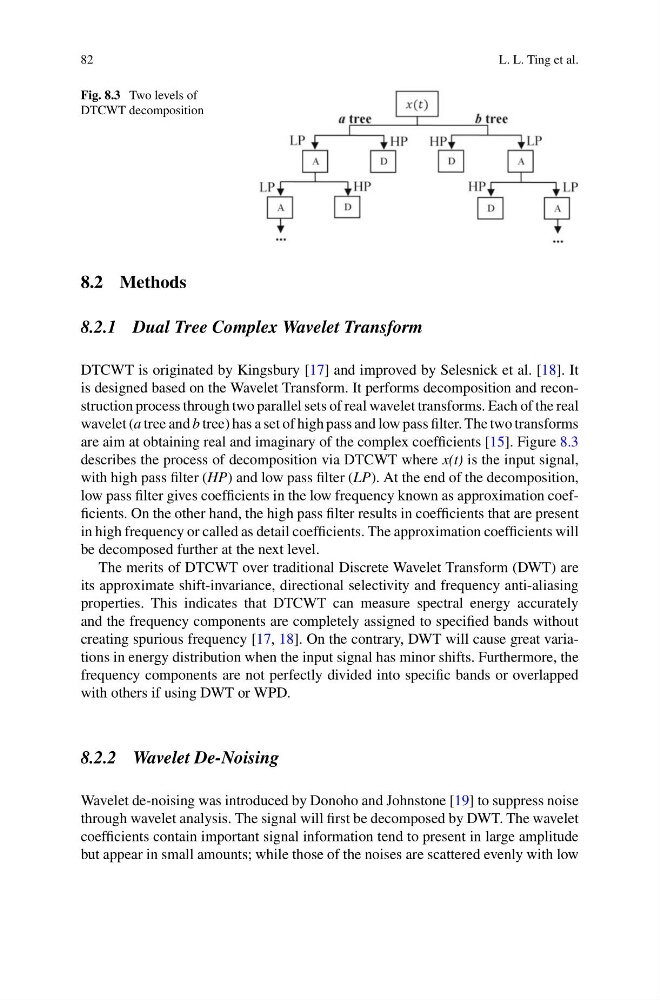
Fig. 8.3 Two levels of
DTCWT decomposition
8.2 Methods
8.2.1 Dual Tree Complex Wavelet Transform
DTCWT is originated by Kingsbury [17] and improved by Selesnick et al. [18]. It
is designed based on the Wavelet Transform. It performs decomposition and reconstruction process through two parallel sets of real wavelet transforms. Each of the real
wavelet (a tree and b tree) has a set of high pass and low pass filter. The two transforms
are aim at obtaining real and imaginary of the complex coefficients [15]. Figure 8.3
describes the process of decomposition via DTCWT where x(t) is the input signal,
with high pass filter (HP) and low pass filter (LP). At the end of the decomposition,
low pass filter gives coefficients in the low frequency known as approximation coefficients. On the other hand, the high pass filter results in coefficients that are present
in high frequency or called as detail coefficients. The approximation coefficients will
be decomposed further at the next level.
The merits of DTCWT over traditional Discrete Wavelet Transform (DWT) are
its approximate shift-invariance, directional selectivity and frequency anti-aliasing
properties. This indicates that DTCWT can measure spectral energy accurately
and the frequency components are completely assigned to specified bands without
creating spurious frequency [17, 18]. On the contrary, DWT will cause great variations in energy distribution when the input signal has minor shifts. Furthermore, the
frequency components are not perfectly divided into specific bands or overlapped
with others if using DWT or WPD.
8.2.2 Wavelet De-Noising
Wavelet de-noising was introduced by Donoho and Johnstone [19] to suppress noise
through wavelet analysis. The signal will first be decomposed by DWT. The wavelet
coefficients contain important signal information tend to present in large amplitude
but appear in small amounts; while those of the noises are scattered evenly with low
L. L. Ting et al.
Fig. 8.3 Two levels of
DTCWT decomposition
8.2 Methods
8.2.1 Dual Tree Complex Wavelet Transform
DTCWT is originated by Kingsbury [17] and improved by Selesnick et al. [18]. It
is designed based on the Wavelet Transform. It performs decomposition and reconstruction process through two parallel sets of real wavelet transforms. Each of the real
wavelet (a tree and b tree) has a set of high pass and low pass filter. The two transforms
are aim at obtaining real and imaginary of the complex coefficients [15]. Figure 8.3
describes the process of decomposition via DTCWT where x(t) is the input signal,
with high pass filter (HP) and low pass filter (LP). At the end of the decomposition,
low pass filter gives coefficients in the low frequency known as approximation coefficients. On the other hand, the high pass filter results in coefficients that are present
in high frequency or called as detail coefficients. The approximation coefficients will
be decomposed further at the next level.
The merits of DTCWT over traditional Discrete Wavelet Transform (DWT) are
its approximate shift-invariance, directional selectivity and frequency anti-aliasing
properties. This indicates that DTCWT can measure spectral energy accurately
and the frequency components are completely assigned to specified bands without
creating spurious frequency [17, 18]. On the contrary, DWT will cause great variations in energy distribution when the input signal has minor shifts. Furthermore, the
frequency components are not perfectly divided into specific bands or overlapped
with others if using DWT or WPD.
8.2.2 Wavelet De-Noising
Wavelet de-noising was introduced by Donoho and Johnstone [19] to suppress noise
through wavelet analysis. The signal will first be decomposed by DWT. The wavelet
coefficients contain important signal information tend to present in large amplitude
but appear in small amounts; while those of the noises are scattered evenly with low