

522
V. S. Simi et al.
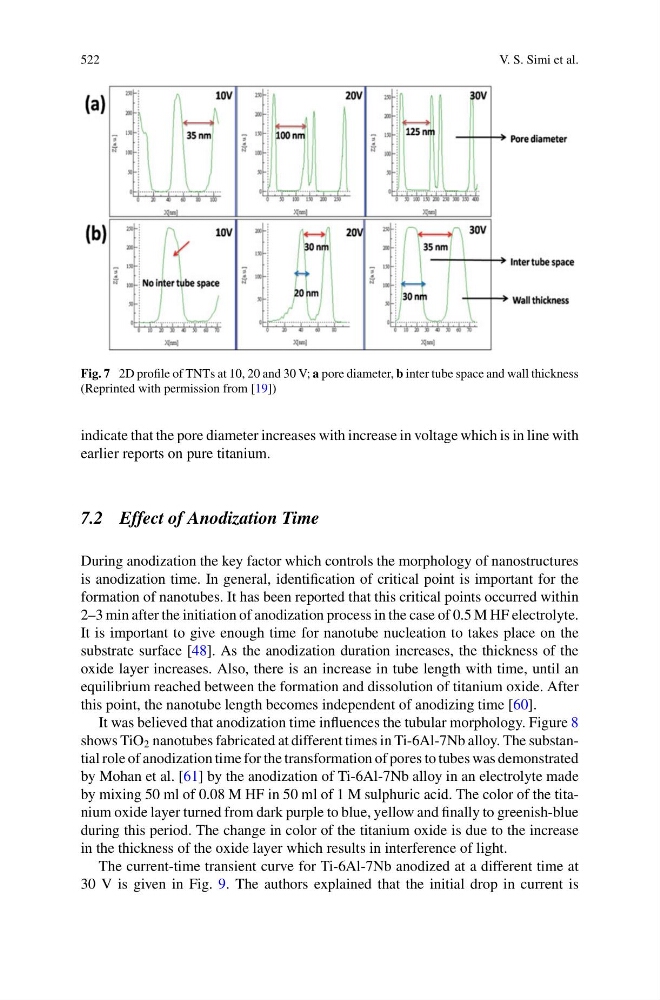
Fig. 7 2D profile of TNTs at 10, 20 and 30 V; a pore diameter, b inter tube space and wall thickness
(Reprinted with permission from [19])
indicate that the pore diameter increases with increase in voltage which is in line with
earlier reports on pure titanium.
7.2 Effect of Anodization Time
During anodization the key factor which controls the morphology of nanostructures
is anodization time. In general, identification of critical point is important for the
formation of nanotubes. It has been reported that this critical points occurred within
2–3 min after the initiation of anodization process in the case of 0.5 M HF electrolyte.
It is important to give enough time for nanotube nucleation to takes place on the
substrate surface [48]. As the anodization duration increases, the thickness of the
oxide layer increases. Also, there is an increase in tube length with time, until an
equilibrium reached between the formation and dissolution of titanium oxide. After
this point, the nanotube length becomes independent of anodizing time [60].
It was believed that anodization time influences the tubular morphology. Figure 8
shows TiO 2 nanotubes fabricated at different times in Ti-6Al-7Nb alloy. The substantial role of anodization time for the transformation of pores to tubes was demonstrated
by Mohan et al. [61] by the anodization of Ti-6Al-7Nb alloy in an electrolyte made
by mixing 50 ml of 0.08 M HF in 50 ml of 1 M sulphuric acid. The color of the titanium oxide layer turned from dark purple to blue, yellow and finally to greenish-blue
during this period. The change in color of the titanium oxide is due to the increase
in the thickness of the oxide layer which results in interference of light.
The current-time transient curve for Ti-6Al-7Nb anodized at a different time at
30 V is given in Fig. 9. The authors explained that the initial drop in current is
V. S. Simi et al.
Fig. 7 2D profile of TNTs at 10, 20 and 30 V; a pore diameter, b inter tube space and wall thickness
(Reprinted with permission from [19])
indicate that the pore diameter increases with increase in voltage which is in line with
earlier reports on pure titanium.
7.2 Effect of Anodization Time
During anodization the key factor which controls the morphology of nanostructures
is anodization time. In general, identification of critical point is important for the
formation of nanotubes. It has been reported that this critical points occurred within
2–3 min after the initiation of anodization process in the case of 0.5 M HF electrolyte.
It is important to give enough time for nanotube nucleation to takes place on the
substrate surface [48]. As the anodization duration increases, the thickness of the
oxide layer increases. Also, there is an increase in tube length with time, until an
equilibrium reached between the formation and dissolution of titanium oxide. After
this point, the nanotube length becomes independent of anodizing time [60].
It was believed that anodization time influences the tubular morphology. Figure 8
shows TiO 2 nanotubes fabricated at different times in Ti-6Al-7Nb alloy. The substantial role of anodization time for the transformation of pores to tubes was demonstrated
by Mohan et al. [61] by the anodization of Ti-6Al-7Nb alloy in an electrolyte made
by mixing 50 ml of 0.08 M HF in 50 ml of 1 M sulphuric acid. The color of the titanium oxide layer turned from dark purple to blue, yellow and finally to greenish-blue
during this period. The change in color of the titanium oxide is due to the increase
in the thickness of the oxide layer which results in interference of light.
The current-time transient curve for Ti-6Al-7Nb anodized at a different time at
30 V is given in Fig. 9. The authors explained that the initial drop in current is