

Tailoring the Surface Functionalities of Titania …
521
Samples anodized at 10 V exhibits a porous morphology with average diameter
32 nm. No inter-tubular space was observed. Regular and self-organized nanotubes
with diameter approximately 45 and 58 nm for the titanium substrate anodized at 20
and 30 V respectively were observed. Nanotubes were separated with inter-tubular
spaces and the height of the nanotubes was found to be 540 nm.
The influence of potential in the formation of nanotubes in the anodization of
Ti-6Al-7Nb alloy was also studied [19]. The FESEM images of titania nanotubes
obtained by anodisation of Ti-6Al-7Nb for 1 h in an electrolyte consisting of 1 M
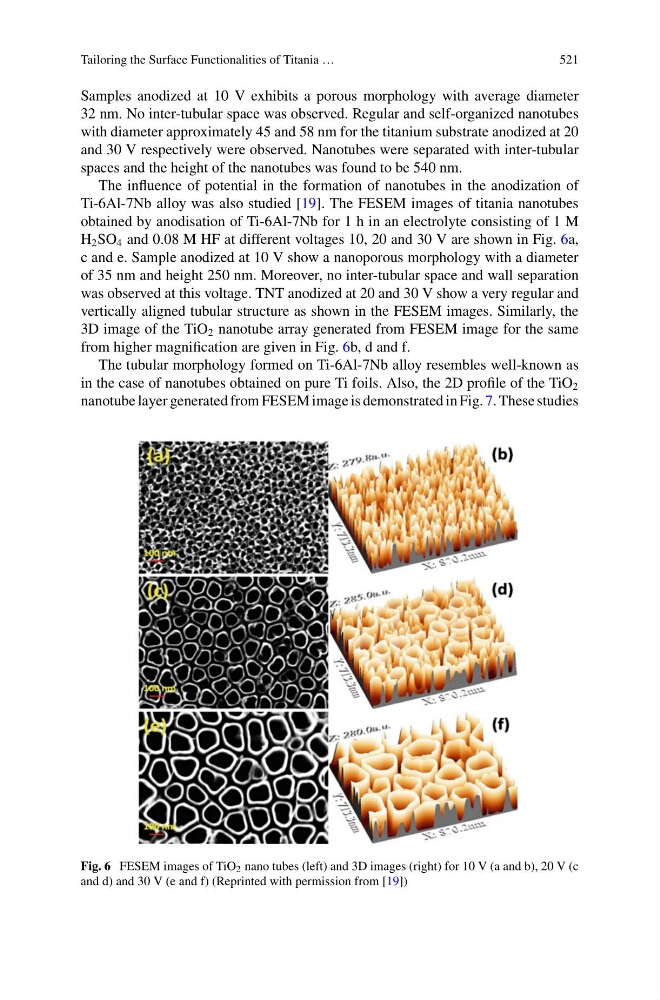
H 2 SO 4 and 0.08 M HF at different voltages 10, 20 and 30 V are shown in Fig. 6a,
c and e. Sample anodized at 10 V show a nanoporous morphology with a diameter
of 35 nm and height 250 nm. Moreover, no inter-tubular space and wall separation
was observed at this voltage. TNT anodized at 20 and 30 V show a very regular and
vertically aligned tubular structure as shown in the FESEM images. Similarly, the
3D image of the TiO 2 nanotube array generated from FESEM image for the same
from higher magnification are given in Fig. 6b, d and f.
The tubular morphology formed on Ti-6Al-7Nb alloy resembles well-known as
in the case of nanotubes obtained on pure Ti foils. Also, the 2D profile of the TiO 2
nanotube layer generated from FESEM image is demonstrated in Fig. 7. These studies
Fig. 6 FESEM images of TiO 2 nano tubes (left) and 3D images (right) for 10 V (a and b), 20 V (c
and d) and 30 V (e and f) (Reprinted with permission from [19])
521
Samples anodized at 10 V exhibits a porous morphology with average diameter
32 nm. No inter-tubular space was observed. Regular and self-organized nanotubes
with diameter approximately 45 and 58 nm for the titanium substrate anodized at 20
and 30 V respectively were observed. Nanotubes were separated with inter-tubular
spaces and the height of the nanotubes was found to be 540 nm.
The influence of potential in the formation of nanotubes in the anodization of
Ti-6Al-7Nb alloy was also studied [19]. The FESEM images of titania nanotubes
obtained by anodisation of Ti-6Al-7Nb for 1 h in an electrolyte consisting of 1 M
H 2 SO 4 and 0.08 M HF at different voltages 10, 20 and 30 V are shown in Fig. 6a,
c and e. Sample anodized at 10 V show a nanoporous morphology with a diameter
of 35 nm and height 250 nm. Moreover, no inter-tubular space and wall separation
was observed at this voltage. TNT anodized at 20 and 30 V show a very regular and
vertically aligned tubular structure as shown in the FESEM images. Similarly, the
3D image of the TiO 2 nanotube array generated from FESEM image for the same
from higher magnification are given in Fig. 6b, d and f.
The tubular morphology formed on Ti-6Al-7Nb alloy resembles well-known as
in the case of nanotubes obtained on pure Ti foils. Also, the 2D profile of the TiO 2
nanotube layer generated from FESEM image is demonstrated in Fig. 7. These studies
Fig. 6 FESEM images of TiO 2 nano tubes (left) and 3D images (right) for 10 V (a and b), 20 V (c
and d) and 30 V (e and f) (Reprinted with permission from [19])