

Tailoring the Surface Functionalities of Titania …
523
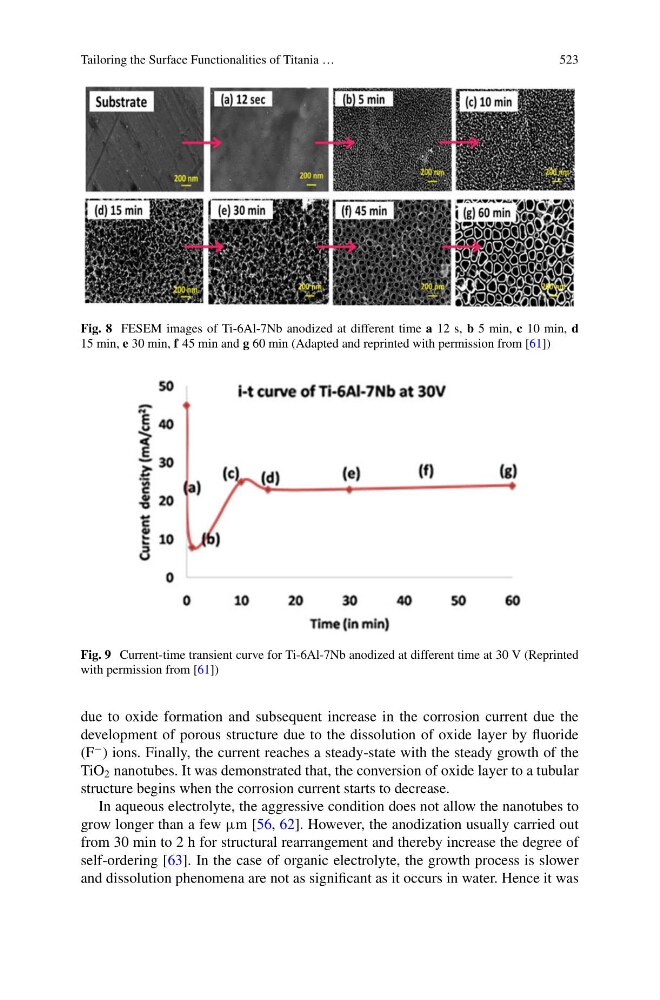
Fig. 8 FESEM images of Ti-6Al-7Nb anodized at different time a 12 s, b 5 min, c 10 min, d
15 min, e 30 min, f 45 min and g 60 min (Adapted and reprinted with permission from [61])
Fig. 9 Current-time transient curve for Ti-6Al-7Nb anodized at different time at 30 V (Reprinted
with permission from [61])
due to oxide formation and subsequent increase in the corrosion current due the
development of porous structure due to the dissolution of oxide layer by fluoride
(F
− ) ions. Finally, the current reaches a steady-state with the steady growth of the
TiO 2 nanotubes. It was demonstrated that, the conversion of oxide layer to a tubular
structure begins when the corrosion current starts to decrease.
In aqueous electrolyte, the aggressive condition does not allow the nanotubes to
grow longer than a few μm [56, 62]. However, the anodization usually carried out
from 30 min to 2 h for structural rearrangement and thereby increase the degree of
self-ordering [63]. In the case of organic electrolyte, the growth process is slower
and dissolution phenomena are not as significant as it occurs in water. Hence it was
523
Fig. 8 FESEM images of Ti-6Al-7Nb anodized at different time a 12 s, b 5 min, c 10 min, d
15 min, e 30 min, f 45 min and g 60 min (Adapted and reprinted with permission from [61])
Fig. 9 Current-time transient curve for Ti-6Al-7Nb anodized at different time at 30 V (Reprinted
with permission from [61])
due to oxide formation and subsequent increase in the corrosion current due the
development of porous structure due to the dissolution of oxide layer by fluoride
(F
− ) ions. Finally, the current reaches a steady-state with the steady growth of the
TiO 2 nanotubes. It was demonstrated that, the conversion of oxide layer to a tubular
structure begins when the corrosion current starts to decrease.
In aqueous electrolyte, the aggressive condition does not allow the nanotubes to
grow longer than a few μm [56, 62]. However, the anodization usually carried out
from 30 min to 2 h for structural rearrangement and thereby increase the degree of
self-ordering [63]. In the case of organic electrolyte, the growth process is slower
and dissolution phenomena are not as significant as it occurs in water. Hence it was