

Surface Nanostructuring of Metallic Materials …
473
a continuous increase in grain size with an increase in depth (Regions II and III).
A steady decrease in the amount of fragmented and deformed grains from the top
surface to the depth is also evident. The formation of strain-induced martensite phase
after SMAT is established by the phase contrast map (Fig. 4b). The martensite phase
is represented by red color while the austenite phase is represented by green color.
The intense red color spots at the top surface represent a higher volume fraction of
the martensite phase due to the higher level of strain and strain rate experienced at
the top surface. The decrease in strain with an increase in depth from the surface is
also evident from the decrease in a number of red spots. The EBSD images of AISI
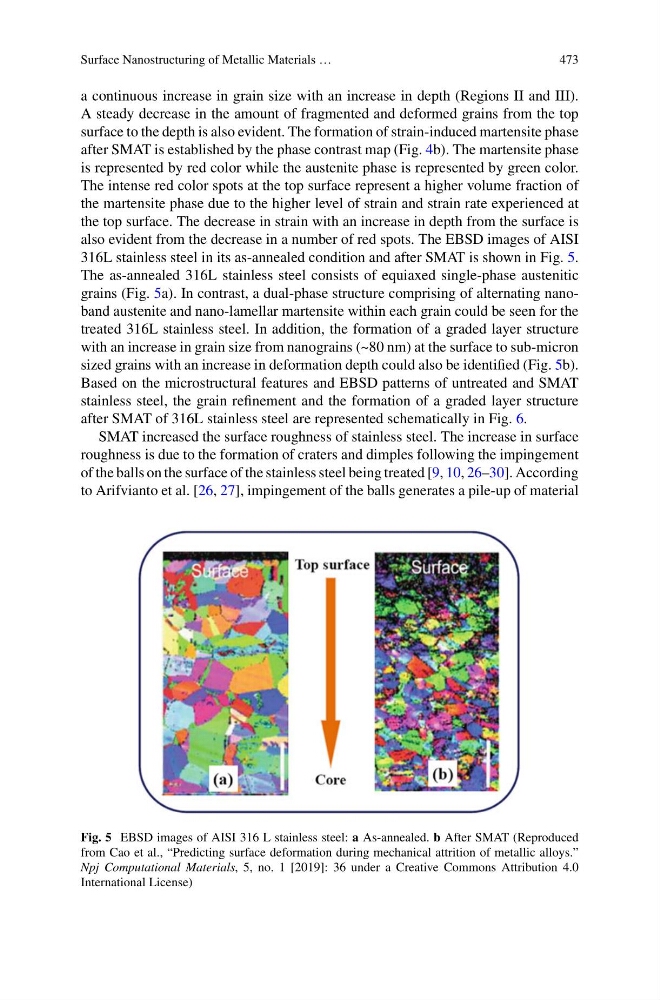
316L stainless steel in its as-annealed condition and after SMAT is shown in Fig. 5.
The as-annealed 316L stainless steel consists of equiaxed single-phase austenitic
grains (Fig. 5a). In contrast, a dual-phase structure comprising of alternating nanoband austenite and nano-lamellar martensite within each grain could be seen for the
treated 316L stainless steel. In addition, the formation of a graded layer structure
with an increase in grain size from nanograins (~80 nm) at the surface to sub-micron
sized grains with an increase in deformation depth could also be identified (Fig. 5b).
Based on the microstructural features and EBSD patterns of untreated and SMAT
stainless steel, the grain refinement and the formation of a graded layer structure
after SMAT of 316L stainless steel are represented schematically in Fig. 6.
SMAT increased the surface roughness of stainless steel. The increase in surface
roughness is due to the formation of craters and dimples following the impingement
of the balls on the surface of the stainless steel being treated [9, 10, 26–30]. According
to Arifvianto et al. [26, 27], impingement of the balls generates a pile-up of material
Fig. 5 EBSD images of AISI 316 L stainless steel: a As-annealed. b After SMAT (Reproduced
from Cao et al., “Predicting surface deformation during mechanical attrition of metallic alloys.”
Npj Computational Materials, 5, no. 1 [2019]: 36 under a Creative Commons Attribution 4.0
International License)
473
a continuous increase in grain size with an increase in depth (Regions II and III).
A steady decrease in the amount of fragmented and deformed grains from the top
surface to the depth is also evident. The formation of strain-induced martensite phase
after SMAT is established by the phase contrast map (Fig. 4b). The martensite phase
is represented by red color while the austenite phase is represented by green color.
The intense red color spots at the top surface represent a higher volume fraction of
the martensite phase due to the higher level of strain and strain rate experienced at
the top surface. The decrease in strain with an increase in depth from the surface is
also evident from the decrease in a number of red spots. The EBSD images of AISI
316L stainless steel in its as-annealed condition and after SMAT is shown in Fig. 5.
The as-annealed 316L stainless steel consists of equiaxed single-phase austenitic
grains (Fig. 5a). In contrast, a dual-phase structure comprising of alternating nanoband austenite and nano-lamellar martensite within each grain could be seen for the
treated 316L stainless steel. In addition, the formation of a graded layer structure
with an increase in grain size from nanograins (~80 nm) at the surface to sub-micron
sized grains with an increase in deformation depth could also be identified (Fig. 5b).
Based on the microstructural features and EBSD patterns of untreated and SMAT
stainless steel, the grain refinement and the formation of a graded layer structure
after SMAT of 316L stainless steel are represented schematically in Fig. 6.
SMAT increased the surface roughness of stainless steel. The increase in surface
roughness is due to the formation of craters and dimples following the impingement
of the balls on the surface of the stainless steel being treated [9, 10, 26–30]. According
to Arifvianto et al. [26, 27], impingement of the balls generates a pile-up of material
Fig. 5 EBSD images of AISI 316 L stainless steel: a As-annealed. b After SMAT (Reproduced
from Cao et al., “Predicting surface deformation during mechanical attrition of metallic alloys.”
Npj Computational Materials, 5, no. 1 [2019]: 36 under a Creative Commons Attribution 4.0
International License)