

Nanomaterials: Surface Functionalization …
425
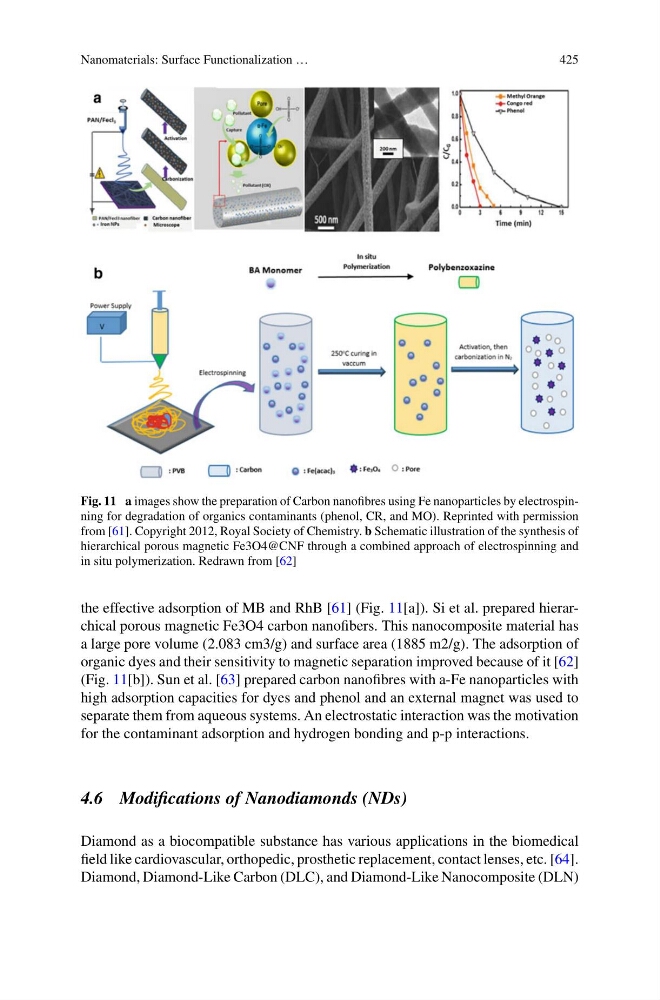
Fig. 11 a images show the preparation of Carbon nanofibres using Fe nanoparticles by electrospinning for degradation of organics contaminants (phenol, CR, and MO). Reprinted with permission
from [61]. Copyright 2012, Royal Society of Chemistry. b Schematic illustration of the synthesis of
hierarchical porous magnetic Fe3O4@CNF through a combined approach of electrospinning and
in situ polymerization. Redrawn from [62]
the effective adsorption of MB and RhB [61] (Fig. 11[a]). Si et al. prepared hierarchical porous magnetic Fe3O4 carbon nanofibers. This nanocomposite material has
a large pore volume (2.083 cm3/g) and surface area (1885 m2/g). The adsorption of
organic dyes and their sensitivity to magnetic separation improved because of it [62]
(Fig. 11[b]). Sun et al. [63] prepared carbon nanofibres with a-Fe nanoparticles with
high adsorption capacities for dyes and phenol and an external magnet was used to
separate them from aqueous systems. An electrostatic interaction was the motivation
for the contaminant adsorption and hydrogen bonding and p-p interactions.
4.6 Modifications of Nanodiamonds (NDs)
Diamond as a biocompatible substance has various applications in the biomedical
field like cardiovascular, orthopedic, prosthetic replacement, contact lenses, etc. [64].
Diamond, Diamond-Like Carbon (DLC), and Diamond-Like Nanocomposite (DLN)
425
Fig. 11 a images show the preparation of Carbon nanofibres using Fe nanoparticles by electrospinning for degradation of organics contaminants (phenol, CR, and MO). Reprinted with permission
from [61]. Copyright 2012, Royal Society of Chemistry. b Schematic illustration of the synthesis of
hierarchical porous magnetic Fe3O4@CNF through a combined approach of electrospinning and
in situ polymerization. Redrawn from [62]
the effective adsorption of MB and RhB [61] (Fig. 11[a]). Si et al. prepared hierarchical porous magnetic Fe3O4 carbon nanofibers. This nanocomposite material has
a large pore volume (2.083 cm3/g) and surface area (1885 m2/g). The adsorption of
organic dyes and their sensitivity to magnetic separation improved because of it [62]
(Fig. 11[b]). Sun et al. [63] prepared carbon nanofibres with a-Fe nanoparticles with
high adsorption capacities for dyes and phenol and an external magnet was used to
separate them from aqueous systems. An electrostatic interaction was the motivation
for the contaminant adsorption and hydrogen bonding and p-p interactions.
4.6 Modifications of Nanodiamonds (NDs)
Diamond as a biocompatible substance has various applications in the biomedical
field like cardiovascular, orthopedic, prosthetic replacement, contact lenses, etc. [64].
Diamond, Diamond-Like Carbon (DLC), and Diamond-Like Nanocomposite (DLN)