

426
A. Kumar et al.
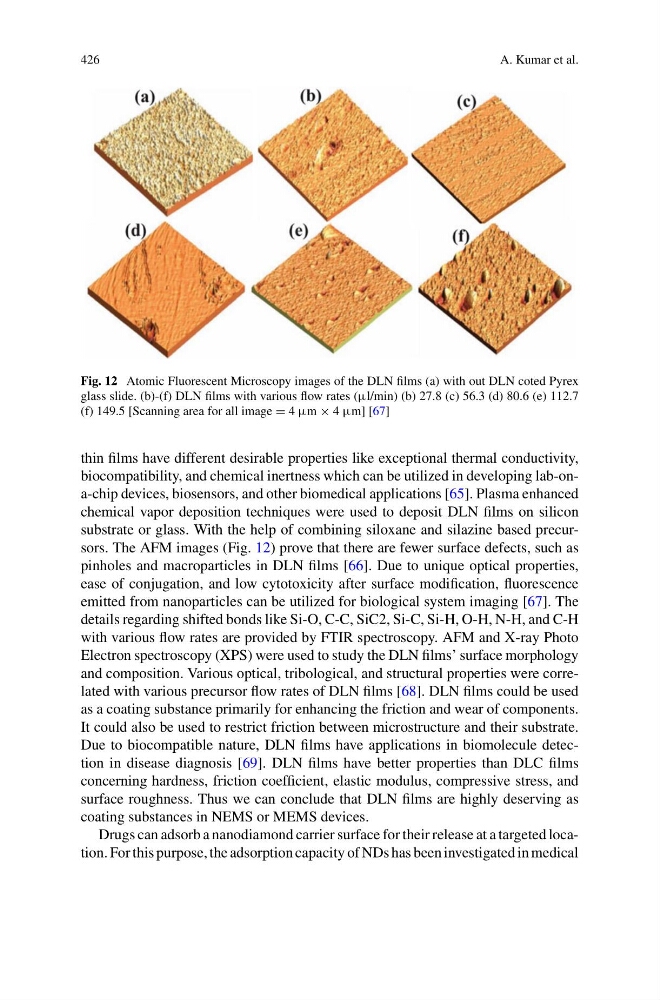
Fig. 12 Atomic Fluorescent Microscopy images of the DLN films (a) with out DLN coted Pyrex
glass slide. (b)-(f) DLN films with various flow rates (μl/min) (b) 27.8 (c) 56.3 (d) 80.6 (e) 112.7
(f) 149.5 [Scanning area for all image = 4 μm × 4 μm] [67]
thin films have different desirable properties like exceptional thermal conductivity,
biocompatibility, and chemical inertness which can be utilized in developing lab-ona-chip devices, biosensors, and other biomedical applications [65]. Plasma enhanced
chemical vapor deposition techniques were used to deposit DLN films on silicon
substrate or glass. With the help of combining siloxane and silazine based precursors. The AFM images (Fig. 12) prove that there are fewer surface defects, such as
pinholes and macroparticles in DLN films [66]. Due to unique optical properties,
ease of conjugation, and low cytotoxicity after surface modification, fluorescence
emitted from nanoparticles can be utilized for biological system imaging [67]. The
details regarding shifted bonds like Si-O, C-C, SiC2, Si-C, Si-H, O-H, N-H, and C-H
with various flow rates are provided by FTIR spectroscopy. AFM and X-ray Photo
Electron spectroscopy (XPS) were used to study the DLN films’ surface morphology
and composition. Various optical, tribological, and structural properties were correlated with various precursor flow rates of DLN films [68]. DLN films could be used
as a coating substance primarily for enhancing the friction and wear of components.
It could also be used to restrict friction between microstructure and their substrate.
Due to biocompatible nature, DLN films have applications in biomolecule detection in disease diagnosis [69]. DLN films have better properties than DLC films
concerning hardness, friction coefficient, elastic modulus, compressive stress, and
surface roughness. Thus we can conclude that DLN films are highly deserving as
coating substances in NEMS or MEMS devices.
Drugs can adsorb a nanodiamond carrier surface for their release at a targeted location. For this purpose, the adsorption capacity of NDs has been investigated in medical
A. Kumar et al.
Fig. 12 Atomic Fluorescent Microscopy images of the DLN films (a) with out DLN coted Pyrex
glass slide. (b)-(f) DLN films with various flow rates (μl/min) (b) 27.8 (c) 56.3 (d) 80.6 (e) 112.7
(f) 149.5 [Scanning area for all image = 4 μm × 4 μm] [67]
thin films have different desirable properties like exceptional thermal conductivity,
biocompatibility, and chemical inertness which can be utilized in developing lab-ona-chip devices, biosensors, and other biomedical applications [65]. Plasma enhanced
chemical vapor deposition techniques were used to deposit DLN films on silicon
substrate or glass. With the help of combining siloxane and silazine based precursors. The AFM images (Fig. 12) prove that there are fewer surface defects, such as
pinholes and macroparticles in DLN films [66]. Due to unique optical properties,
ease of conjugation, and low cytotoxicity after surface modification, fluorescence
emitted from nanoparticles can be utilized for biological system imaging [67]. The
details regarding shifted bonds like Si-O, C-C, SiC2, Si-C, Si-H, O-H, N-H, and C-H
with various flow rates are provided by FTIR spectroscopy. AFM and X-ray Photo
Electron spectroscopy (XPS) were used to study the DLN films’ surface morphology
and composition. Various optical, tribological, and structural properties were correlated with various precursor flow rates of DLN films [68]. DLN films could be used
as a coating substance primarily for enhancing the friction and wear of components.
It could also be used to restrict friction between microstructure and their substrate.
Due to biocompatible nature, DLN films have applications in biomolecule detection in disease diagnosis [69]. DLN films have better properties than DLC films
concerning hardness, friction coefficient, elastic modulus, compressive stress, and
surface roughness. Thus we can conclude that DLN films are highly deserving as
coating substances in NEMS or MEMS devices.
Drugs can adsorb a nanodiamond carrier surface for their release at a targeted location. For this purpose, the adsorption capacity of NDs has been investigated in medical