

Nanomaterials: Surface Functionalization …
415
nanoparticles exhibit various properties like high surface plasmonic resonance, high
biocompatibility with chemical stability, lower toxicity, surface bio-conjugation, the
higher surface to volume ratio, and, thus, can be used in cancer diagnosis and therapeutics [28]. Different ideas on the biosynthesis of gold and silver nanoparticles and
their applications in various fields were presented by T.S. Santra et al. Focus should
be paid on developing stable gold, silver, or other metallic nanoparticles; that could
be useful for biomedical applications in future. So the effort is to develop Ag/Au
nanoparticles to make them multifunctional and tunable by external signals and
then turning them into Nano-devices. [29] reported that nanosecond pulsed photoporation mediated by nano-corrugated mushroom-shaped Au coated polystyrene
nanoparticles (nm-AuPNPs) shows effective intracellular molecular delivery with a
high percentage of cell viability. The pulsed laser application at the plasmonic peak
of 945 nm creates nano-bubbles that explode and form membrane pores, which in
turn helps in the transfection of molecules into the cells. Optimization of various
parameters such as laser exposure time, concentration, and molecular size of nmAuPNPs improve the results. Therefore, the proposed methodology has proved to be
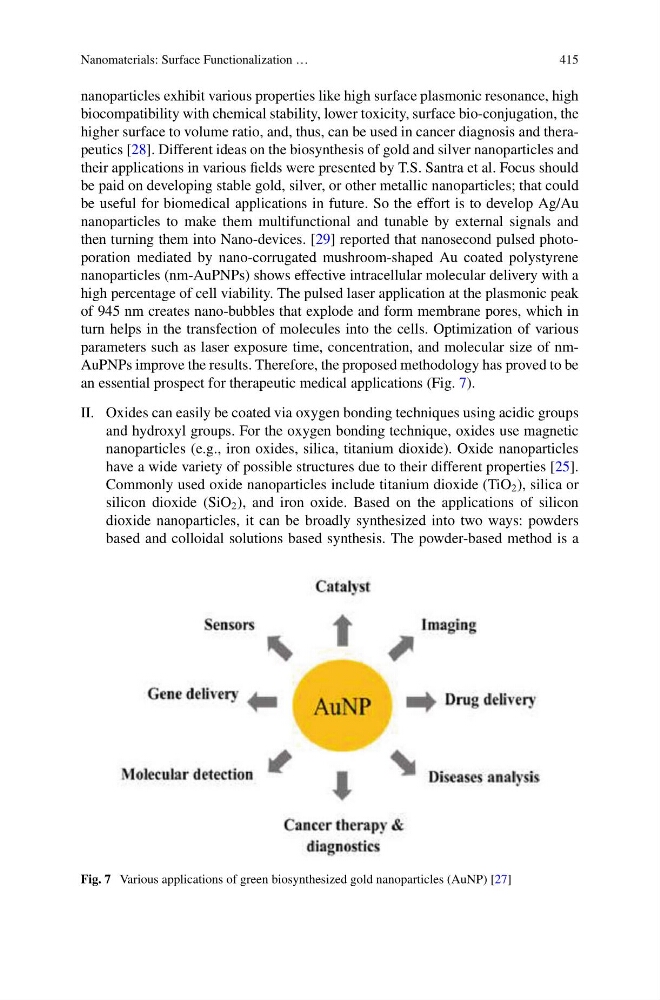
an essential prospect for therapeutic medical applications (Fig. 7).
II. Oxides can easily be coated via oxygen bonding techniques using acidic groups
and hydroxyl groups. For the oxygen bonding technique, oxides use magnetic
nanoparticles (e.g., iron oxides, silica, titanium dioxide). Oxide nanoparticles
have a wide variety of possible structures due to their different properties [25].
Commonly used oxide nanoparticles include titanium dioxide (TiO 2 ), silica or
silicon dioxide (SiO 2 ), and iron oxide. Based on the applications of silicon
dioxide nanoparticles, it can be broadly synthesized into two ways: powders
based and colloidal solutions based synthesis. The powder-based method is a
Fig. 7 Various applications of green biosynthesized gold nanoparticles (AuNP) [27]
415
nanoparticles exhibit various properties like high surface plasmonic resonance, high
biocompatibility with chemical stability, lower toxicity, surface bio-conjugation, the
higher surface to volume ratio, and, thus, can be used in cancer diagnosis and therapeutics [28]. Different ideas on the biosynthesis of gold and silver nanoparticles and
their applications in various fields were presented by T.S. Santra et al. Focus should
be paid on developing stable gold, silver, or other metallic nanoparticles; that could
be useful for biomedical applications in future. So the effort is to develop Ag/Au
nanoparticles to make them multifunctional and tunable by external signals and
then turning them into Nano-devices. [29] reported that nanosecond pulsed photoporation mediated by nano-corrugated mushroom-shaped Au coated polystyrene
nanoparticles (nm-AuPNPs) shows effective intracellular molecular delivery with a
high percentage of cell viability. The pulsed laser application at the plasmonic peak
of 945 nm creates nano-bubbles that explode and form membrane pores, which in
turn helps in the transfection of molecules into the cells. Optimization of various
parameters such as laser exposure time, concentration, and molecular size of nmAuPNPs improve the results. Therefore, the proposed methodology has proved to be
an essential prospect for therapeutic medical applications (Fig. 7).
II. Oxides can easily be coated via oxygen bonding techniques using acidic groups
and hydroxyl groups. For the oxygen bonding technique, oxides use magnetic
nanoparticles (e.g., iron oxides, silica, titanium dioxide). Oxide nanoparticles
have a wide variety of possible structures due to their different properties [25].
Commonly used oxide nanoparticles include titanium dioxide (TiO 2 ), silica or
silicon dioxide (SiO 2 ), and iron oxide. Based on the applications of silicon
dioxide nanoparticles, it can be broadly synthesized into two ways: powders
based and colloidal solutions based synthesis. The powder-based method is a
Fig. 7 Various applications of green biosynthesized gold nanoparticles (AuNP) [27]