

414
A. Kumar et al.
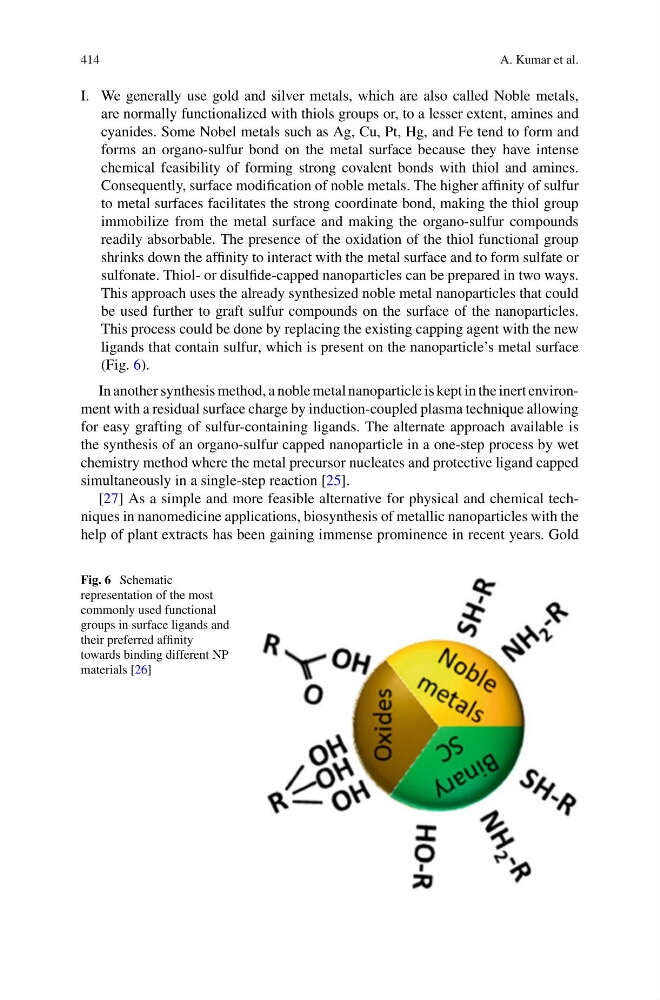
I. We generally use gold and silver metals, which are also called Noble metals,
are normally functionalized with thiols groups or, to a lesser extent, amines and
cyanides. Some Nobel metals such as Ag, Cu, Pt, Hg, and Fe tend to form and
forms an organo-sulfur bond on the metal surface because they have intense
chemical feasibility of forming strong covalent bonds with thiol and amines.
Consequently, surface modification of noble metals. The higher affinity of sulfur
to metal surfaces facilitates the strong coordinate bond, making the thiol group
immobilize from the metal surface and making the organo-sulfur compounds
readily absorbable. The presence of the oxidation of the thiol functional group
shrinks down the affinity to interact with the metal surface and to form sulfate or
sulfonate. Thiol- or disulfide-capped nanoparticles can be prepared in two ways.
This approach uses the already synthesized noble metal nanoparticles that could
be used further to graft sulfur compounds on the surface of the nanoparticles.
This process could be done by replacing the existing capping agent with the new
ligands that contain sulfur, which is present on the nanoparticle’s metal surface
(Fig. 6).
In another synthesis method, a noble metal nanoparticle is kept in the inert environment with a residual surface charge by induction-coupled plasma technique allowing
for easy grafting of sulfur-containing ligands. The alternate approach available is
the synthesis of an organo-sulfur capped nanoparticle in a one-step process by wet
chemistry method where the metal precursor nucleates and protective ligand capped
simultaneously in a single-step reaction [25].
[27] As a simple and more feasible alternative for physical and chemical techniques in nanomedicine applications, biosynthesis of metallic nanoparticles with the
help of plant extracts has been gaining immense prominence in recent years. Gold
Fig. 6 Schematic
representation of the most
commonly used functional
groups in surface ligands and
their preferred affinity
towards binding different NP
materials [26]
A. Kumar et al.
I. We generally use gold and silver metals, which are also called Noble metals,
are normally functionalized with thiols groups or, to a lesser extent, amines and
cyanides. Some Nobel metals such as Ag, Cu, Pt, Hg, and Fe tend to form and
forms an organo-sulfur bond on the metal surface because they have intense
chemical feasibility of forming strong covalent bonds with thiol and amines.
Consequently, surface modification of noble metals. The higher affinity of sulfur
to metal surfaces facilitates the strong coordinate bond, making the thiol group
immobilize from the metal surface and making the organo-sulfur compounds
readily absorbable. The presence of the oxidation of the thiol functional group
shrinks down the affinity to interact with the metal surface and to form sulfate or
sulfonate. Thiol- or disulfide-capped nanoparticles can be prepared in two ways.
This approach uses the already synthesized noble metal nanoparticles that could
be used further to graft sulfur compounds on the surface of the nanoparticles.
This process could be done by replacing the existing capping agent with the new
ligands that contain sulfur, which is present on the nanoparticle’s metal surface
(Fig. 6).
In another synthesis method, a noble metal nanoparticle is kept in the inert environment with a residual surface charge by induction-coupled plasma technique allowing
for easy grafting of sulfur-containing ligands. The alternate approach available is
the synthesis of an organo-sulfur capped nanoparticle in a one-step process by wet
chemistry method where the metal precursor nucleates and protective ligand capped
simultaneously in a single-step reaction [25].
[27] As a simple and more feasible alternative for physical and chemical techniques in nanomedicine applications, biosynthesis of metallic nanoparticles with the
help of plant extracts has been gaining immense prominence in recent years. Gold
Fig. 6 Schematic
representation of the most
commonly used functional
groups in surface ligands and
their preferred affinity
towards binding different NP
materials [26]