

Nanomaterials for Medical Imaging …
345
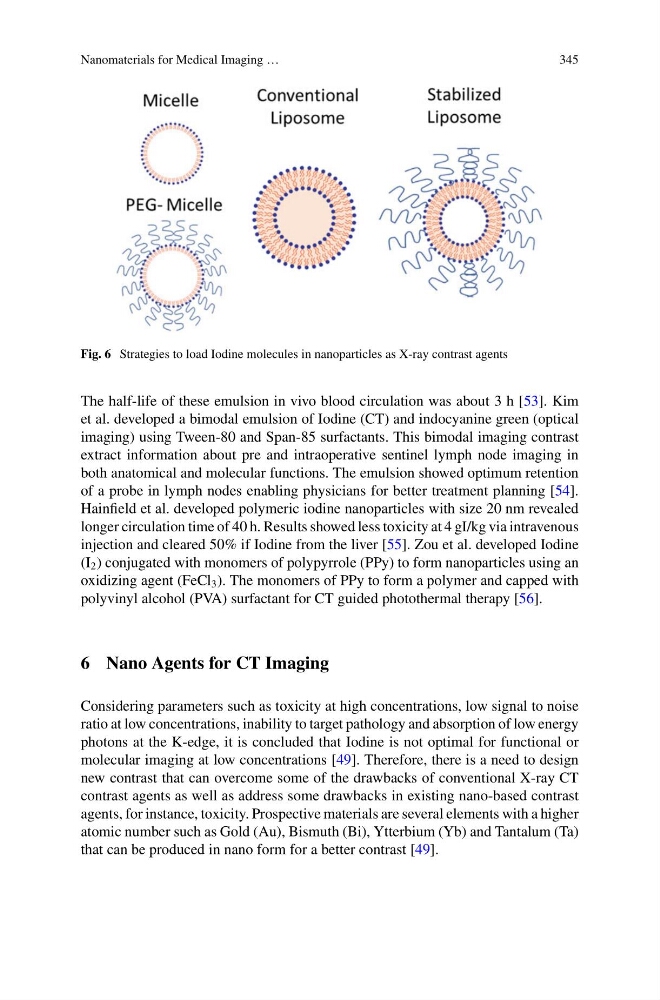
Fig. 6 Strategies to load Iodine molecules in nanoparticles as X-ray contrast agents
The half-life of these emulsion in vivo blood circulation was about 3 h [53]. Kim
et al. developed a bimodal emulsion of Iodine (CT) and indocyanine green (optical
imaging) using Tween-80 and Span-85 surfactants. This bimodal imaging contrast
extract information about pre and intraoperative sentinel lymph node imaging in
both anatomical and molecular functions. The emulsion showed optimum retention
of a probe in lymph nodes enabling physicians for better treatment planning [54].
Hainfield et al. developed polymeric iodine nanoparticles with size 20 nm revealed
longer circulation time of 40 h. Results showed less toxicity at 4 gI/kg via intravenous
injection and cleared 50% if Iodine from the liver [55]. Zou et al. developed Iodine
(I 2 ) conjugated with monomers of polypyrrole (PPy) to form nanoparticles using an
oxidizing agent (FeCl 3 ). The monomers of PPy to form a polymer and capped with
polyvinyl alcohol (PVA) surfactant for CT guided photothermal therapy [56].
6 Nano Agents for CT Imaging
Considering parameters such as toxicity at high concentrations, low signal to noise
ratio at low concentrations, inability to target pathology and absorption of low energy
photons at the K-edge, it is concluded that Iodine is not optimal for functional or
molecular imaging at low concentrations [49]. Therefore, there is a need to design
new contrast that can overcome some of the drawbacks of conventional X-ray CT
contrast agents as well as address some drawbacks in existing nano-based contrast
agents, for instance, toxicity. Prospective materials are several elements with a higher
atomic number such as Gold (Au), Bismuth (Bi), Ytterbium (Yb) and Tantalum (Ta)
that can be produced in nano form for a better contrast [49].
345
Fig. 6 Strategies to load Iodine molecules in nanoparticles as X-ray contrast agents
The half-life of these emulsion in vivo blood circulation was about 3 h [53]. Kim
et al. developed a bimodal emulsion of Iodine (CT) and indocyanine green (optical
imaging) using Tween-80 and Span-85 surfactants. This bimodal imaging contrast
extract information about pre and intraoperative sentinel lymph node imaging in
both anatomical and molecular functions. The emulsion showed optimum retention
of a probe in lymph nodes enabling physicians for better treatment planning [54].
Hainfield et al. developed polymeric iodine nanoparticles with size 20 nm revealed
longer circulation time of 40 h. Results showed less toxicity at 4 gI/kg via intravenous
injection and cleared 50% if Iodine from the liver [55]. Zou et al. developed Iodine
(I 2 ) conjugated with monomers of polypyrrole (PPy) to form nanoparticles using an
oxidizing agent (FeCl 3 ). The monomers of PPy to form a polymer and capped with
polyvinyl alcohol (PVA) surfactant for CT guided photothermal therapy [56].
6 Nano Agents for CT Imaging
Considering parameters such as toxicity at high concentrations, low signal to noise
ratio at low concentrations, inability to target pathology and absorption of low energy
photons at the K-edge, it is concluded that Iodine is not optimal for functional or
molecular imaging at low concentrations [49]. Therefore, there is a need to design
new contrast that can overcome some of the drawbacks of conventional X-ray CT
contrast agents as well as address some drawbacks in existing nano-based contrast
agents, for instance, toxicity. Prospective materials are several elements with a higher
atomic number such as Gold (Au), Bismuth (Bi), Ytterbium (Yb) and Tantalum (Ta)
that can be produced in nano form for a better contrast [49].