

346
N. Ashwin Kumar et al.
6.1 Gold-Based Nanomaterials
In early history, Gold has been used as a purple color coating in the paint glasses
described by Faraday in 1857. Characterizing colloidal gold revealed high biocompatibility with better surface modification properties enabling them for applications
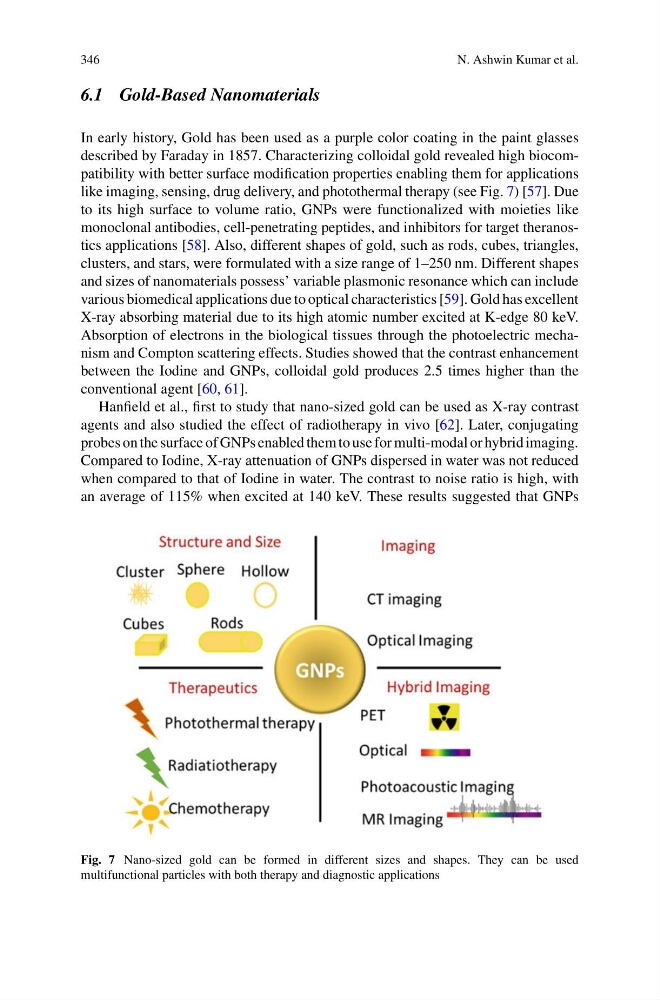
like imaging, sensing, drug delivery, and photothermal therapy (see Fig. 7) [57]. Due
to its high surface to volume ratio, GNPs were functionalized with moieties like
monoclonal antibodies, cell-penetrating peptides, and inhibitors for target theranostics applications [58]. Also, different shapes of gold, such as rods, cubes, triangles,
clusters, and stars, were formulated with a size range of 1–250 nm. Different shapes
and sizes of nanomaterials possess’ variable plasmonic resonance which can include
various biomedical applications due to optical characteristics [59]. Gold has excellent
X-ray absorbing material due to its high atomic number excited at K-edge 80 keV.
Absorption of electrons in the biological tissues through the photoelectric mechanism and Compton scattering effects. Studies showed that the contrast enhancement
between the Iodine and GNPs, colloidal gold produces 2.5 times higher than the
conventional agent [60, 61].
Hanfield et al., first to study that nano-sized gold can be used as X-ray contrast
agents and also studied the effect of radiotherapy in vivo [62]. Later, conjugating
probes on the surface of GNPs enabled them to use for multi-modal or hybrid imaging.
Compared to Iodine, X-ray attenuation of GNPs dispersed in water was not reduced
when compared to that of Iodine in water. The contrast to noise ratio is high, with
an average of 115% when excited at 140 keV. These results suggested that GNPs
Fig. 7 Nano-sized gold can be formed in different sizes and shapes. They can be used
multifunctional particles with both therapy and diagnostic applications
N. Ashwin Kumar et al.
6.1 Gold-Based Nanomaterials
In early history, Gold has been used as a purple color coating in the paint glasses
described by Faraday in 1857. Characterizing colloidal gold revealed high biocompatibility with better surface modification properties enabling them for applications
like imaging, sensing, drug delivery, and photothermal therapy (see Fig. 7) [57]. Due
to its high surface to volume ratio, GNPs were functionalized with moieties like
monoclonal antibodies, cell-penetrating peptides, and inhibitors for target theranostics applications [58]. Also, different shapes of gold, such as rods, cubes, triangles,
clusters, and stars, were formulated with a size range of 1–250 nm. Different shapes
and sizes of nanomaterials possess’ variable plasmonic resonance which can include
various biomedical applications due to optical characteristics [59]. Gold has excellent
X-ray absorbing material due to its high atomic number excited at K-edge 80 keV.
Absorption of electrons in the biological tissues through the photoelectric mechanism and Compton scattering effects. Studies showed that the contrast enhancement
between the Iodine and GNPs, colloidal gold produces 2.5 times higher than the
conventional agent [60, 61].
Hanfield et al., first to study that nano-sized gold can be used as X-ray contrast
agents and also studied the effect of radiotherapy in vivo [62]. Later, conjugating
probes on the surface of GNPs enabled them to use for multi-modal or hybrid imaging.
Compared to Iodine, X-ray attenuation of GNPs dispersed in water was not reduced
when compared to that of Iodine in water. The contrast to noise ratio is high, with
an average of 115% when excited at 140 keV. These results suggested that GNPs
Fig. 7 Nano-sized gold can be formed in different sizes and shapes. They can be used
multifunctional particles with both therapy and diagnostic applications