

Hydrogels: Biomaterials for Sustained and Localized Drug Delivery
235
• Nanoclays also show improved mechanical, high aspect ratio, and anisotropic
morphology with tissue adhesive properties. When mixed with linear and
branched polymers, it can form reversible structures, due to non-covalent
interactions helping in absorption and desorption [195].
4.2.4. Metallic nanoparticles are classified as 0D hydrogel additives are used to
prepare hydrogel nanocomposites [198–143]. In addition to the above, metallic NPs
are widely used in creating conductive scaffolds, actuators, sensors, tracking agents
in DDS. They can be functionalized to enhance polymer-NPs interactions.
5 Drug Release Mechanisms
Fabrication of drug-loaded polymeric network for the targeted and sustained release
can follow any of the above mention methods. The drug release mechanisms
largely depend upon the nature of the hydrogel. While in most cases, hydrogel
follows diffusion controlled drug release (see Sects. 5.1 and 5.2). Stimuli-responsive
smart polymer for drug release has been an incredible challenge. These polymeric
systems respond to environmental stimuli (both physical and chemical) are called
as environment-sensitive polymers (ESP)/stimuli-responsive polymer/intelligent
polymers (refer Sect. 5.3).
5.1 Diffusion Controlled Drug Release
The hydrogel is one of the most explored biomaterials for designing both pulsatile and
prolonged drug delivery systems (DDS). Diffusion controlled drug release kinetics
is generally calculated as the amount of drug released concerning the given time
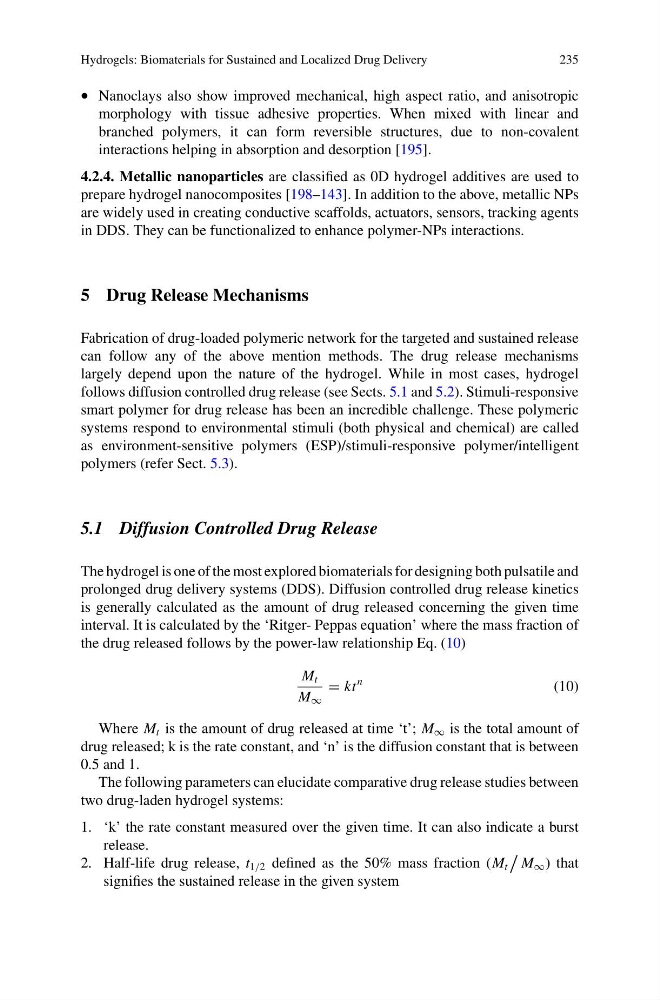
interval. It is calculated by the ‘Ritger- Peppas equation’ where the mass fraction of
the drug released follows by the power-law relationship Eq. (10)
M t
M ∞
= kt
n
(10)
Where M t is the amount of drug released at time ‘t’; M ∞ is the total amount of
drug released; k is the rate constant, and ‘n’ is the diffusion constant that is between
0.5 and 1.
The following parameters can elucidate comparative drug release studies between
two drug-laden hydrogel systems:
1. ‘k’ the rate constant measured over the given time. It can also indicate a burst
release.
2. Half-life drug release, t 1/2 defined as the 50% mass fraction (M t
M ∞ ) that
signifies the sustained release in the given system
235
• Nanoclays also show improved mechanical, high aspect ratio, and anisotropic
morphology with tissue adhesive properties. When mixed with linear and
branched polymers, it can form reversible structures, due to non-covalent
interactions helping in absorption and desorption [195].
4.2.4. Metallic nanoparticles are classified as 0D hydrogel additives are used to
prepare hydrogel nanocomposites [198–143]. In addition to the above, metallic NPs
are widely used in creating conductive scaffolds, actuators, sensors, tracking agents
in DDS. They can be functionalized to enhance polymer-NPs interactions.
5 Drug Release Mechanisms
Fabrication of drug-loaded polymeric network for the targeted and sustained release
can follow any of the above mention methods. The drug release mechanisms
largely depend upon the nature of the hydrogel. While in most cases, hydrogel
follows diffusion controlled drug release (see Sects. 5.1 and 5.2). Stimuli-responsive
smart polymer for drug release has been an incredible challenge. These polymeric
systems respond to environmental stimuli (both physical and chemical) are called
as environment-sensitive polymers (ESP)/stimuli-responsive polymer/intelligent
polymers (refer Sect. 5.3).
5.1 Diffusion Controlled Drug Release
The hydrogel is one of the most explored biomaterials for designing both pulsatile and
prolonged drug delivery systems (DDS). Diffusion controlled drug release kinetics
is generally calculated as the amount of drug released concerning the given time
interval. It is calculated by the ‘Ritger- Peppas equation’ where the mass fraction of
the drug released follows by the power-law relationship Eq. (10)
M t
M ∞
= kt
n
(10)
Where M t is the amount of drug released at time ‘t’; M ∞ is the total amount of
drug released; k is the rate constant, and ‘n’ is the diffusion constant that is between
0.5 and 1.
The following parameters can elucidate comparative drug release studies between
two drug-laden hydrogel systems:
1. ‘k’ the rate constant measured over the given time. It can also indicate a burst
release.
2. Half-life drug release, t 1/2 defined as the 50% mass fraction (M t
M ∞ ) that
signifies the sustained release in the given system