

236
G. Keerthiga et al.
Different methods are used to control drug delivery in various hydrogel systems.
Diffusion controlled hydrogel systems (given by the above equation) typically gives
a half-life of 1 day and relatively higher burst release (k > 50%). To increase t 1/2 ~
2–3 days, drug release is slow down by several mechanisms, such as the introduction
of chemical bonds or polymer network degradation systems.
5.2 Effect of Hydrogel Mesh Size in Diffusion Mediated
Drug Release
Diffusion is interrelated to the mesh size of the hydrogel, as it largely influences
the drug-polymer interactions. When,r mesh /r drug > 1, drug release is governed by
diffusion. Smaller drug molecules can freely move through the polymeric network,
and diffusion is independent of the mesh size. In this case, Stokes-Einstein equation
(Eq. 10) is used to measure the diffusivity (D), that is interdependent on the radius
of the drug molecule (r drug ), usually ranges with its molecular weight and viscosity
of the solution (η),
D =
RT
6πηr drug
(10)
Where R is the gas constant and T is the absolute temperature. In addition to
this diffusion controlled drug release mechanisms, polymeric swelling, mechanical
deformation, and network degradation are also considered, depending upon the nature
of the polymer, crosslinking mechanism and intended application.
5.3 Stimuli-Responsive Drug Release Mechanism
HNCs, which are designed to respond to stimuli such as
pH/temperature/concentration/light and release the drug act as controlled drug
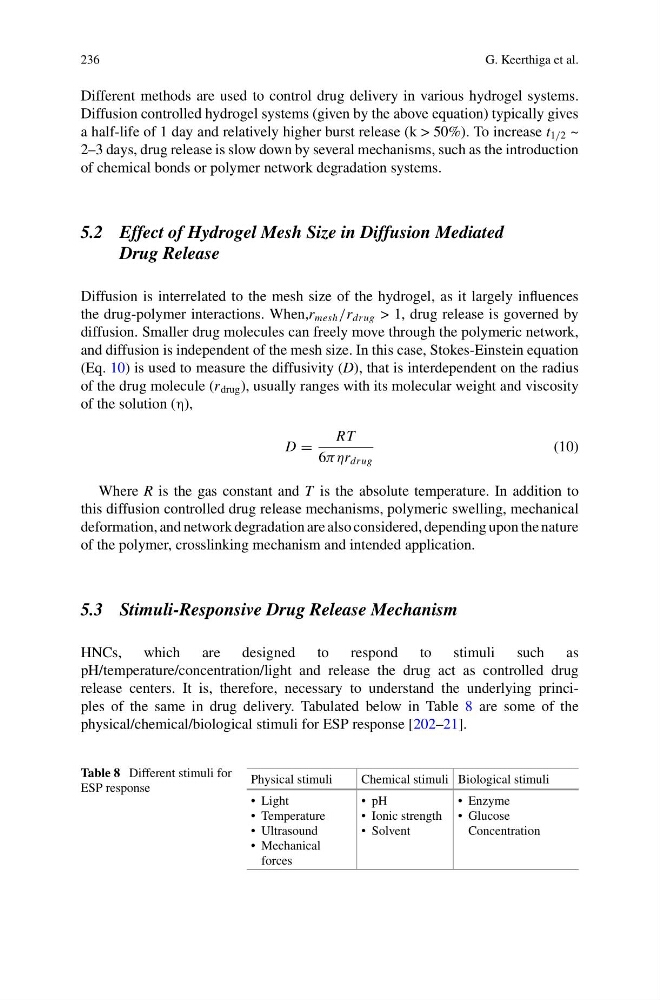
release centers. It is, therefore, necessary to understand the underlying principles of the same in drug delivery. Tabulated below in Table 8 are some of the
physical/chemical/biological stimuli for ESP response [202–21].
Table 8 Different stimuli for
ESP response
Physical stimuli
Chemical stimuli Biological stimuli
• Light
• Temperature
• Ultrasound
• Mechanical
forces
• pH
• Ionic strength
• Solvent
• Enzyme
• Glucose
Concentration
G. Keerthiga et al.
Different methods are used to control drug delivery in various hydrogel systems.
Diffusion controlled hydrogel systems (given by the above equation) typically gives
a half-life of 1 day and relatively higher burst release (k > 50%). To increase t 1/2 ~
2–3 days, drug release is slow down by several mechanisms, such as the introduction
of chemical bonds or polymer network degradation systems.
5.2 Effect of Hydrogel Mesh Size in Diffusion Mediated
Drug Release
Diffusion is interrelated to the mesh size of the hydrogel, as it largely influences
the drug-polymer interactions. When,r mesh /r drug > 1, drug release is governed by
diffusion. Smaller drug molecules can freely move through the polymeric network,
and diffusion is independent of the mesh size. In this case, Stokes-Einstein equation
(Eq. 10) is used to measure the diffusivity (D), that is interdependent on the radius
of the drug molecule (r drug ), usually ranges with its molecular weight and viscosity
of the solution (η),
D =
RT
6πηr drug
(10)
Where R is the gas constant and T is the absolute temperature. In addition to
this diffusion controlled drug release mechanisms, polymeric swelling, mechanical
deformation, and network degradation are also considered, depending upon the nature
of the polymer, crosslinking mechanism and intended application.
5.3 Stimuli-Responsive Drug Release Mechanism
HNCs, which are designed to respond to stimuli such as
pH/temperature/concentration/light and release the drug act as controlled drug
release centers. It is, therefore, necessary to understand the underlying principles of the same in drug delivery. Tabulated below in Table 8 are some of the
physical/chemical/biological stimuli for ESP response [202–21].
Table 8 Different stimuli for
ESP response
Physical stimuli
Chemical stimuli Biological stimuli
• Light
• Temperature
• Ultrasound
• Mechanical
forces
• pH
• Ionic strength
• Solvent
• Enzyme
• Glucose
Concentration