

Hydrogels: Biomaterials for Sustained and Localized Drug Delivery
233
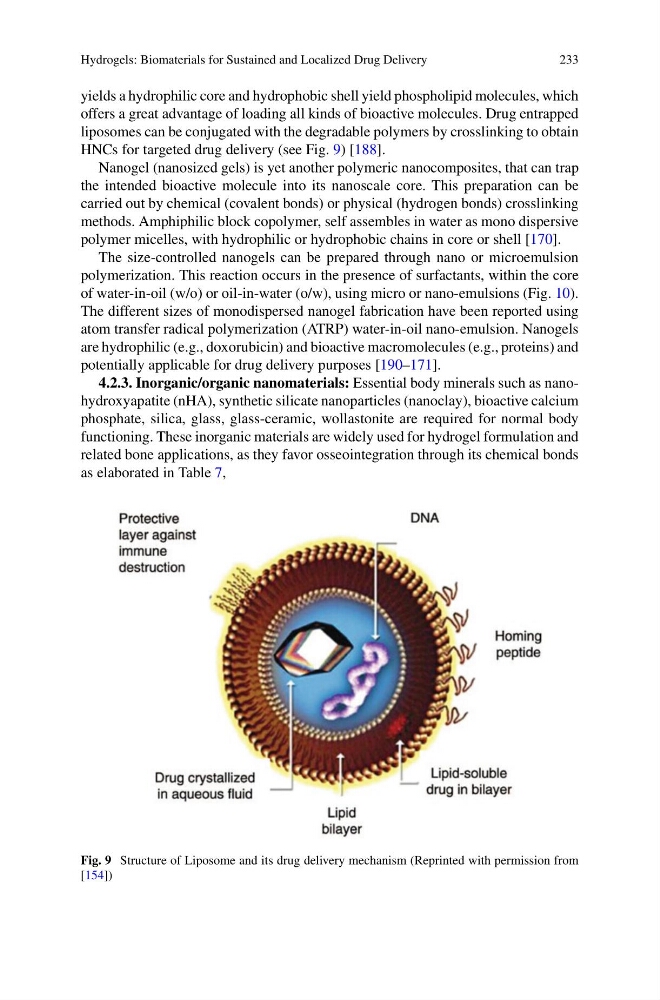
yields a hydrophilic core and hydrophobic shell yield phospholipid molecules, which
offers a great advantage of loading all kinds of bioactive molecules. Drug entrapped
liposomes can be conjugated with the degradable polymers by crosslinking to obtain
HNCs for targeted drug delivery (see Fig. 9) [188].
Nanogel (nanosized gels) is yet another polymeric nanocomposites, that can trap
the intended bioactive molecule into its nanoscale core. This preparation can be
carried out by chemical (covalent bonds) or physical (hydrogen bonds) crosslinking
methods. Amphiphilic block copolymer, self assembles in water as mono dispersive
polymer micelles, with hydrophilic or hydrophobic chains in core or shell [170].
The size-controlled nanogels can be prepared through nano or microemulsion
polymerization. This reaction occurs in the presence of surfactants, within the core
of water-in-oil (w/o) or oil-in-water (o/w), using micro or nano-emulsions (Fig. 10).
The different sizes of monodispersed nanogel fabrication have been reported using
atom transfer radical polymerization (ATRP) water-in-oil nano-emulsion. Nanogels
are hydrophilic (e.g., doxorubicin) and bioactive macromolecules (e.g., proteins) and
potentially applicable for drug delivery purposes [190–171].
4.2.3. Inorganic/organic nanomaterials: Essential body minerals such as nanohydroxyapatite (nHA), synthetic silicate nanoparticles (nanoclay), bioactive calcium
phosphate, silica, glass, glass-ceramic, wollastonite are required for normal body
functioning. These inorganic materials are widely used for hydrogel formulation and
related bone applications, as they favor osseointegration through its chemical bonds
as elaborated in Table 7,
Fig. 9 Structure of Liposome and its drug delivery mechanism (Reprinted with permission from
[154])
233
yields a hydrophilic core and hydrophobic shell yield phospholipid molecules, which
offers a great advantage of loading all kinds of bioactive molecules. Drug entrapped
liposomes can be conjugated with the degradable polymers by crosslinking to obtain
HNCs for targeted drug delivery (see Fig. 9) [188].
Nanogel (nanosized gels) is yet another polymeric nanocomposites, that can trap
the intended bioactive molecule into its nanoscale core. This preparation can be
carried out by chemical (covalent bonds) or physical (hydrogen bonds) crosslinking
methods. Amphiphilic block copolymer, self assembles in water as mono dispersive
polymer micelles, with hydrophilic or hydrophobic chains in core or shell [170].
The size-controlled nanogels can be prepared through nano or microemulsion
polymerization. This reaction occurs in the presence of surfactants, within the core
of water-in-oil (w/o) or oil-in-water (o/w), using micro or nano-emulsions (Fig. 10).
The different sizes of monodispersed nanogel fabrication have been reported using
atom transfer radical polymerization (ATRP) water-in-oil nano-emulsion. Nanogels
are hydrophilic (e.g., doxorubicin) and bioactive macromolecules (e.g., proteins) and
potentially applicable for drug delivery purposes [190–171].
4.2.3. Inorganic/organic nanomaterials: Essential body minerals such as nanohydroxyapatite (nHA), synthetic silicate nanoparticles (nanoclay), bioactive calcium
phosphate, silica, glass, glass-ceramic, wollastonite are required for normal body
functioning. These inorganic materials are widely used for hydrogel formulation and
related bone applications, as they favor osseointegration through its chemical bonds
as elaborated in Table 7,
Fig. 9 Structure of Liposome and its drug delivery mechanism (Reprinted with permission from
[154])