

228
G. Keerthiga et al.
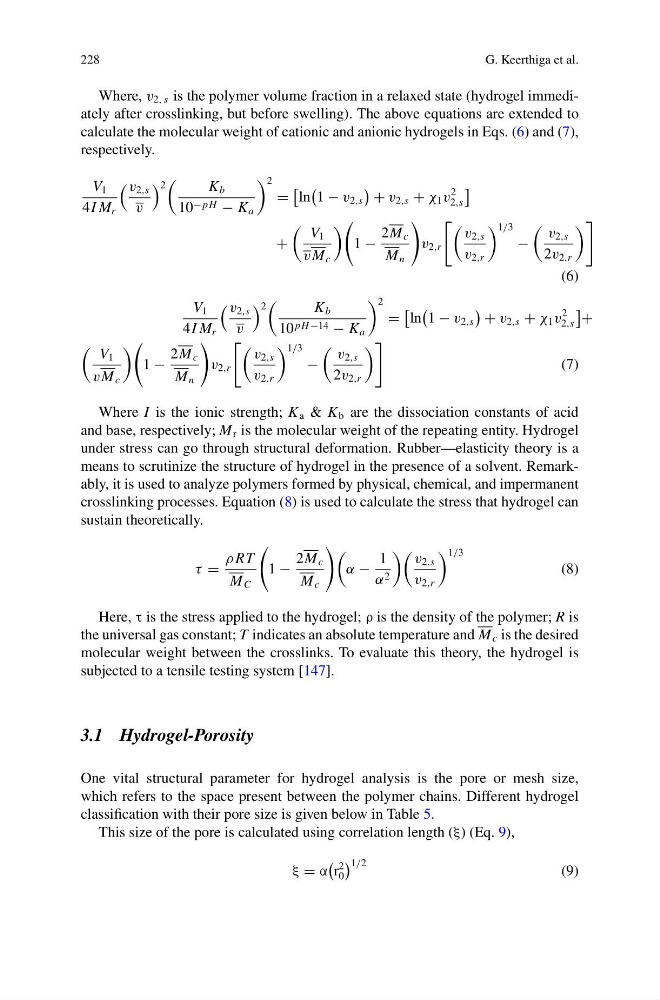
Where, v 2, s is the polymer volume fraction in a relaxed state (hydrogel immediately after crosslinking, but before swelling). The above equations are extended to
calculate the molecular weight of cationic and anionic hydrogels in Eqs. (6) and (7),
respectively.
V 1
4I M r
v 2,s
v
2
K b
10 − pH − K a
2
=
ln
1 − v 2,s
+ v 2,s + χ 1 v
2
2,s
+
V 1
v M c
1 −
2M c
M n
v 2,r
v 2,s
v 2,r
1/3
−
v 2,s
2v 2,r
(6)
V 1
4I M r
v 2,s
v
2
K b
10 pH−14 − K a
2
=
ln
1 − v 2,s
+ v 2,s + χ 1 v
2
2,s
+
V 1
v M c
1 −
2M c
M n
v 2,r
v 2,s
v 2,r
1/3
−
v 2,s
2v 2,r
(7)
Where I is the ionic strength; K a & K b are the dissociation constants of acid
and base, respectively; M r is the molecular weight of the repeating entity. Hydrogel
under stress can go through structural deformation. Rubber—elasticity theory is a
means to scrutinize the structure of hydrogel in the presence of a solvent. Remarkably, it is used to analyze polymers formed by physical, chemical, and impermanent
crosslinking processes. Equation (8) is used to calculate the stress that hydrogel can
sustain theoretically.
τ =
ρ RT
M C
1 −
2M c
M c
α −
1
α 2
v 2,s
v 2,r
1/3
(8)
Here, τ is the stress applied to the hydrogel; ρ is the density of the polymer; R is
the universal gas constant; T indicates an absolute temperature and M c is the desired
molecular weight between the crosslinks. To evaluate this theory, the hydrogel is
subjected to a tensile testing system [147].
3.1 Hydrogel-Porosity
One vital structural parameter for hydrogel analysis is the pore or mesh size,
which refers to the space present between the polymer chains. Different hydrogel
classification with their pore size is given below in Table 5.
This size of the pore is calculated using correlation length (ξ) (Eq. 9),
ξ = α
r
2
0
1/2
(9)
G. Keerthiga et al.
Where, v 2, s is the polymer volume fraction in a relaxed state (hydrogel immediately after crosslinking, but before swelling). The above equations are extended to
calculate the molecular weight of cationic and anionic hydrogels in Eqs. (6) and (7),
respectively.
V 1
4I M r
v 2,s
v
2
K b
10 − pH − K a
2
=
ln
1 − v 2,s
+ v 2,s + χ 1 v
2
2,s
+
V 1
v M c
1 −
2M c
M n
v 2,r
v 2,s
v 2,r
1/3
−
v 2,s
2v 2,r
(6)
V 1
4I M r
v 2,s
v
2
K b
10 pH−14 − K a
2
=
ln
1 − v 2,s
+ v 2,s + χ 1 v
2
2,s
+
V 1
v M c
1 −
2M c
M n
v 2,r
v 2,s
v 2,r
1/3
−
v 2,s
2v 2,r
(7)
Where I is the ionic strength; K a & K b are the dissociation constants of acid
and base, respectively; M r is the molecular weight of the repeating entity. Hydrogel
under stress can go through structural deformation. Rubber—elasticity theory is a
means to scrutinize the structure of hydrogel in the presence of a solvent. Remarkably, it is used to analyze polymers formed by physical, chemical, and impermanent
crosslinking processes. Equation (8) is used to calculate the stress that hydrogel can
sustain theoretically.
τ =
ρ RT
M C
1 −
2M c
M c
α −
1
α 2
v 2,s
v 2,r
1/3
(8)
Here, τ is the stress applied to the hydrogel; ρ is the density of the polymer; R is
the universal gas constant; T indicates an absolute temperature and M c is the desired
molecular weight between the crosslinks. To evaluate this theory, the hydrogel is
subjected to a tensile testing system [147].
3.1 Hydrogel-Porosity
One vital structural parameter for hydrogel analysis is the pore or mesh size,
which refers to the space present between the polymer chains. Different hydrogel
classification with their pore size is given below in Table 5.
This size of the pore is calculated using correlation length (ξ) (Eq. 9),
ξ = α
r
2
0
1/2
(9)