

Hydrogels: Biomaterials for Sustained and Localized Drug Delivery
229
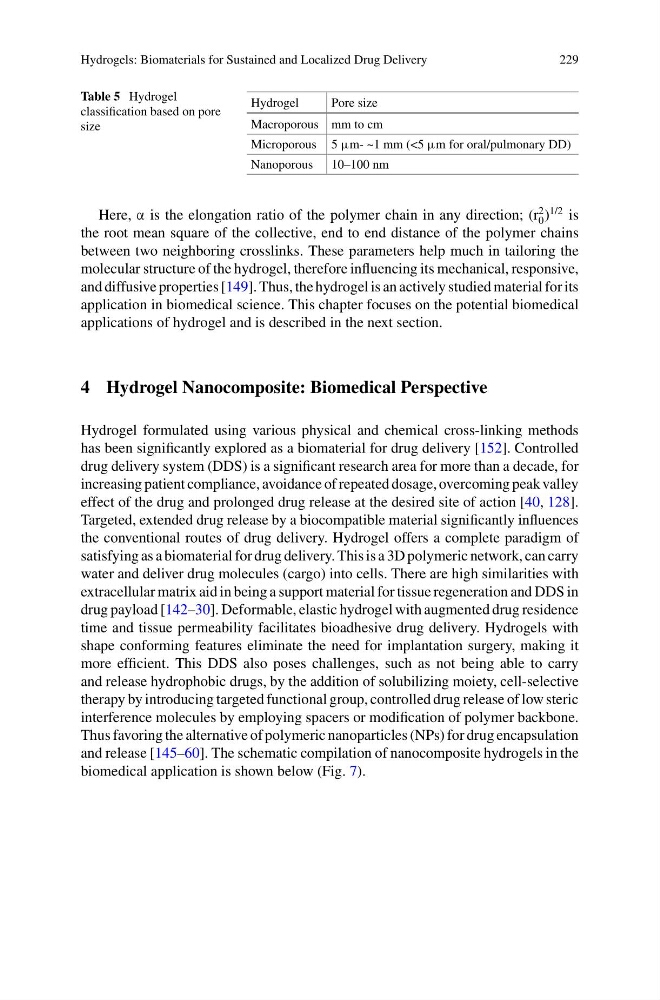
Table 5 Hydrogel
classification based on pore
size
Hydrogel
Pore size
Macroporous mm to cm
Microporous 5 μm- ~1 mm (<5 μm for oral/pulmonary DD)
Nanoporous 10–100 nm
Here, α is the elongation ratio of the polymer chain in any direction; (r
2
0 )
1/2 is
the root mean square of the collective, end to end distance of the polymer chains
between two neighboring crosslinks. These parameters help much in tailoring the
molecular structure of the hydrogel, therefore influencing its mechanical, responsive,
and diffusive properties [149]. Thus, the hydrogel is an actively studied material for its
application in biomedical science. This chapter focuses on the potential biomedical
applications of hydrogel and is described in the next section.
4 Hydrogel Nanocomposite: Biomedical Perspective
Hydrogel formulated using various physical and chemical cross-linking methods
has been significantly explored as a biomaterial for drug delivery [152]. Controlled
drug delivery system (DDS) is a significant research area for more than a decade, for
increasing patient compliance, avoidance of repeated dosage, overcoming peak valley
effect of the drug and prolonged drug release at the desired site of action [40, 128].
Targeted, extended drug release by a biocompatible material significantly influences
the conventional routes of drug delivery. Hydrogel offers a complete paradigm of
satisfying as a biomaterial for drug delivery. This is a 3D polymeric network, can carry
water and deliver drug molecules (cargo) into cells. There are high similarities with
extracellular matrix aid in being a support material for tissue regeneration and DDS in
drug payload [142–30]. Deformable, elastic hydrogel with augmented drug residence
time and tissue permeability facilitates bioadhesive drug delivery. Hydrogels with
shape conforming features eliminate the need for implantation surgery, making it
more efficient. This DDS also poses challenges, such as not being able to carry
and release hydrophobic drugs, by the addition of solubilizing moiety, cell-selective
therapy by introducing targeted functional group, controlled drug release of low steric
interference molecules by employing spacers or modification of polymer backbone.
Thus favoring the alternative of polymeric nanoparticles (NPs) for drug encapsulation
and release [145–60]. The schematic compilation of nanocomposite hydrogels in the
biomedical application is shown below (Fig. 7).
229
Table 5 Hydrogel
classification based on pore
size
Hydrogel
Pore size
Macroporous mm to cm
Microporous 5 μm- ~1 mm (<5 μm for oral/pulmonary DD)
Nanoporous 10–100 nm
Here, α is the elongation ratio of the polymer chain in any direction; (r
2
0 )
1/2 is
the root mean square of the collective, end to end distance of the polymer chains
between two neighboring crosslinks. These parameters help much in tailoring the
molecular structure of the hydrogel, therefore influencing its mechanical, responsive,
and diffusive properties [149]. Thus, the hydrogel is an actively studied material for its
application in biomedical science. This chapter focuses on the potential biomedical
applications of hydrogel and is described in the next section.
4 Hydrogel Nanocomposite: Biomedical Perspective
Hydrogel formulated using various physical and chemical cross-linking methods
has been significantly explored as a biomaterial for drug delivery [152]. Controlled
drug delivery system (DDS) is a significant research area for more than a decade, for
increasing patient compliance, avoidance of repeated dosage, overcoming peak valley
effect of the drug and prolonged drug release at the desired site of action [40, 128].
Targeted, extended drug release by a biocompatible material significantly influences
the conventional routes of drug delivery. Hydrogel offers a complete paradigm of
satisfying as a biomaterial for drug delivery. This is a 3D polymeric network, can carry
water and deliver drug molecules (cargo) into cells. There are high similarities with
extracellular matrix aid in being a support material for tissue regeneration and DDS in
drug payload [142–30]. Deformable, elastic hydrogel with augmented drug residence
time and tissue permeability facilitates bioadhesive drug delivery. Hydrogels with
shape conforming features eliminate the need for implantation surgery, making it
more efficient. This DDS also poses challenges, such as not being able to carry
and release hydrophobic drugs, by the addition of solubilizing moiety, cell-selective
therapy by introducing targeted functional group, controlled drug release of low steric
interference molecules by employing spacers or modification of polymer backbone.
Thus favoring the alternative of polymeric nanoparticles (NPs) for drug encapsulation
and release [145–60]. The schematic compilation of nanocomposite hydrogels in the
biomedical application is shown below (Fig. 7).