

Hydrogels: Biomaterials for Sustained and Localized Drug Delivery
227
Hydrogels with no ionic moieties can be analyzed by Flory-Rehner theory, which
is a combinatorial conjecture of thermodynamics and elasticity. This theory states
that, when a cross-linked polymer gel plunged in a fluid, it is allowed to reach in
equilibrium exerts, which is equal to the thermodynamic force of mixing and the
retraction force of the polymer chains. Defining in terms of Gibbs free energy as
Eq. 1,
G total = G mixing + G elastic
(1)
Where, G elastic is the total refractive elastic force developed inside the gel; G mixing
is the spontaneous mixing force of the polymer with the surrounding fluid. The
above equation is differentiated with respect to the number of solvent molecules, the
temperature and pressure as constants result in Eq. 2,
μ 1 − μ 1, o = μ elastic + μ mixing
(2)
Where μ 1 is the chemical potential of the solvent (fluid) in the polymer gel and
μ 1, o is the chemical potential of the pure solvent.
At equilibrium, the difference between the chemical potential of the fluid inside
and outside of the gel will be 0. Thus, making the chemical potential due to mixing
and elastic forces are equal (Eq. 3).
μ elastic = μ mi xing
(3)
Change in the chemical potential due to elastic forces of the polymer chain can be
evaluated using rubber elasticity theory. The interaction between the polymer and the
surrounding fluid is given as χ 1 . Below, Eq. (4) is used to calculate molecular weight
between adjacent crosslinks M c of a neutral hydrogel in the absence of solvent.
1
M c
=
2
M n
−
v
V 1
ln
1 − v 2,s
+ v 2,s + χ 1 v
2
2,s
v
1/3
2,s −
v 2,s
2
(4)
Where M n is the molecular weight of the polymer prepared identically in the
absence of cross-linking agent; v is the polymer specific volume, and V 1 is the molar
volume of water.
Ideal conditions are modified according to the real-time application and speculated
to accord the need. The presence of water influences the elastic force, and polymer
is subjected to influencing the chemical potential. Considering the volume fraction
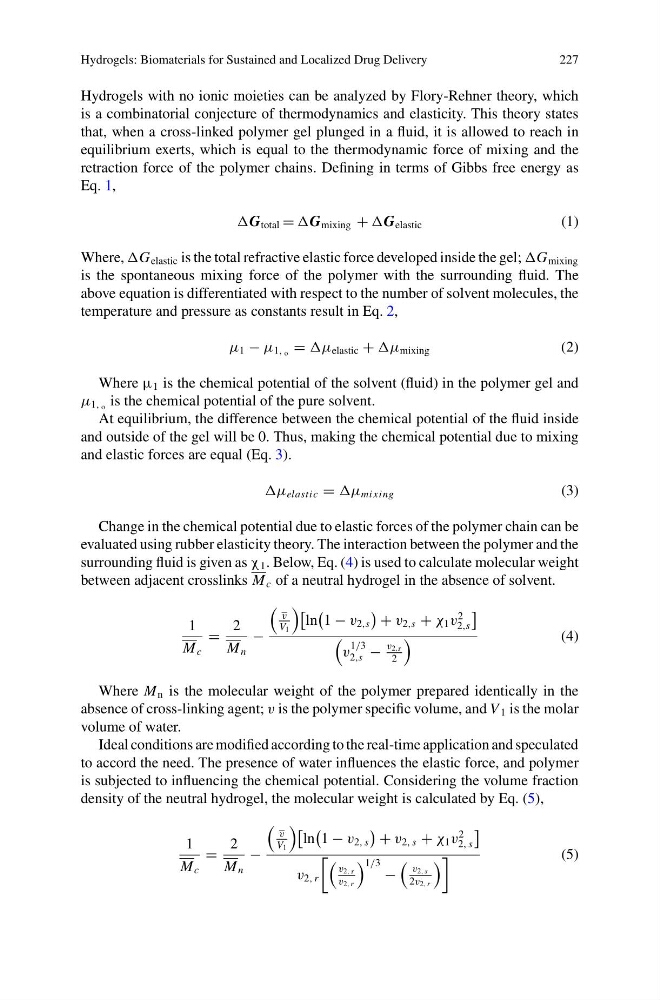
density of the neutral hydrogel, the molecular weight is calculated by Eq. (5),
1
M c
=
2
M n
−
v
V 1
ln
1 − v 2, s
+ v 2, s + χ 1 v
2
2, s
v 2, r
v 2, s
v 2, r
1/3 −
v 2, s
2v 2, r
(5)
227
Hydrogels with no ionic moieties can be analyzed by Flory-Rehner theory, which
is a combinatorial conjecture of thermodynamics and elasticity. This theory states
that, when a cross-linked polymer gel plunged in a fluid, it is allowed to reach in
equilibrium exerts, which is equal to the thermodynamic force of mixing and the
retraction force of the polymer chains. Defining in terms of Gibbs free energy as
Eq. 1,
G total = G mixing + G elastic
(1)
Where, G elastic is the total refractive elastic force developed inside the gel; G mixing
is the spontaneous mixing force of the polymer with the surrounding fluid. The
above equation is differentiated with respect to the number of solvent molecules, the
temperature and pressure as constants result in Eq. 2,
μ 1 − μ 1, o = μ elastic + μ mixing
(2)
Where μ 1 is the chemical potential of the solvent (fluid) in the polymer gel and
μ 1, o is the chemical potential of the pure solvent.
At equilibrium, the difference between the chemical potential of the fluid inside
and outside of the gel will be 0. Thus, making the chemical potential due to mixing
and elastic forces are equal (Eq. 3).
μ elastic = μ mi xing
(3)
Change in the chemical potential due to elastic forces of the polymer chain can be
evaluated using rubber elasticity theory. The interaction between the polymer and the
surrounding fluid is given as χ 1 . Below, Eq. (4) is used to calculate molecular weight
between adjacent crosslinks M c of a neutral hydrogel in the absence of solvent.
1
M c
=
2
M n
−
v
V 1
ln
1 − v 2,s
+ v 2,s + χ 1 v
2
2,s
v
1/3
2,s −
v 2,s
2
(4)
Where M n is the molecular weight of the polymer prepared identically in the
absence of cross-linking agent; v is the polymer specific volume, and V 1 is the molar
volume of water.
Ideal conditions are modified according to the real-time application and speculated
to accord the need. The presence of water influences the elastic force, and polymer
is subjected to influencing the chemical potential. Considering the volume fraction
density of the neutral hydrogel, the molecular weight is calculated by Eq. (5),
1
M c
=
2
M n
−
v
V 1
ln
1 − v 2, s
+ v 2, s + χ 1 v
2
2, s
v 2, r
v 2, s
v 2, r
1/3 −
v 2, s
2v 2, r
(5)