

Hydrogels: Biomaterials for Sustained and Localized Drug Delivery
223
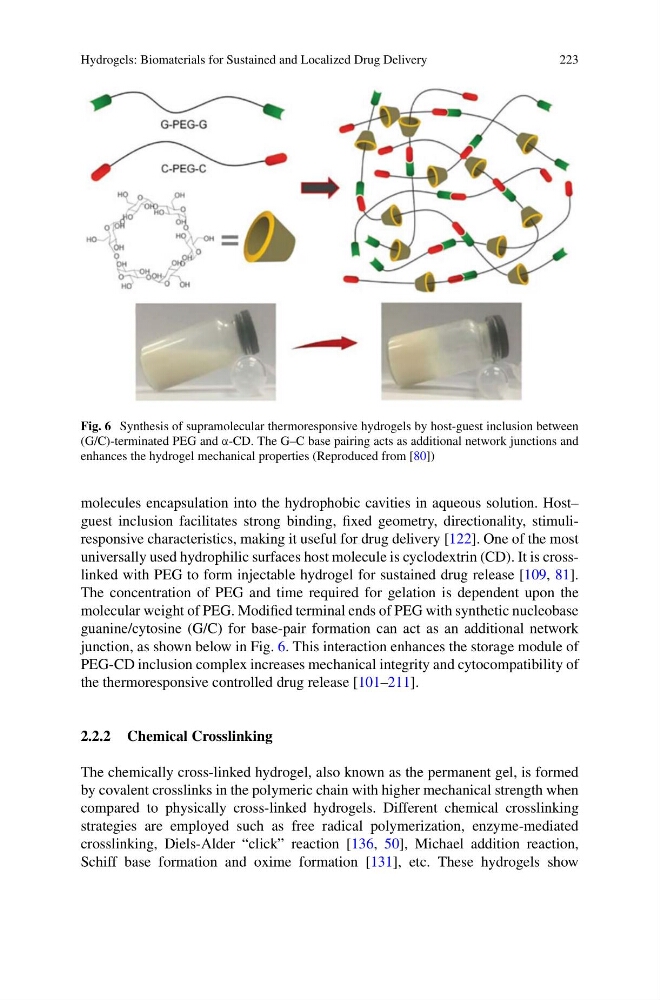
Fig. 6 Synthesis of supramolecular thermoresponsive hydrogels by host-guest inclusion between
(G/C)-terminated PEG and α-CD. The G–C base pairing acts as additional network junctions and
enhances the hydrogel mechanical properties (Reproduced from [80])
molecules encapsulation into the hydrophobic cavities in aqueous solution. Host–
guest inclusion facilitates strong binding, fixed geometry, directionality, stimuliresponsive characteristics, making it useful for drug delivery [122]. One of the most
universally used hydrophilic surfaces host molecule is cyclodextrin (CD). It is crosslinked with PEG to form injectable hydrogel for sustained drug release [109, 81].
The concentration of PEG and time required for gelation is dependent upon the
molecular weight of PEG. Modified terminal ends of PEG with synthetic nucleobase
guanine/cytosine (G/C) for base-pair formation can act as an additional network
junction, as shown below in Fig. 6. This interaction enhances the storage module of
PEG-CD inclusion complex increases mechanical integrity and cytocompatibility of
the thermoresponsive controlled drug release [101–211].
2.2.2 Chemical Crosslinking
The chemically cross-linked hydrogel, also known as the permanent gel, is formed
by covalent crosslinks in the polymeric chain with higher mechanical strength when
compared to physically cross-linked hydrogels. Different chemical crosslinking
strategies are employed such as free radical polymerization, enzyme-mediated
crosslinking, Diels-Alder “click” reaction [136, 50], Michael addition reaction,
Schiff base formation and oxime formation [131], etc. These hydrogels show
223
Fig. 6 Synthesis of supramolecular thermoresponsive hydrogels by host-guest inclusion between
(G/C)-terminated PEG and α-CD. The G–C base pairing acts as additional network junctions and
enhances the hydrogel mechanical properties (Reproduced from [80])
molecules encapsulation into the hydrophobic cavities in aqueous solution. Host–
guest inclusion facilitates strong binding, fixed geometry, directionality, stimuliresponsive characteristics, making it useful for drug delivery [122]. One of the most
universally used hydrophilic surfaces host molecule is cyclodextrin (CD). It is crosslinked with PEG to form injectable hydrogel for sustained drug release [109, 81].
The concentration of PEG and time required for gelation is dependent upon the
molecular weight of PEG. Modified terminal ends of PEG with synthetic nucleobase
guanine/cytosine (G/C) for base-pair formation can act as an additional network
junction, as shown below in Fig. 6. This interaction enhances the storage module of
PEG-CD inclusion complex increases mechanical integrity and cytocompatibility of
the thermoresponsive controlled drug release [101–211].
2.2.2 Chemical Crosslinking
The chemically cross-linked hydrogel, also known as the permanent gel, is formed
by covalent crosslinks in the polymeric chain with higher mechanical strength when
compared to physically cross-linked hydrogels. Different chemical crosslinking
strategies are employed such as free radical polymerization, enzyme-mediated
crosslinking, Diels-Alder “click” reaction [136, 50], Michael addition reaction,
Schiff base formation and oxime formation [131], etc. These hydrogels show