

224
G. Keerthiga et al.
higher stability under physiological conditions, enhanced mechanical property, and
modifiable degradation behavior.
i. Crosslinking by photopolymerization
Light-activated cross-linking has been broadly used for hydrogel formation and
therapeutics encapsulation and delivery [107–85]. Hydrogel formation is rapid at
ambient temperature under placid conditions and alterable mechanical properties by
controlling crosslinking reaction [135]. The choice of photo-initiated polymerization site is crucial as hydrogel formation occurs only in the irradiated light areas
[220]. The composition of photo crosslinked biomedical hydrogels usually involves
the presence of unsaturated groups that are incredibly reactive to favor free radical
chain intensification polymerization when exposed to light. Also, cytocompatiblephotoinitiators such as riboflavin phosphonate [61], camphorquinone [44], eosin Y
[181], Irgacure 1173 [80], Irgacure 819, Irgacure 2959 [216] are required depending
upon the wavelength absorption needed and given at the intended site. Photoinitiators
absorb at specific wavelengths such as UV (250–370 nm), visible blue and purple
(405–550 nm) or red light (750–810 nm) and either deteriorate (Type I) or acquire
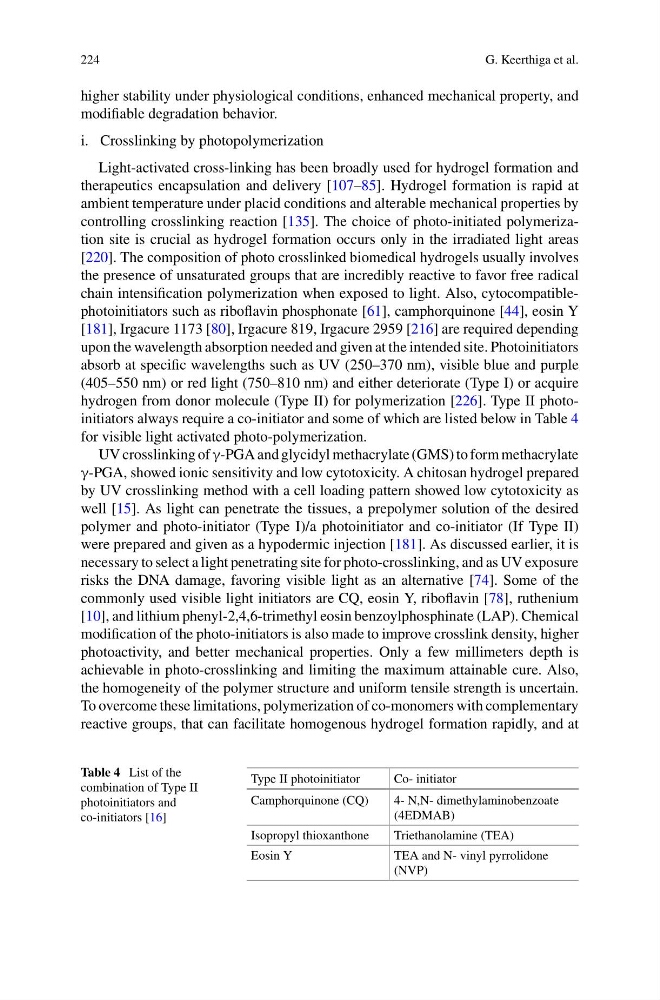
hydrogen from donor molecule (Type II) for polymerization [226]. Type II photoinitiators always require a co-initiator and some of which are listed below in Table 4
for visible light activated photo-polymerization.
UV crosslinking of γ-PGA and glycidyl methacrylate (GMS) to form methacrylate
γ-PGA, showed ionic sensitivity and low cytotoxicity. A chitosan hydrogel prepared
by UV crosslinking method with a cell loading pattern showed low cytotoxicity as
well [15]. As light can penetrate the tissues, a prepolymer solution of the desired
polymer and photo-initiator (Type I)/a photoinitiator and co-initiator (If Type II)
were prepared and given as a hypodermic injection [181]. As discussed earlier, it is
necessary to select a light penetrating site for photo-crosslinking, and as UV exposure
risks the DNA damage, favoring visible light as an alternative [74]. Some of the
commonly used visible light initiators are CQ, eosin Y, riboflavin [78], ruthenium
[10], and lithium phenyl-2,4,6-trimethyl eosin benzoylphosphinate (LAP). Chemical
modification of the photo-initiators is also made to improve crosslink density, higher
photoactivity, and better mechanical properties. Only a few millimeters depth is
achievable in photo-crosslinking and limiting the maximum attainable cure. Also,
the homogeneity of the polymer structure and uniform tensile strength is uncertain.
To overcome these limitations, polymerization of co-monomers with complementary
reactive groups, that can facilitate homogenous hydrogel formation rapidly, and at
Table 4 List of the
combination of Type II
photoinitiators and
co-initiators [16]
Type II photoinitiator
Co- initiator
Camphorquinone (CQ)
4- N,N- dimethylaminobenzoate
(4EDMAB)
Isopropyl thioxanthone
Triethanolamine (TEA)
Eosin Y
TEA and N- vinyl pyrrolidone
(NVP)
G. Keerthiga et al.
higher stability under physiological conditions, enhanced mechanical property, and
modifiable degradation behavior.
i. Crosslinking by photopolymerization
Light-activated cross-linking has been broadly used for hydrogel formation and
therapeutics encapsulation and delivery [107–85]. Hydrogel formation is rapid at
ambient temperature under placid conditions and alterable mechanical properties by
controlling crosslinking reaction [135]. The choice of photo-initiated polymerization site is crucial as hydrogel formation occurs only in the irradiated light areas
[220]. The composition of photo crosslinked biomedical hydrogels usually involves
the presence of unsaturated groups that are incredibly reactive to favor free radical
chain intensification polymerization when exposed to light. Also, cytocompatiblephotoinitiators such as riboflavin phosphonate [61], camphorquinone [44], eosin Y
[181], Irgacure 1173 [80], Irgacure 819, Irgacure 2959 [216] are required depending
upon the wavelength absorption needed and given at the intended site. Photoinitiators
absorb at specific wavelengths such as UV (250–370 nm), visible blue and purple
(405–550 nm) or red light (750–810 nm) and either deteriorate (Type I) or acquire
hydrogen from donor molecule (Type II) for polymerization [226]. Type II photoinitiators always require a co-initiator and some of which are listed below in Table 4
for visible light activated photo-polymerization.
UV crosslinking of γ-PGA and glycidyl methacrylate (GMS) to form methacrylate
γ-PGA, showed ionic sensitivity and low cytotoxicity. A chitosan hydrogel prepared
by UV crosslinking method with a cell loading pattern showed low cytotoxicity as
well [15]. As light can penetrate the tissues, a prepolymer solution of the desired
polymer and photo-initiator (Type I)/a photoinitiator and co-initiator (If Type II)
were prepared and given as a hypodermic injection [181]. As discussed earlier, it is
necessary to select a light penetrating site for photo-crosslinking, and as UV exposure
risks the DNA damage, favoring visible light as an alternative [74]. Some of the
commonly used visible light initiators are CQ, eosin Y, riboflavin [78], ruthenium
[10], and lithium phenyl-2,4,6-trimethyl eosin benzoylphosphinate (LAP). Chemical
modification of the photo-initiators is also made to improve crosslink density, higher
photoactivity, and better mechanical properties. Only a few millimeters depth is
achievable in photo-crosslinking and limiting the maximum attainable cure. Also,
the homogeneity of the polymer structure and uniform tensile strength is uncertain.
To overcome these limitations, polymerization of co-monomers with complementary
reactive groups, that can facilitate homogenous hydrogel formation rapidly, and at
Table 4 List of the
combination of Type II
photoinitiators and
co-initiators [16]
Type II photoinitiator
Co- initiator
Camphorquinone (CQ)
4- N,N- dimethylaminobenzoate
(4EDMAB)
Isopropyl thioxanthone
Triethanolamine (TEA)
Eosin Y
TEA and N- vinyl pyrrolidone
(NVP)