

222
G. Keerthiga et al.
polymeric network is known to exhibit high resilience, increased strength, and shape
memory behavior [59].
v. Crosslink by Metal coordination
Metal-ligand interaction between the metal ions and functional groups in the
polymeric chains has been considered as a unique Lewis acid-base interaction, which
is regarded as more potent than other non-covalent bonds. This moderate energy
facilitates metal-ligand interaction occurrence or breakdown, which helps in selfhealing property [111]. Mechanical properties of metal coordination based hydrogels
such as hydrogel strength, toughness, the strength of the coordination bond, required
tunable temperature-sensitive/pH-responsive/shape memory ability can be acquired
accordingly to the application intended as they form sol-gel characteristics based on
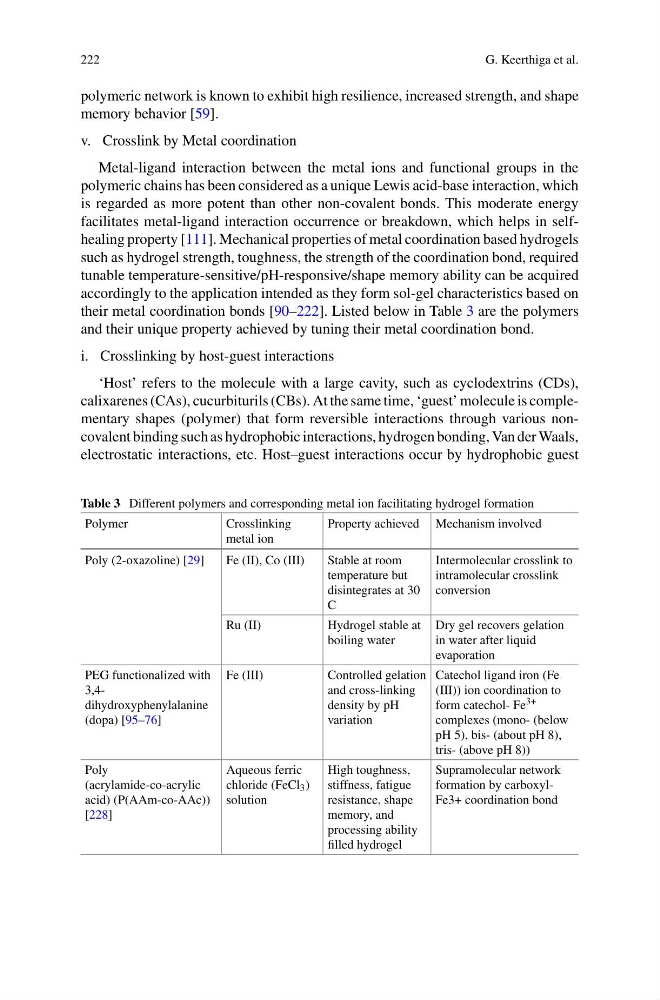
their metal coordination bonds [90–222]. Listed below in Table 3 are the polymers
and their unique property achieved by tuning their metal coordination bond.
i. Crosslinking by host-guest interactions
‘Host’ refers to the molecule with a large cavity, such as cyclodextrins (CDs),
calixarenes (CAs), cucurbiturils (CBs). At the same time, ‘guest’ molecule is complementary shapes (polymer) that form reversible interactions through various noncovalent binding such as hydrophobic interactions, hydrogen bonding, Van der Waals,
electrostatic interactions, etc. Host–guest interactions occur by hydrophobic guest
Table 3 Different polymers and corresponding metal ion facilitating hydrogel formation
Polymer
Crosslinking
metal ion
Property achieved Mechanism involved
Poly (2-oxazoline) [29]
Fe (II), Co (III)
Stable at room
temperature but
disintegrates at 30
C
Intermolecular crosslink to
intramolecular crosslink
conversion
Ru (II)
Hydrogel stable at
boiling water
Dry gel recovers gelation
in water after liquid
evaporation
PEG functionalized with
3,4dihydroxyphenylalanine
(dopa) [95–76]
Fe (III)
Controlled gelation
and cross-linking
density by pH
variation
Catechol ligand iron (Fe
(III)) ion coordination to
form catechol- Fe 3+
complexes (mono- (below
pH 5), bis- (about pH 8),
tris- (above pH 8))
Poly
(acrylamide-co-acrylic
acid) (P(AAm-co-AAc))
[228]
Aqueous ferric
chloride (FeCl 3 )
solution
High toughness,
stiffness, fatigue
resistance, shape
memory, and
processing ability
filled hydrogel
Supramolecular network
formation by carboxylFe3+ coordination bond
G. Keerthiga et al.
polymeric network is known to exhibit high resilience, increased strength, and shape
memory behavior [59].
v. Crosslink by Metal coordination
Metal-ligand interaction between the metal ions and functional groups in the
polymeric chains has been considered as a unique Lewis acid-base interaction, which
is regarded as more potent than other non-covalent bonds. This moderate energy
facilitates metal-ligand interaction occurrence or breakdown, which helps in selfhealing property [111]. Mechanical properties of metal coordination based hydrogels
such as hydrogel strength, toughness, the strength of the coordination bond, required
tunable temperature-sensitive/pH-responsive/shape memory ability can be acquired
accordingly to the application intended as they form sol-gel characteristics based on
their metal coordination bonds [90–222]. Listed below in Table 3 are the polymers
and their unique property achieved by tuning their metal coordination bond.
i. Crosslinking by host-guest interactions
‘Host’ refers to the molecule with a large cavity, such as cyclodextrins (CDs),
calixarenes (CAs), cucurbiturils (CBs). At the same time, ‘guest’ molecule is complementary shapes (polymer) that form reversible interactions through various noncovalent binding such as hydrophobic interactions, hydrogen bonding, Van der Waals,
electrostatic interactions, etc. Host–guest interactions occur by hydrophobic guest
Table 3 Different polymers and corresponding metal ion facilitating hydrogel formation
Polymer
Crosslinking
metal ion
Property achieved Mechanism involved
Poly (2-oxazoline) [29]
Fe (II), Co (III)
Stable at room
temperature but
disintegrates at 30
C
Intermolecular crosslink to
intramolecular crosslink
conversion
Ru (II)
Hydrogel stable at
boiling water
Dry gel recovers gelation
in water after liquid
evaporation
PEG functionalized with
3,4dihydroxyphenylalanine
(dopa) [95–76]
Fe (III)
Controlled gelation
and cross-linking
density by pH
variation
Catechol ligand iron (Fe
(III)) ion coordination to
form catechol- Fe 3+
complexes (mono- (below
pH 5), bis- (about pH 8),
tris- (above pH 8))
Poly
(acrylamide-co-acrylic
acid) (P(AAm-co-AAc))
[228]
Aqueous ferric
chloride (FeCl 3 )
solution
High toughness,
stiffness, fatigue
resistance, shape
memory, and
processing ability
filled hydrogel
Supramolecular network
formation by carboxylFe3+ coordination bond