

Hydrogels: Biomaterials for Sustained and Localized Drug Delivery
221
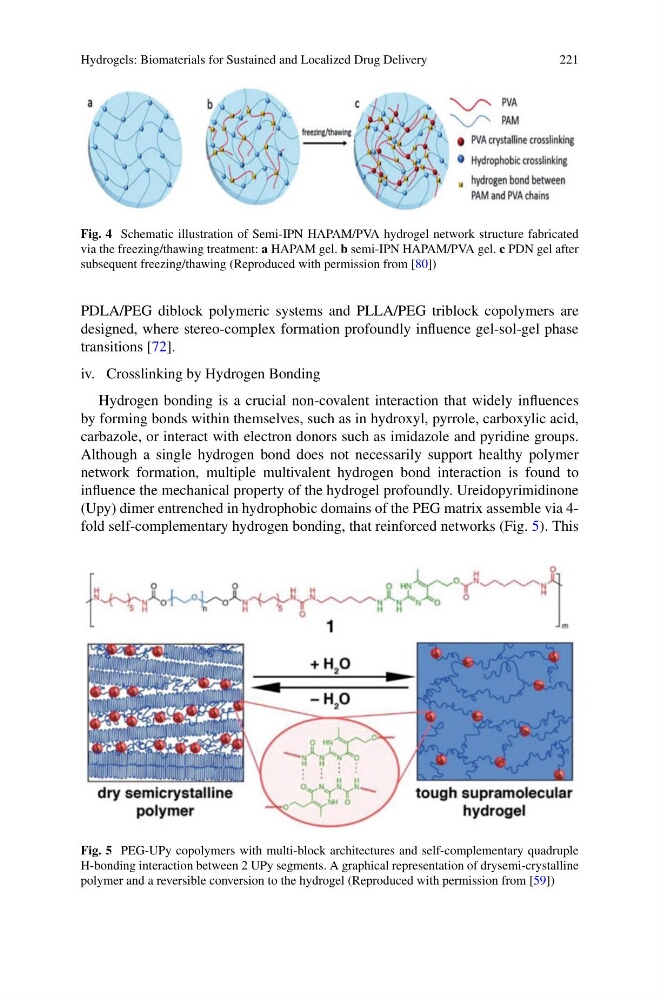
Fig. 4 Schematic illustration of Semi-IPN HAPAM/PVA hydrogel network structure fabricated
via the freezing/thawing treatment: a HAPAM gel. b semi-IPN HAPAM/PVA gel. c PDN gel after
subsequent freezing/thawing (Reproduced with permission from [80])
PDLA/PEG diblock polymeric systems and PLLA/PEG triblock copolymers are
designed, where stereo-complex formation profoundly influence gel-sol-gel phase
transitions [72].
iv. Crosslinking by Hydrogen Bonding
Hydrogen bonding is a crucial non-covalent interaction that widely influences
by forming bonds within themselves, such as in hydroxyl, pyrrole, carboxylic acid,
carbazole, or interact with electron donors such as imidazole and pyridine groups.
Although a single hydrogen bond does not necessarily support healthy polymer
network formation, multiple multivalent hydrogen bond interaction is found to
influence the mechanical property of the hydrogel profoundly. Ureidopyrimidinone
(Upy) dimer entrenched in hydrophobic domains of the PEG matrix assemble via 4fold self-complementary hydrogen bonding, that reinforced networks (Fig. 5). This
Fig. 5 PEG-UPy copolymers with multi-block architectures and self-complementary quadruple
H-bonding interaction between 2 UPy segments. A graphical representation of drysemi-crystalline
polymer and a reversible conversion to the hydrogel (Reproduced with permission from [59])
221
Fig. 4 Schematic illustration of Semi-IPN HAPAM/PVA hydrogel network structure fabricated
via the freezing/thawing treatment: a HAPAM gel. b semi-IPN HAPAM/PVA gel. c PDN gel after
subsequent freezing/thawing (Reproduced with permission from [80])
PDLA/PEG diblock polymeric systems and PLLA/PEG triblock copolymers are
designed, where stereo-complex formation profoundly influence gel-sol-gel phase
transitions [72].
iv. Crosslinking by Hydrogen Bonding
Hydrogen bonding is a crucial non-covalent interaction that widely influences
by forming bonds within themselves, such as in hydroxyl, pyrrole, carboxylic acid,
carbazole, or interact with electron donors such as imidazole and pyridine groups.
Although a single hydrogen bond does not necessarily support healthy polymer
network formation, multiple multivalent hydrogen bond interaction is found to
influence the mechanical property of the hydrogel profoundly. Ureidopyrimidinone
(Upy) dimer entrenched in hydrophobic domains of the PEG matrix assemble via 4fold self-complementary hydrogen bonding, that reinforced networks (Fig. 5). This
Fig. 5 PEG-UPy copolymers with multi-block architectures and self-complementary quadruple
H-bonding interaction between 2 UPy segments. A graphical representation of drysemi-crystalline
polymer and a reversible conversion to the hydrogel (Reproduced with permission from [59])