

Solution Combustion Synthesis of Calcium …
189
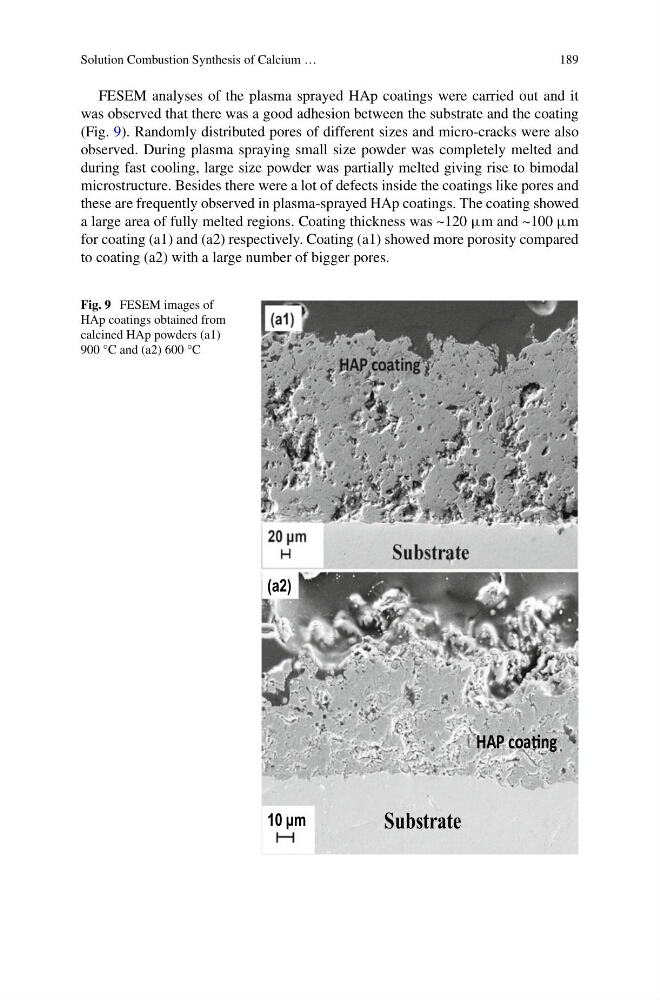
FESEM analyses of the plasma sprayed HAp coatings were carried out and it
was observed that there was a good adhesion between the substrate and the coating
(Fig. 9). Randomly distributed pores of different sizes and micro-cracks were also
observed. During plasma spraying small size powder was completely melted and
during fast cooling, large size powder was partially melted giving rise to bimodal
microstructure. Besides there were a lot of defects inside the coatings like pores and
these are frequently observed in plasma-sprayed HAp coatings. The coating showed
a large area of fully melted regions. Coating thickness was ~120 μm and ~100 μm
for coating (a1) and (a2) respectively. Coating (a1) showed more porosity compared
to coating (a2) with a large number of bigger pores.
Fig. 9 FESEM images of
HAp coatings obtained from
calcined HAp powders (a1)
900 °C and (a2) 600 °C
10 µm
(a2)
HAP coaƟng
Substrate
189
FESEM analyses of the plasma sprayed HAp coatings were carried out and it
was observed that there was a good adhesion between the substrate and the coating
(Fig. 9). Randomly distributed pores of different sizes and micro-cracks were also
observed. During plasma spraying small size powder was completely melted and
during fast cooling, large size powder was partially melted giving rise to bimodal
microstructure. Besides there were a lot of defects inside the coatings like pores and
these are frequently observed in plasma-sprayed HAp coatings. The coating showed
a large area of fully melted regions. Coating thickness was ~120 μm and ~100 μm
for coating (a1) and (a2) respectively. Coating (a1) showed more porosity compared
to coating (a2) with a large number of bigger pores.
Fig. 9 FESEM images of
HAp coatings obtained from
calcined HAp powders (a1)
900 °C and (a2) 600 °C
10 µm
(a2)
HAP coaƟng
Substrate