

188
S. T. Aruna and M. Shilpa
4.5 FESEM Images of the Calcined Powders
and Plasma-Sprayed Coatings
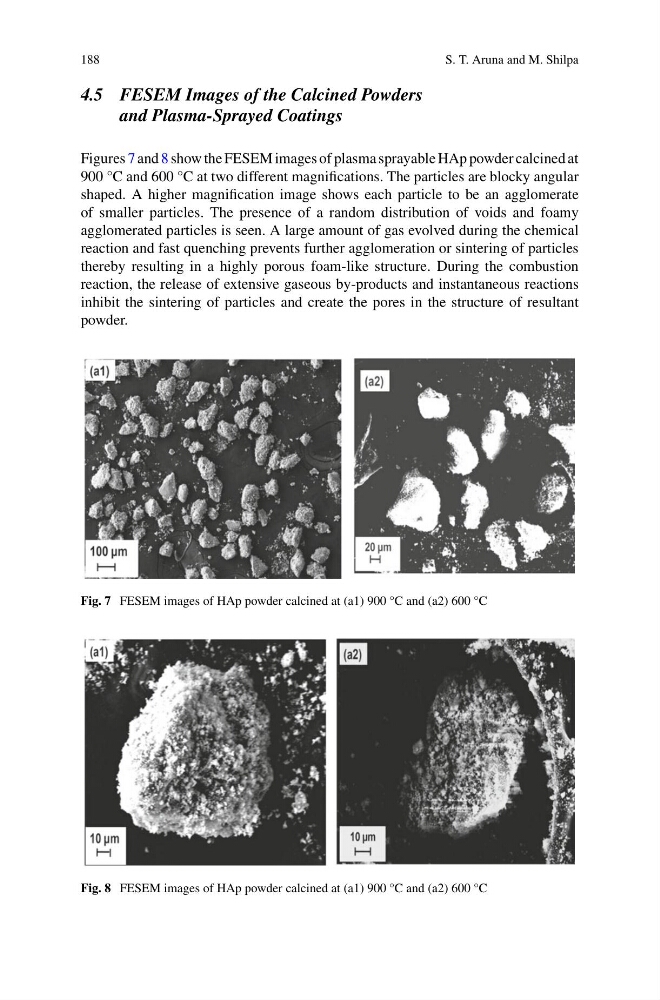
Figures 7 and 8 show the FESEM images of plasma sprayable HAp powder calcined at
900 °C and 600 °C at two different magnifications. The particles are blocky angular
shaped. A higher magnification image shows each particle to be an agglomerate
of smaller particles. The presence of a random distribution of voids and foamy
agglomerated particles is seen. A large amount of gas evolved during the chemical
reaction and fast quenching prevents further agglomeration or sintering of particles
thereby resulting in a highly porous foam-like structure. During the combustion
reaction, the release of extensive gaseous by-products and instantaneous reactions
inhibit the sintering of particles and create the pores in the structure of resultant
powder.
Fig. 7 FESEM images of HAp powder calcined at (a1) 900 °C and (a2) 600 °C
Fig. 8 FESEM images of HAp powder calcined at (a1) 900 °C and (a2) 600 °C
S. T. Aruna and M. Shilpa
4.5 FESEM Images of the Calcined Powders
and Plasma-Sprayed Coatings
Figures 7 and 8 show the FESEM images of plasma sprayable HAp powder calcined at
900 °C and 600 °C at two different magnifications. The particles are blocky angular
shaped. A higher magnification image shows each particle to be an agglomerate
of smaller particles. The presence of a random distribution of voids and foamy
agglomerated particles is seen. A large amount of gas evolved during the chemical
reaction and fast quenching prevents further agglomeration or sintering of particles
thereby resulting in a highly porous foam-like structure. During the combustion
reaction, the release of extensive gaseous by-products and instantaneous reactions
inhibit the sintering of particles and create the pores in the structure of resultant
powder.
Fig. 7 FESEM images of HAp powder calcined at (a1) 900 °C and (a2) 600 °C
Fig. 8 FESEM images of HAp powder calcined at (a1) 900 °C and (a2) 600 °C