

190
S. T. Aruna and M. Shilpa
(a)
(b)
(c)
(d)
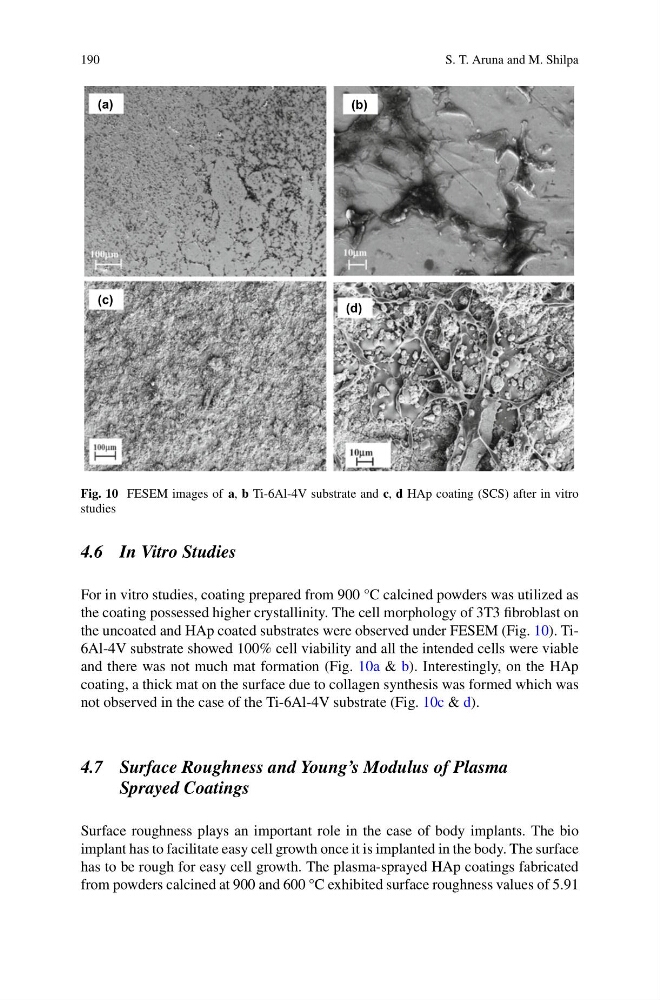
Fig. 10 FESEM images of a, b Ti-6Al-4V substrate and c, d HAp coating (SCS) after in vitro
studies
4.6 In Vitro Studies
For in vitro studies, coating prepared from 900 °C calcined powders was utilized as
the coating possessed higher crystallinity. The cell morphology of 3T3 fibroblast on
the uncoated and HAp coated substrates were observed under FESEM (Fig. 10). Ti6Al-4V substrate showed 100% cell viability and all the intended cells were viable
and there was not much mat formation (Fig. 10a & b). Interestingly, on the HAp
coating, a thick mat on the surface due to collagen synthesis was formed which was
not observed in the case of the Ti-6Al-4V substrate (Fig. 10c & d).
4.7 Surface Roughness and Young’s Modulus of Plasma
Sprayed Coatings
Surface roughness plays an important role in the case of body implants. The bio
implant has to facilitate easy cell growth once it is implanted in the body. The surface
has to be rough for easy cell growth. The plasma-sprayed HAp coatings fabricated
from powders calcined at 900 and 600 °C exhibited surface roughness values of 5.91
S. T. Aruna and M. Shilpa
(a)
(b)
(c)
(d)
Fig. 10 FESEM images of a, b Ti-6Al-4V substrate and c, d HAp coating (SCS) after in vitro
studies
4.6 In Vitro Studies
For in vitro studies, coating prepared from 900 °C calcined powders was utilized as
the coating possessed higher crystallinity. The cell morphology of 3T3 fibroblast on
the uncoated and HAp coated substrates were observed under FESEM (Fig. 10). Ti6Al-4V substrate showed 100% cell viability and all the intended cells were viable
and there was not much mat formation (Fig. 10a & b). Interestingly, on the HAp
coating, a thick mat on the surface due to collagen synthesis was formed which was
not observed in the case of the Ti-6Al-4V substrate (Fig. 10c & d).
4.7 Surface Roughness and Young’s Modulus of Plasma
Sprayed Coatings
Surface roughness plays an important role in the case of body implants. The bio
implant has to facilitate easy cell growth once it is implanted in the body. The surface
has to be rough for easy cell growth. The plasma-sprayed HAp coatings fabricated
from powders calcined at 900 and 600 °C exhibited surface roughness values of 5.91