

I.2 Ordering of Operators
521
ψ| ˆ
A( ˆ
p, ˆ
q)|ψ =
1
2π ¯
h
∞
−∞
∞
−∞
dpdq A(p, q) f (p, q).
(I.10)
Thus, the operators ˆ
A( ˆ
p, ˆ
q) have been expressed in terms of the phase functions
A(p, q), and the state of the system is represented by the Wigner function f (p, q).
(Jensen and Niu 1990 have used momentum and position phase functions closely
related to A(p, q) to study the delta-kicked rotor.)
I.2 Ordering of Operators
If we are given a phase function A(p, q), there is a method for obtaining the
corresponding operator, ˆ
A( ˆ
p, ˆ
q), with the correct ordering of momentum and
position operators ˆ
p and ˆ
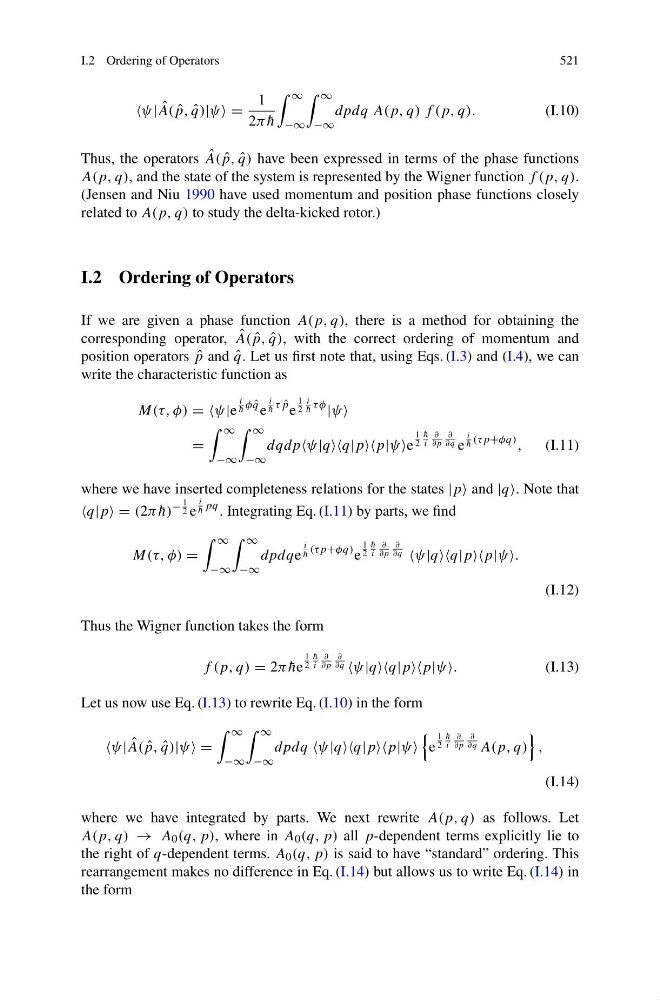
q. Let us first note that, using Eqs. (I.3) and (I.4), we can
write the characteristic function as
M(τ, φ) = =ψ|e
i
¯
h φ ˆ
q e
i
¯
h τ ˆ
p e
1
2
i
¯
h τ φ |ψ
=
∞
−∞
∞
−∞
dqdpψ|qq|pp|ψe
1
2
¯
h
i
∂
∂p
∂
∂q e
i
¯
h (τp+φq) ,
(I.11)
where we have inserted completeness relations for the states |p and |q. Note that
q|p = (2π ¯
h)
−
1
2 e
i
¯
h pq . Integrating Eq. (I.11) by parts, we find
M(τ, φ) =
∞
−∞
∞
−∞
dpdqe
i
¯
h (τp+φq) e
1
2
¯
h
i
∂
∂p
∂
∂q ψ|qq|pp|ψ.
(I.12)
Thus the Wigner function takes the form
f (p, q) = 2π ¯
he
1
2
¯
h
i
∂
∂p
∂
∂q ψ|qq|pp|ψ.
(I.13)
Let us now use Eq. (I.13) to rewrite Eq. (I.10) in the form
ψ| ˆ
A( ˆ
p, ˆ
q)|ψ =
∞
−∞
∞
−∞
dpdq ψ|qq|pp|ψ
e
1
2
¯
h
i
∂
∂p
∂
∂q A(p, q)
,
(I.14)
where we have integrated by parts. We next rewrite A(p, q) as follows. Let
A(p, q) → A 0 (q, p), where in A 0 (q, p) all p-dependent terms explicitly lie to
the right of q-dependent terms. A 0 (q, p) is said to have “standard” ordering. This
rearrangement makes no difference in Eq. (I.14) but allows us to write Eq. (I.14) in
the form
521
ψ| ˆ
A( ˆ
p, ˆ
q)|ψ =
1
2π ¯
h
∞
−∞
∞
−∞
dpdq A(p, q) f (p, q).
(I.10)
Thus, the operators ˆ
A( ˆ
p, ˆ
q) have been expressed in terms of the phase functions
A(p, q), and the state of the system is represented by the Wigner function f (p, q).
(Jensen and Niu 1990 have used momentum and position phase functions closely
related to A(p, q) to study the delta-kicked rotor.)
I.2 Ordering of Operators
If we are given a phase function A(p, q), there is a method for obtaining the
corresponding operator, ˆ
A( ˆ
p, ˆ
q), with the correct ordering of momentum and
position operators ˆ
p and ˆ
q. Let us first note that, using Eqs. (I.3) and (I.4), we can
write the characteristic function as
M(τ, φ) = =ψ|e
i
¯
h φ ˆ
q e
i
¯
h τ ˆ
p e
1
2
i
¯
h τ φ |ψ
=
∞
−∞
∞
−∞
dqdpψ|qq|pp|ψe
1
2
¯
h
i
∂
∂p
∂
∂q e
i
¯
h (τp+φq) ,
(I.11)
where we have inserted completeness relations for the states |p and |q. Note that
q|p = (2π ¯
h)
−
1
2 e
i
¯
h pq . Integrating Eq. (I.11) by parts, we find
M(τ, φ) =
∞
−∞
∞
−∞
dpdqe
i
¯
h (τp+φq) e
1
2
¯
h
i
∂
∂p
∂
∂q ψ|qq|pp|ψ.
(I.12)
Thus the Wigner function takes the form
f (p, q) = 2π ¯
he
1
2
¯
h
i
∂
∂p
∂
∂q ψ|qq|pp|ψ.
(I.13)
Let us now use Eq. (I.13) to rewrite Eq. (I.10) in the form
ψ| ˆ
A( ˆ
p, ˆ
q)|ψ =
∞
−∞
∞
−∞
dpdq ψ|qq|pp|ψ
e
1
2
¯
h
i
∂
∂p
∂
∂q A(p, q)
,
(I.14)
where we have integrated by parts. We next rewrite A(p, q) as follows. Let
A(p, q) → A 0 (q, p), where in A 0 (q, p) all p-dependent terms explicitly lie to
the right of q-dependent terms. A 0 (q, p) is said to have “standard” ordering. This
rearrangement makes no difference in Eq. (I.14) but allows us to write Eq. (I.14) in
the form