

522
I Moyal Bracket and Wigner Function
ψ| ˆ
A( ˆ
p, ˆ
q)|ψ =
∞
−∞
∞
−∞
dpdqψ|qq|pp|ψ
e
1
2
¯
h
i
∂
∂p
∂
∂q A o (q, p)
=
∞
−∞
∞
−∞
dpdqψ|qq|p
e
1
2
¯
h
i
∂
∂p
∂
∂q A o (q, p)
p|ψ
= =ψ|
e
1
2
¯
h
i
∂
∂ ˆ
p
∂
∂ ˆ
q A 0 ( ˆ
p, ˆ
q)
|ψ.
(I.15)
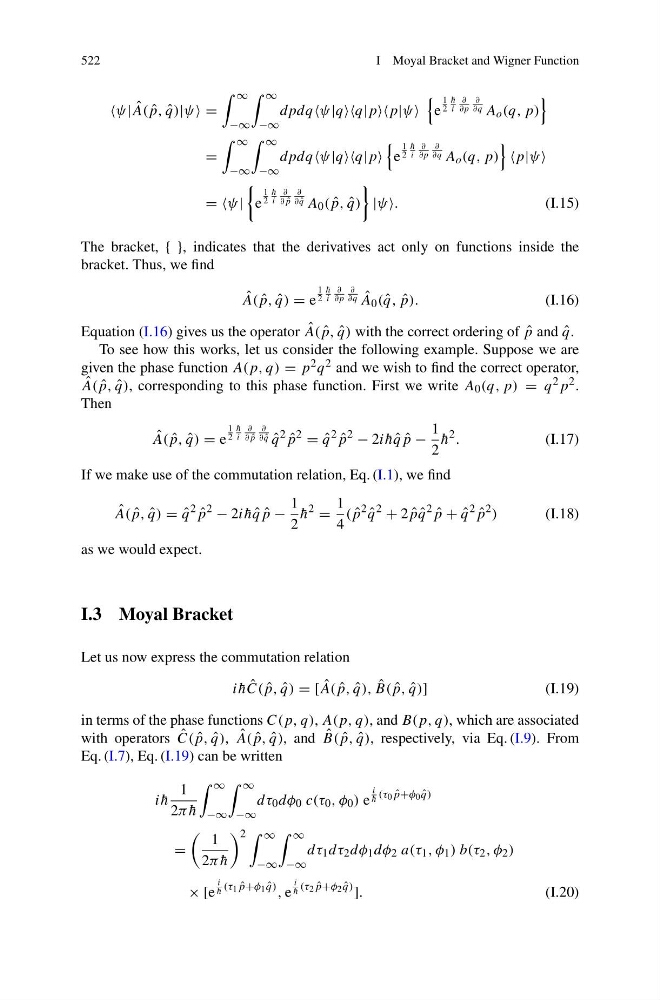
The bracket, { }, indicates that the derivatives act only on functions inside the
bracket. Thus, we find
ˆ
A( ˆ
p, ˆ
q) = e
1
2
¯
h
i
∂
∂p
∂
∂q ˆ
A 0 ( ˆ
q, ˆ
p).
(I.16)
Equation (I.16) gives us the operator ˆ
A( ˆ
p, ˆ
q) with the correct ordering of ˆ
p and ˆ
q.
To see how this works, let us consider the following example. Suppose we are
given the phase function A(p, q) = p 2 q 2 and we wish to find the correct operator,
ˆ
A( ˆ
p, ˆ
q), corresponding to this phase function. First we write A 0 (q, p) = q 2 p 2 .
Then
ˆ
A( ˆ
p, ˆ
q) = e
1
2
¯
h
i
∂
∂ ˆ
p
∂
∂ ˆ
q ˆ
q
2
ˆ
p
2
= ˆ
q
2
ˆ
p
2
− 2i ¯
h ˆ
q ˆ
p −
1
2
¯
h
2 .
(I.17)
If we make use of the commutation relation, Eq. (I.1), we find
ˆ
A( ˆ
p, ˆ
q) = ˆ
q
2
ˆ
p
2
− 2i ¯
h ˆ
q ˆ
p −
1
2
¯
h
2
=
1
4
( ˆ
p
2
ˆ
q
2
+ 2 ˆ
p ˆ
q
2
ˆ
p + ˆ
q
2
ˆ
p
2 )
(I.18)
as we would expect.
I.3 Moyal Bracket
Let us now express the commutation relation
i ¯
h ˆ
C( ˆ
p, ˆ
q) = [ ˆ
A( ˆ
p, ˆ
q), ˆ
B( ˆ
p, ˆ
q)]
(I.19)
in terms of the phase functions C(p, q), A(p, q), and B(p, q), which are associated
with operators ˆ
C( ˆ
p, ˆ
q), ˆ
A( ˆ
p, ˆ
q), and ˆ
B( ˆ
p, ˆ
q), respectively, via Eq. (I.9). From
Eq. (I.7), Eq. (I.19) can be written
i ¯
h
1
2π ¯
h
∞
−∞
∞
−∞
dτ 0 dφ 0 c(τ 0 , φ 0 ) e
i
¯
h (τ 0 ˆ
p+φ 0 ˆ
q)
=
1
2π ¯
h
2 ∞
−∞
∞
−∞
dτ 1 dτ 2 dφ 1 dφ 2 a(τ 1 , φ 1 ) b(τ 2 , φ 2 )
× [e
i
¯
h (τ 1 ˆ
p+φ 1 ˆ
q) , e
i
¯
h (τ 2 ˆ
p+φ 2 ˆ
q) ].
(I.20)
I Moyal Bracket and Wigner Function
ψ| ˆ
A( ˆ
p, ˆ
q)|ψ =
∞
−∞
∞
−∞
dpdqψ|qq|pp|ψ
e
1
2
¯
h
i
∂
∂p
∂
∂q A o (q, p)
=
∞
−∞
∞
−∞
dpdqψ|qq|p
e
1
2
¯
h
i
∂
∂p
∂
∂q A o (q, p)
p|ψ
= =ψ|
e
1
2
¯
h
i
∂
∂ ˆ
p
∂
∂ ˆ
q A 0 ( ˆ
p, ˆ
q)
|ψ.
(I.15)
The bracket, { }, indicates that the derivatives act only on functions inside the
bracket. Thus, we find
ˆ
A( ˆ
p, ˆ
q) = e
1
2
¯
h
i
∂
∂p
∂
∂q ˆ
A 0 ( ˆ
q, ˆ
p).
(I.16)
Equation (I.16) gives us the operator ˆ
A( ˆ
p, ˆ
q) with the correct ordering of ˆ
p and ˆ
q.
To see how this works, let us consider the following example. Suppose we are
given the phase function A(p, q) = p 2 q 2 and we wish to find the correct operator,
ˆ
A( ˆ
p, ˆ
q), corresponding to this phase function. First we write A 0 (q, p) = q 2 p 2 .
Then
ˆ
A( ˆ
p, ˆ
q) = e
1
2
¯
h
i
∂
∂ ˆ
p
∂
∂ ˆ
q ˆ
q
2
ˆ
p
2
= ˆ
q
2
ˆ
p
2
− 2i ¯
h ˆ
q ˆ
p −
1
2
¯
h
2 .
(I.17)
If we make use of the commutation relation, Eq. (I.1), we find
ˆ
A( ˆ
p, ˆ
q) = ˆ
q
2
ˆ
p
2
− 2i ¯
h ˆ
q ˆ
p −
1
2
¯
h
2
=
1
4
( ˆ
p
2
ˆ
q
2
+ 2 ˆ
p ˆ
q
2
ˆ
p + ˆ
q
2
ˆ
p
2 )
(I.18)
as we would expect.
I.3 Moyal Bracket
Let us now express the commutation relation
i ¯
h ˆ
C( ˆ
p, ˆ
q) = [ ˆ
A( ˆ
p, ˆ
q), ˆ
B( ˆ
p, ˆ
q)]
(I.19)
in terms of the phase functions C(p, q), A(p, q), and B(p, q), which are associated
with operators ˆ
C( ˆ
p, ˆ
q), ˆ
A( ˆ
p, ˆ
q), and ˆ
B( ˆ
p, ˆ
q), respectively, via Eq. (I.9). From
Eq. (I.7), Eq. (I.19) can be written
i ¯
h
1
2π ¯
h
∞
−∞
∞
−∞
dτ 0 dφ 0 c(τ 0 , φ 0 ) e
i
¯
h (τ 0 ˆ
p+φ 0 ˆ
q)
=
1
2π ¯
h
2 ∞
−∞
∞
−∞
dτ 1 dτ 2 dφ 1 dφ 2 a(τ 1 , φ 1 ) b(τ 2 , φ 2 )
× [e
i
¯
h (τ 1 ˆ
p+φ 1 ˆ
q) , e
i
¯
h (τ 2 ˆ
p+φ 2 ˆ
q) ].
(I.20)