

520
I Moyal Bracket and Wigner Function
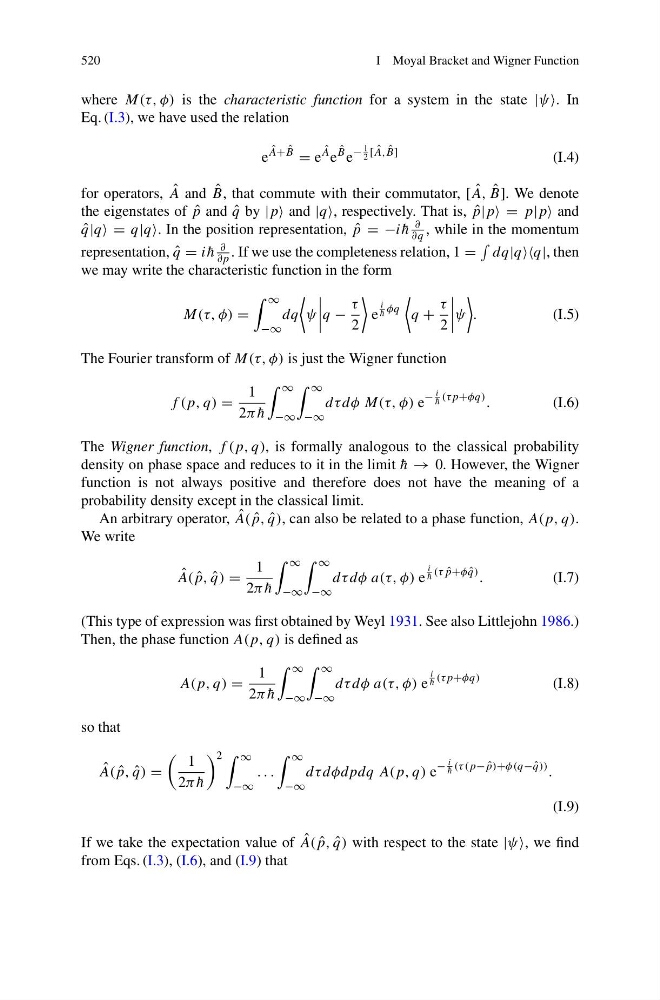
where M(τ, φ) is the characteristic function for a system in the state |ψ. In
Eq. (I.3), we have used the relation
e
ˆ
A+ ˆ
B
= e
ˆ
A e
ˆ
B e
−
1
2 [ ˆ
A, ˆ
B]
(I.4)
for operators, ˆ
A and ˆ
B, that commute with their commutator, [ ˆ
A, ˆ
B]. We denote
the eigenstates of ˆ
p and ˆ
q by |p and |q, respectively. That is, ˆ
p|p = p|p and
ˆ
q|q = q|q. In the position representation, ˆ
p = −i ¯
h
∂
∂q , while in the momentum
representation, ˆ
q = i ¯
h
∂
∂p . If we use the completeness relation, 1 =
dq|qq|, then
we may write the characteristic function in the form
M(τ, φ) =
∞
−∞
dq
ψ
q −
τ
2
e
i
¯
h φq
q +
τ
2
ψ
.
(I.5)
The Fourier transform of M(τ, φ) is just the Wigner function
f (p, q) =
1
2π ¯
h
∞
−∞
∞
−∞
dτ dφ M(τ, φ) e
−
i
¯
h (τp+φq) .
(I.6)
The Wigner function, f (p, q), is formally analogous to the classical probability
density on phase space and reduces to it in the limit ¯
h → 0. However, the Wigner
function is not always positive and therefore does not have the meaning of a
probability density except in the classical limit.
An arbitrary operator, ˆ
A( ˆ
p, ˆ
q), can also be related to a phase function, A(p, q).
We write
ˆ
A( ˆ
p, ˆ
q) =
1
2π ¯
h
∞
−∞
∞
−∞
dτ dφ a(τ, φ) e
i
¯
h (τ ˆ
p+φ ˆ
q) .
(I.7)
(This type of expression was first obtained by Weyl 1931. See also Littlejohn 1986.)
Then, the phase function A(p, q) is defined as
A(p, q) =
1
2π ¯
h
∞
−∞
∞
−∞
dτ dφ a(τ, φ) e
i
¯
h (τp+φq)
(I.8)
so that
ˆ
A( ˆ
p, ˆ
q) =
1
2π ¯
h
2 ∞
−∞
. . .
∞
−∞
dτ dφdpdq A(p, q) e
−
i
¯
h (τ (p− ˆ
p)+φ(q− ˆ
q)) .
(I.9)
If we take the expectation value of ˆ
A( ˆ
p, ˆ
q) with respect to the state |ψ, we find
from Eqs. (I.3), (I.6), and (I.9) that
I Moyal Bracket and Wigner Function
where M(τ, φ) is the characteristic function for a system in the state |ψ. In
Eq. (I.3), we have used the relation
e
ˆ
A+ ˆ
B
= e
ˆ
A e
ˆ
B e
−
1
2 [ ˆ
A, ˆ
B]
(I.4)
for operators, ˆ
A and ˆ
B, that commute with their commutator, [ ˆ
A, ˆ
B]. We denote
the eigenstates of ˆ
p and ˆ
q by |p and |q, respectively. That is, ˆ
p|p = p|p and
ˆ
q|q = q|q. In the position representation, ˆ
p = −i ¯
h
∂
∂q , while in the momentum
representation, ˆ
q = i ¯
h
∂
∂p . If we use the completeness relation, 1 =
dq|qq|, then
we may write the characteristic function in the form
M(τ, φ) =
∞
−∞
dq
ψ
q −
τ
2
e
i
¯
h φq
q +
τ
2
ψ
.
(I.5)
The Fourier transform of M(τ, φ) is just the Wigner function
f (p, q) =
1
2π ¯
h
∞
−∞
∞
−∞
dτ dφ M(τ, φ) e
−
i
¯
h (τp+φq) .
(I.6)
The Wigner function, f (p, q), is formally analogous to the classical probability
density on phase space and reduces to it in the limit ¯
h → 0. However, the Wigner
function is not always positive and therefore does not have the meaning of a
probability density except in the classical limit.
An arbitrary operator, ˆ
A( ˆ
p, ˆ
q), can also be related to a phase function, A(p, q).
We write
ˆ
A( ˆ
p, ˆ
q) =
1
2π ¯
h
∞
−∞
∞
−∞
dτ dφ a(τ, φ) e
i
¯
h (τ ˆ
p+φ ˆ
q) .
(I.7)
(This type of expression was first obtained by Weyl 1931. See also Littlejohn 1986.)
Then, the phase function A(p, q) is defined as
A(p, q) =
1
2π ¯
h
∞
−∞
∞
−∞
dτ dφ a(τ, φ) e
i
¯
h (τp+φq)
(I.8)
so that
ˆ
A( ˆ
p, ˆ
q) =
1
2π ¯
h
2 ∞
−∞
. . .
∞
−∞
dτ dφdpdq A(p, q) e
−
i
¯
h (τ (p− ˆ
p)+φ(q− ˆ
q)) .
(I.9)
If we take the expectation value of ˆ
A( ˆ
p, ˆ
q) with respect to the state |ψ, we find
from Eqs. (I.3), (I.6), and (I.9) that