

Appendix I
Moyal Bracket and Wigner Function
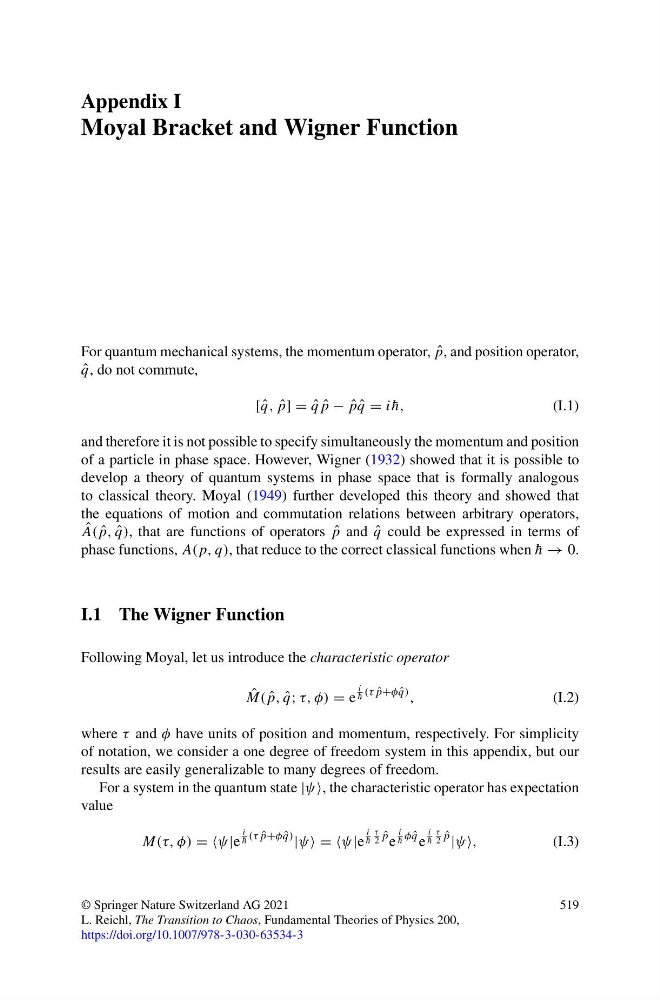
For quantum mechanical systems, the momentum operator, ˆ
p, and position operator,
ˆ
q, do not commute,
[ ˆ
q, ˆ
p] = ˆ
q ˆ
p − ˆ
p ˆ
q = i ¯
h,
(I.1)
and therefore it is not possible to specify simultaneously the momentum and position
of a particle in phase space. However, Wigner (1932) showed that it is possible to
develop a theory of quantum systems in phase space that is formally analogous
to classical theory. Moyal (1949) further developed this theory and showed that
the equations of motion and commutation relations between arbitrary operators,
ˆ
A( ˆ
p, ˆ
q), that are functions of operators ˆ
p and ˆ
q could be expressed in terms of
phase functions, A(p, q), that reduce to the correct classical functions when ¯
h → 0.
I.1 The Wigner Function
Following Moyal, let us introduce the characteristic operator
ˆ
M( ˆ
p, ˆ
q; τ, φ) = e
i
¯
h (τ ˆ
p+φ ˆ
q) ,
(I.2)
where τ and φ have units of position and momentum, respectively. For simplicity
of notation, we consider a one degree of freedom system in this appendix, but our
results are easily generalizable to many degrees of freedom.
For a system in the quantum state |ψ, the characteristic operator has expectation
value
M(τ, φ) = =ψ|e
i
¯
h (τ ˆ
p+φ ˆ
q) |ψ = =ψ|e
i
¯
h
τ
2 ˆ
p e
i
¯
h φ ˆ
q e
i
¯
h
τ
2 ˆ
p |ψ,
(I.3)
© Springer Nature Switzerland AG 2021
L. Reichl, The Transition to Chaos, Fundamental Theories of Physics 200,
https://doi.org/10.1007/978-3-030-63534-3
519
Moyal Bracket and Wigner Function
For quantum mechanical systems, the momentum operator, ˆ
p, and position operator,
ˆ
q, do not commute,
[ ˆ
q, ˆ
p] = ˆ
q ˆ
p − ˆ
p ˆ
q = i ¯
h,
(I.1)
and therefore it is not possible to specify simultaneously the momentum and position
of a particle in phase space. However, Wigner (1932) showed that it is possible to
develop a theory of quantum systems in phase space that is formally analogous
to classical theory. Moyal (1949) further developed this theory and showed that
the equations of motion and commutation relations between arbitrary operators,
ˆ
A( ˆ
p, ˆ
q), that are functions of operators ˆ
p and ˆ
q could be expressed in terms of
phase functions, A(p, q), that reduce to the correct classical functions when ¯
h → 0.
I.1 The Wigner Function
Following Moyal, let us introduce the characteristic operator
ˆ
M( ˆ
p, ˆ
q; τ, φ) = e
i
¯
h (τ ˆ
p+φ ˆ
q) ,
(I.2)
where τ and φ have units of position and momentum, respectively. For simplicity
of notation, we consider a one degree of freedom system in this appendix, but our
results are easily generalizable to many degrees of freedom.
For a system in the quantum state |ψ, the characteristic operator has expectation
value
M(τ, φ) = =ψ|e
i
¯
h (τ ˆ
p+φ ˆ
q) |ψ = =ψ|e
i
¯
h
τ
2 ˆ
p e
i
¯
h φ ˆ
q e
i
¯
h
τ
2 ˆ
p |ψ,
(I.3)
© Springer Nature Switzerland AG 2021
L. Reichl, The Transition to Chaos, Fundamental Theories of Physics 200,
https://doi.org/10.1007/978-3-030-63534-3
519