

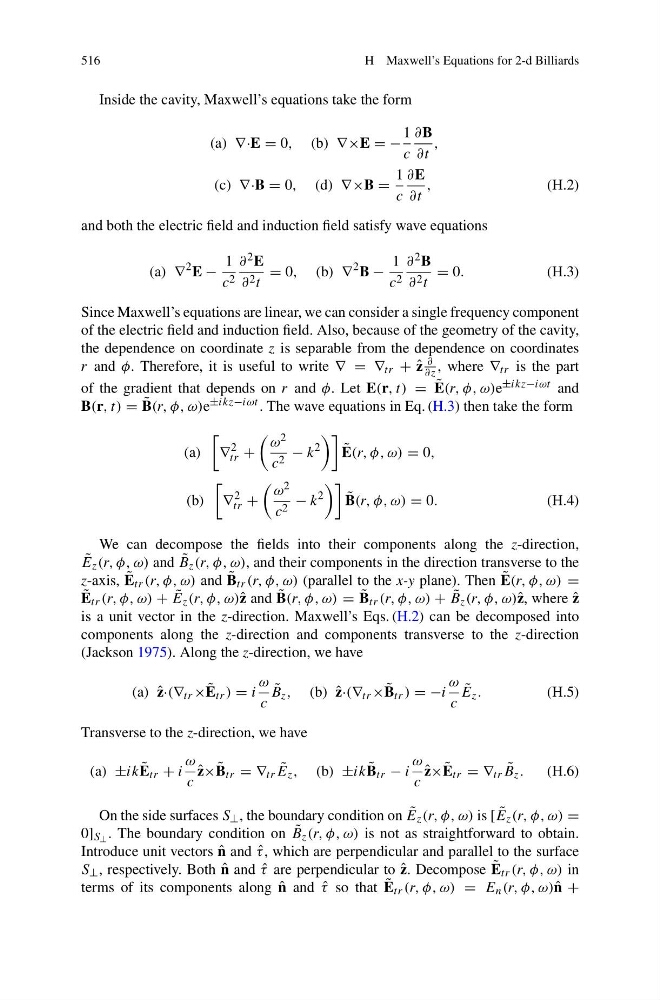
516
H Maxwell’s Equations for 2-d Billiards
Inside the cavity, Maxwell’s equations take the form
(a) ∇·E = 0, (b) ∇×E = −
1
c
∂B
∂t
,
(c) ∇·B = 0, (d) ∇×B =
1
c
∂E
∂t
,
(H.2)
and both the electric field and induction field satisfy wave equations
(a) ∇
2 E −
1
c 2
∂ 2 E
∂ 2 t
= 0, (b) ∇
2 B −
1
c 2
∂ 2 B
∂ 2 t
= 0.
(H.3)
Since Maxwell’s equations are linear, we can consider a single frequency component
of the electric field and induction field. Also, because of the geometry of the cavity,
the dependence on coordinate z is separable from the dependence on coordinates
r and φ. Therefore, it is useful to write ∇ = ∇ tr + ˆ
z
∂
∂z , where ∇ tr is the part
of the gradient that depends on r and φ. Let E(r, t) = ˜
E(r, φ, ω)e ±ikz−iωt and
B(r, t) = ˜
B(r, φ, ω)e ±ikz−iωt . The wave equations in Eq. (H.3) then take the form
(a)
∇
2
tr +
ω 2
c 2 − k
2
˜
E(r, φ, ω) = 0,
(b)
∇
2
tr +
ω 2
c 2 − k
2
˜
B(r, φ, ω) = 0.
(H.4)
We can decompose the fields into their components along the z-direction,
˜
E z (r, φ, ω) and ˜
B z (r, φ, ω), and their components in the direction transverse to the
z-axis, ˜
E tr (r, φ, ω) and ˜
B tr (r, φ, ω) (parallel to the x-y plane). Then ˜
E(r, φ, ω) =
˜
E tr (r, φ, ω) + ˜
E z (r, φ, ω)ˆ z and ˜
B(r, φ, ω) = ˜
B tr (r, φ, ω) + ˜
B z (r, φ, ω)ˆ z, where ˆ
z
is a unit vector in the z-direction. Maxwell’s Eqs. (H.2) can be decomposed into
components along the z-direction and components transverse to the z-direction
(Jackson 1975). Along the z-direction, we have
(a) ˆ
z·(∇ tr × ˜
E tr ) = i
ω
c
˜
B z , (b) ˆ
z·(∇ tr × ˜
B tr ) = −i
ω
c
˜
E z .
(H.5)
Transverse to the z-direction, we have
(a) ±ik ˜
E tr + i
ω
c
ˆ
z× ˜
B tr = ∇ tr ˜
E z , (b) ±ik ˜
B tr − i
ω
c
ˆ
z× ˜
E tr = ∇ tr ˜
B z .
(H.6)
On the side surfaces S ⊥ , the boundary condition on ˜
E z (r, φ, ω) is [ ˜
E z (r, φ, ω) =
0] S ⊥ . The boundary condition on ˜
B z (r, φ, ω) is not as straightforward to obtain.
Introduce unit vectors ˆ
n and ˆ
τ , which are perpendicular and parallel to the surface
S ⊥ , respectively. Both ˆ
n and ˆ
τ are perpendicular to ˆ
z. Decompose ˜
E tr (r, φ, ω) in
terms of its components along ˆ
n and ˆ
τ so that ˜
E tr (r, φ, ω) = E n (r, φ, ω)ˆ n +
H Maxwell’s Equations for 2-d Billiards
Inside the cavity, Maxwell’s equations take the form
(a) ∇·E = 0, (b) ∇×E = −
1
c
∂B
∂t
,
(c) ∇·B = 0, (d) ∇×B =
1
c
∂E
∂t
,
(H.2)
and both the electric field and induction field satisfy wave equations
(a) ∇
2 E −
1
c 2
∂ 2 E
∂ 2 t
= 0, (b) ∇
2 B −
1
c 2
∂ 2 B
∂ 2 t
= 0.
(H.3)
Since Maxwell’s equations are linear, we can consider a single frequency component
of the electric field and induction field. Also, because of the geometry of the cavity,
the dependence on coordinate z is separable from the dependence on coordinates
r and φ. Therefore, it is useful to write ∇ = ∇ tr + ˆ
z
∂
∂z , where ∇ tr is the part
of the gradient that depends on r and φ. Let E(r, t) = ˜
E(r, φ, ω)e ±ikz−iωt and
B(r, t) = ˜
B(r, φ, ω)e ±ikz−iωt . The wave equations in Eq. (H.3) then take the form
(a)
∇
2
tr +
ω 2
c 2 − k
2
˜
E(r, φ, ω) = 0,
(b)
∇
2
tr +
ω 2
c 2 − k
2
˜
B(r, φ, ω) = 0.
(H.4)
We can decompose the fields into their components along the z-direction,
˜
E z (r, φ, ω) and ˜
B z (r, φ, ω), and their components in the direction transverse to the
z-axis, ˜
E tr (r, φ, ω) and ˜
B tr (r, φ, ω) (parallel to the x-y plane). Then ˜
E(r, φ, ω) =
˜
E tr (r, φ, ω) + ˜
E z (r, φ, ω)ˆ z and ˜
B(r, φ, ω) = ˜
B tr (r, φ, ω) + ˜
B z (r, φ, ω)ˆ z, where ˆ
z
is a unit vector in the z-direction. Maxwell’s Eqs. (H.2) can be decomposed into
components along the z-direction and components transverse to the z-direction
(Jackson 1975). Along the z-direction, we have
(a) ˆ
z·(∇ tr × ˜
E tr ) = i
ω
c
˜
B z , (b) ˆ
z·(∇ tr × ˜
B tr ) = −i
ω
c
˜
E z .
(H.5)
Transverse to the z-direction, we have
(a) ±ik ˜
E tr + i
ω
c
ˆ
z× ˜
B tr = ∇ tr ˜
E z , (b) ±ik ˜
B tr − i
ω
c
ˆ
z× ˜
E tr = ∇ tr ˜
B z .
(H.6)
On the side surfaces S ⊥ , the boundary condition on ˜
E z (r, φ, ω) is [ ˜
E z (r, φ, ω) =
0] S ⊥ . The boundary condition on ˜
B z (r, φ, ω) is not as straightforward to obtain.
Introduce unit vectors ˆ
n and ˆ
τ , which are perpendicular and parallel to the surface
S ⊥ , respectively. Both ˆ
n and ˆ
τ are perpendicular to ˆ
z. Decompose ˜
E tr (r, φ, ω) in
terms of its components along ˆ
n and ˆ
τ so that ˜
E tr (r, φ, ω) = E n (r, φ, ω)ˆ n +