

Appendix H
Maxwell’s Equations for 2-d Billiards
In this appendix, we derive the conditions for which electromagnetic modes in a
microwave cavity behave in a manner identical to a quantum particle in a cavity of
the same shape.
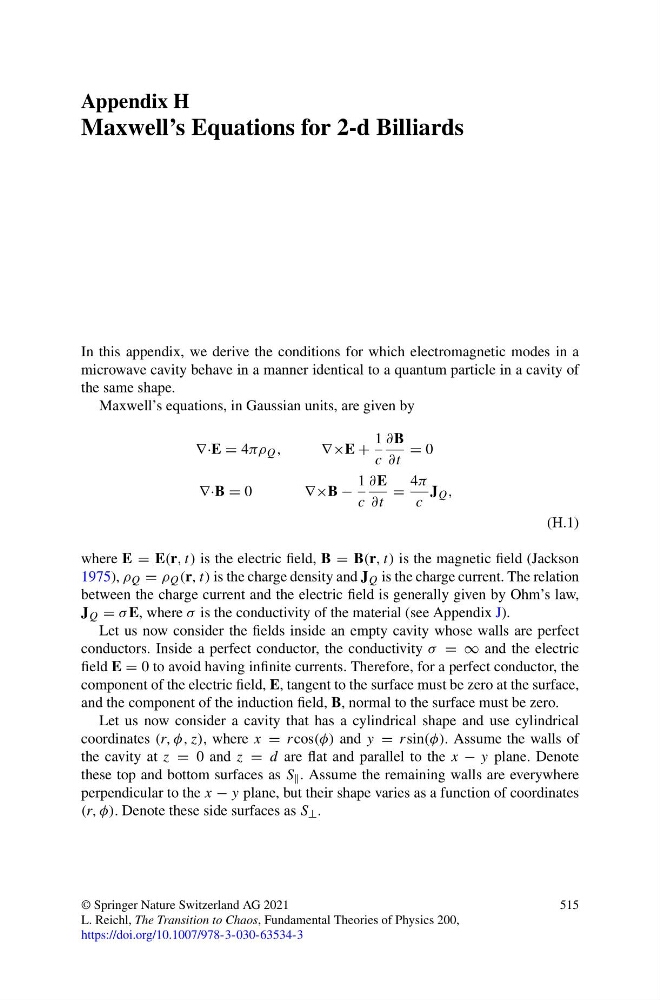
Maxwell’s equations, in Gaussian units, are given by
∇·E = 4πρ Q ,
∇×E +
1
c
∂B
∂t
= 0
∇·B = 0
∇×B −
1
c
∂E
∂t
=
4π
c
J Q ,
(H.1)
where E = E(r, t) is the electric field, B = B(r, t) is the magnetic field (Jackson
1975), ρ Q = ρ Q (r, t) is the charge density and J Q is the charge current. The relation
between the charge current and the electric field is generally given by Ohm’s law,
J Q = σ E, where σ is the conductivity of the material (see Appendix J).
Let us now consider the fields inside an empty cavity whose walls are perfect
conductors. Inside a perfect conductor, the conductivity σ = ∞ and the electric
field E = 0 to avoid having infinite currents. Therefore, for a perfect conductor, the
component of the electric field, E, tangent to the surface must be zero at the surface,
and the component of the induction field, B, normal to the surface must be zero.
Let us now consider a cavity that has a cylindrical shape and use cylindrical
coordinates (r, φ, z), where x = rcos(φ) and y = rsin(φ). Assume the walls of
the cavity at z = 0 and z = d are flat and parallel to the x − y plane. Denote
these top and bottom surfaces as S . Assume the remaining walls are everywhere
perpendicular to the x − y plane, but their shape varies as a function of coordinates
(r, φ). Denote these side surfaces as S ⊥ .
© Springer Nature Switzerland AG 2021
L. Reichl, The Transition to Chaos, Fundamental Theories of Physics 200,
https://doi.org/10.1007/978-3-030-63534-3
515
Maxwell’s Equations for 2-d Billiards
In this appendix, we derive the conditions for which electromagnetic modes in a
microwave cavity behave in a manner identical to a quantum particle in a cavity of
the same shape.
Maxwell’s equations, in Gaussian units, are given by
∇·E = 4πρ Q ,
∇×E +
1
c
∂B
∂t
= 0
∇·B = 0
∇×B −
1
c
∂E
∂t
=
4π
c
J Q ,
(H.1)
where E = E(r, t) is the electric field, B = B(r, t) is the magnetic field (Jackson
1975), ρ Q = ρ Q (r, t) is the charge density and J Q is the charge current. The relation
between the charge current and the electric field is generally given by Ohm’s law,
J Q = σ E, where σ is the conductivity of the material (see Appendix J).
Let us now consider the fields inside an empty cavity whose walls are perfect
conductors. Inside a perfect conductor, the conductivity σ = ∞ and the electric
field E = 0 to avoid having infinite currents. Therefore, for a perfect conductor, the
component of the electric field, E, tangent to the surface must be zero at the surface,
and the component of the induction field, B, normal to the surface must be zero.
Let us now consider a cavity that has a cylindrical shape and use cylindrical
coordinates (r, φ, z), where x = rcos(φ) and y = rsin(φ). Assume the walls of
the cavity at z = 0 and z = d are flat and parallel to the x − y plane. Denote
these top and bottom surfaces as S . Assume the remaining walls are everywhere
perpendicular to the x − y plane, but their shape varies as a function of coordinates
(r, φ). Denote these side surfaces as S ⊥ .
© Springer Nature Switzerland AG 2021
L. Reichl, The Transition to Chaos, Fundamental Theories of Physics 200,
https://doi.org/10.1007/978-3-030-63534-3
515