

H.1 Transverse Magnetic Modes
517
E τ (r, φ, ω) ˆ
τ . Similarly, ˜
B tr (r, φ, ω) = B n (r, φ, ω)ˆ n + B τ (r, φ, ω) ˆ
τ . Substitute in
Eq. (H.6.b) and take the dot product of the resulting equation with unit vector ˆ
n. The
result is
±ikB n − i
ω
c
E τ =
∂B z
∂n
.
(H.7)
However, on the surface S ⊥ , [B n ] S ⊥ = 0 and [E τ ] S ⊥ = 0. This gives [
∂ ˜
B z
∂n ] S ⊥ = 0.
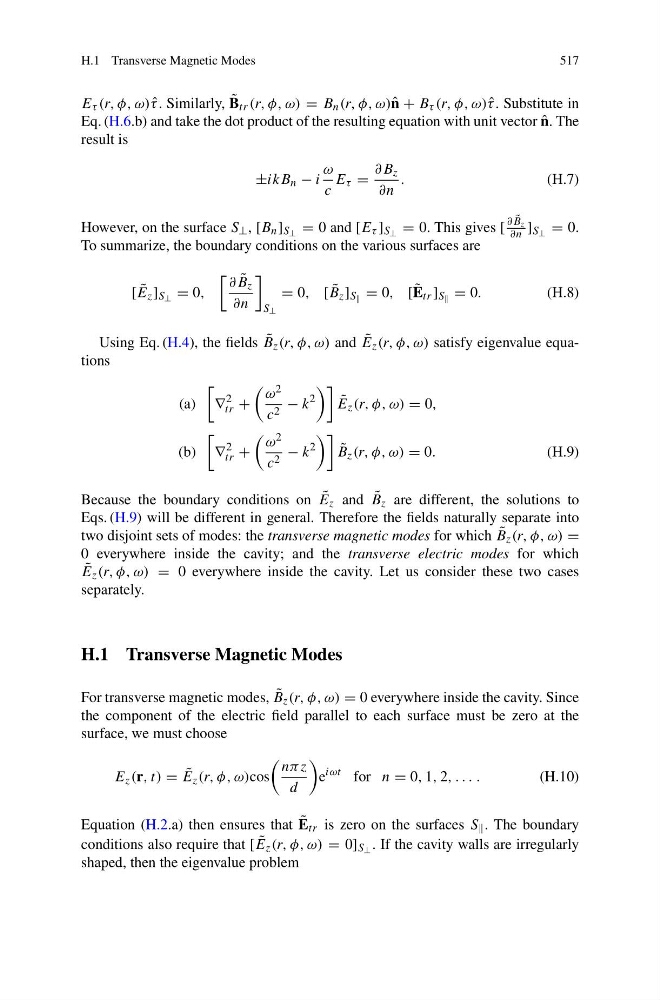
To summarize, the boundary conditions on the various surfaces are
[ ˜
E z ] S ⊥ = 0,
∂ ˜
B z
∂n
S ⊥
= 0, [ ˜
B z ] S = 0, [ ˜
E tr ] S = 0.
(H.8)
Using Eq. (H.4), the fields ˜
B z (r, φ, ω) and ˜
E z (r, φ, ω) satisfy eigenvalue equations
(a)
∇
2
tr +
ω 2
c 2 − k
2
˜
E z (r, φ, ω) = 0,
(b)
∇
2
tr +
ω 2
c 2 − k
2
˜
B z (r, φ, ω) = 0.
(H.9)
Because the boundary conditions on ˜
E z and ˜
B z are different, the solutions to
Eqs. (H.9) will be different in general. Therefore the fields naturally separate into
two disjoint sets of modes: the transverse magnetic modes for which ˜
B z (r, φ, ω) =
0 everywhere inside the cavity; and the transverse electric modes for which
˜
E z (r, φ, ω) = 0 everywhere inside the cavity. Let us consider these two cases
separately.
H.1 Transverse Magnetic Modes
For transverse magnetic modes, ˜
B z (r, φ, ω) = 0 everywhere inside the cavity. Since
the component of the electric field parallel to each surface must be zero at the
surface, we must choose
E z (r, t) = ˜
E z (r, φ, ω)cos
nπ z
d
e
iωt for n = 0, 1, 2, . . . .
(H.10)
Equation (H.2.a) then ensures that ˜
E tr is zero on the surfaces S . The boundary
conditions also require that [ ˜
E z (r, φ, ω) = 0] S ⊥ . If the cavity walls are irregularly
shaped, then the eigenvalue problem
517
E τ (r, φ, ω) ˆ
τ . Similarly, ˜
B tr (r, φ, ω) = B n (r, φ, ω)ˆ n + B τ (r, φ, ω) ˆ
τ . Substitute in
Eq. (H.6.b) and take the dot product of the resulting equation with unit vector ˆ
n. The
result is
±ikB n − i
ω
c
E τ =
∂B z
∂n
.
(H.7)
However, on the surface S ⊥ , [B n ] S ⊥ = 0 and [E τ ] S ⊥ = 0. This gives [
∂ ˜
B z
∂n ] S ⊥ = 0.
To summarize, the boundary conditions on the various surfaces are
[ ˜
E z ] S ⊥ = 0,
∂ ˜
B z
∂n
S ⊥
= 0, [ ˜
B z ] S = 0, [ ˜
E tr ] S = 0.
(H.8)
Using Eq. (H.4), the fields ˜
B z (r, φ, ω) and ˜
E z (r, φ, ω) satisfy eigenvalue equations
(a)
∇
2
tr +
ω 2
c 2 − k
2
˜
E z (r, φ, ω) = 0,
(b)
∇
2
tr +
ω 2
c 2 − k
2
˜
B z (r, φ, ω) = 0.
(H.9)
Because the boundary conditions on ˜
E z and ˜
B z are different, the solutions to
Eqs. (H.9) will be different in general. Therefore the fields naturally separate into
two disjoint sets of modes: the transverse magnetic modes for which ˜
B z (r, φ, ω) =
0 everywhere inside the cavity; and the transverse electric modes for which
˜
E z (r, φ, ω) = 0 everywhere inside the cavity. Let us consider these two cases
separately.
H.1 Transverse Magnetic Modes
For transverse magnetic modes, ˜
B z (r, φ, ω) = 0 everywhere inside the cavity. Since
the component of the electric field parallel to each surface must be zero at the
surface, we must choose
E z (r, t) = ˜
E z (r, φ, ω)cos
nπ z
d
e
iωt for n = 0, 1, 2, . . . .
(H.10)
Equation (H.2.a) then ensures that ˜
E tr is zero on the surfaces S . The boundary
conditions also require that [ ˜
E z (r, φ, ω) = 0] S ⊥ . If the cavity walls are irregularly
shaped, then the eigenvalue problem