

G.3 Circular Orthogonal Ensemble (COE)
497
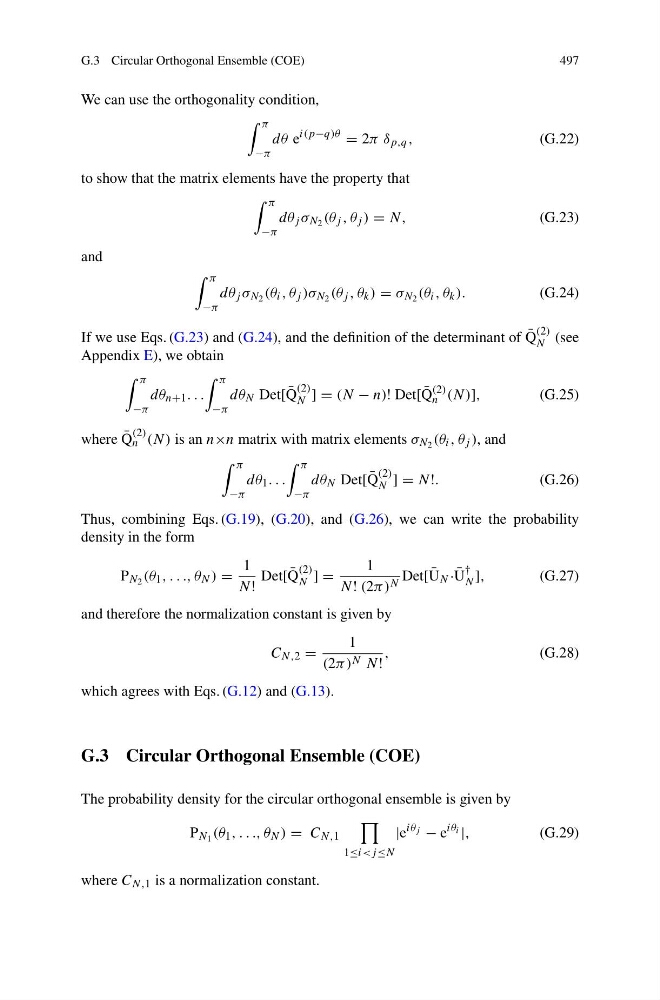
We can use the orthogonality condition,
π
−π
dθ e
i(p−q)θ
= 2π δ p,q ,
(G.22)
to show that the matrix elements have the property that
π
−π
dθ j σ N 2 (θ j , θ j ) = N,
(G.23)
and
π
−π
dθ j σ N 2 (θ i , θ j )σ N 2 (θ j , θ k ) = σ N 2 (θ i , θ k ).
(G.24)
If we use Eqs. (G.23) and (G.24), and the definition of the determinant of ¯
Q
(2)
N (see
Appendix E), we obtain
π
−π
dθ n+1 . . .
π
−π
dθ N Det[ ¯
Q
(2)
N ] = (N − n)! Det[ ¯
Q
(2)
n (N)],
(G.25)
where ¯
Q
(2)
n (N) is an n×n matrix with matrix elements σ N 2 (θ i , θ j ), and
π
−π
dθ 1 . . .
π
−π
dθ N Det[ ¯
Q
(2)
N ] = N!.
(G.26)
Thus, combining Eqs. (G.19), (G.20), and (G.26), we can write the probability
density in the form
P N 2 (θ 1 , . . ., θ N ) =
1
N!
Det[ ¯
Q
(2)
N ] =
1
N! (2π) N Det[ ¯
U N · ¯
U
†
N ],
(G.27)
and therefore the normalization constant is given by
C N,2 =
1
(2π) N N!
,
(G.28)
which agrees with Eqs. (G.12) and (G.13).
G.3 Circular Orthogonal Ensemble (COE)
The probability density for the circular orthogonal ensemble is given by
P N 1 (θ 1 , . . ., θ N ) = C N,1
1≤i
iθ j − e
iθ i |,
(G.29)
where C N,1 is a normalization constant.
497
We can use the orthogonality condition,
π
−π
dθ e
i(p−q)θ
= 2π δ p,q ,
(G.22)
to show that the matrix elements have the property that
π
−π
dθ j σ N 2 (θ j , θ j ) = N,
(G.23)
and
π
−π
dθ j σ N 2 (θ i , θ j )σ N 2 (θ j , θ k ) = σ N 2 (θ i , θ k ).
(G.24)
If we use Eqs. (G.23) and (G.24), and the definition of the determinant of ¯
Q
(2)
N (see
Appendix E), we obtain
π
−π
dθ n+1 . . .
π
−π
dθ N Det[ ¯
Q
(2)
N ] = (N − n)! Det[ ¯
Q
(2)
n (N)],
(G.25)
where ¯
Q
(2)
n (N) is an n×n matrix with matrix elements σ N 2 (θ i , θ j ), and
π
−π
dθ 1 . . .
π
−π
dθ N Det[ ¯
Q
(2)
N ] = N!.
(G.26)
Thus, combining Eqs. (G.19), (G.20), and (G.26), we can write the probability
density in the form
P N 2 (θ 1 , . . ., θ N ) =
1
N!
Det[ ¯
Q
(2)
N ] =
1
N! (2π) N Det[ ¯
U N · ¯
U
†
N ],
(G.27)
and therefore the normalization constant is given by
C N,2 =
1
(2π) N N!
,
(G.28)
which agrees with Eqs. (G.12) and (G.13).
G.3 Circular Orthogonal Ensemble (COE)
The probability density for the circular orthogonal ensemble is given by
P N 1 (θ 1 , . . ., θ N ) = C N,1
1≤i
iθ j − e
iθ i |,
(G.29)
where C N,1 is a normalization constant.