

F.1 Gaussian Orthogonal Ensemble (GOE)
473
and
all
dx 1 . . .
all
dx N Qdet[ ¯
Q N ] = N! ¯
1
(F.27)
where
all dx j =
∞
−∞ dx j .
F.1.2 Cluster Functions for GOE
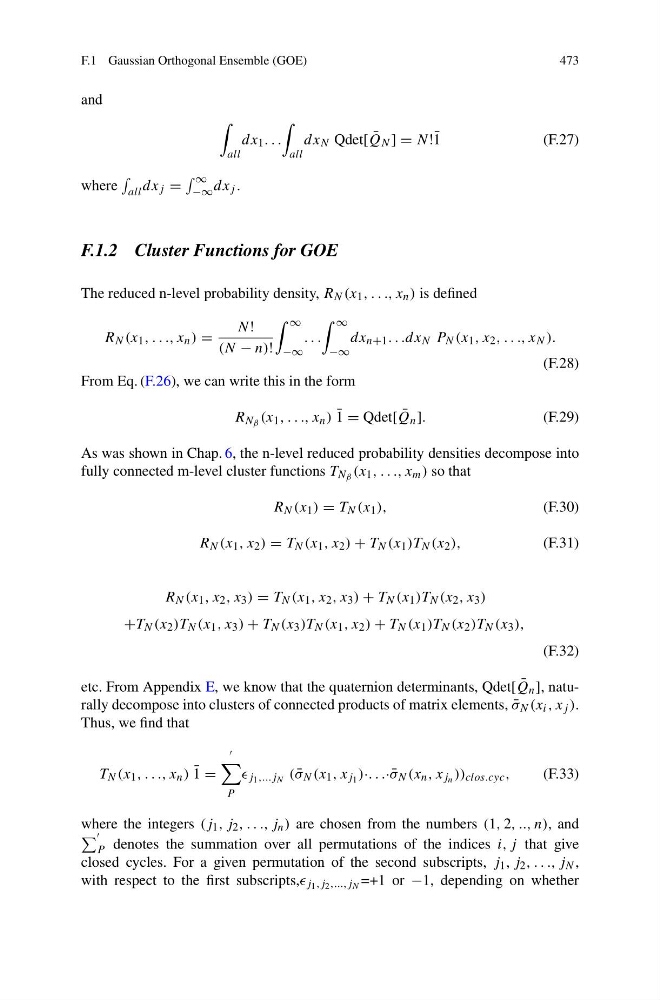
The reduced n-level probability density, R N (x 1 , . . ., x n ) is defined
R N (x 1 , . . ., x n ) =
N!
(N − n)!
∞
−∞
. . .
∞
−∞
dx n+1 . . .dx N P N (x 1 , x 2 , . . ., x N ).
(F.28)
From Eq. (F.26), we can write this in the form
R N β (x 1 , . . ., x n ) ¯
1 = Qdet[ ¯
Q n ].
(F.29)
As was shown in Chap. 6, the n-level reduced probability densities decompose into
fully connected m-level cluster functions T N β (x 1 , . . ., x m ) so that
R N (x 1 ) = T N (x 1 ),
(F.30)
R N (x 1 , x 2 ) = T N (x 1 , x 2 ) + T N (x 1 )T N (x 2 ),
(F.31)
R N (x 1 , x 2 , x 3 ) = T N (x 1 , x 2 , x 3 ) + T N (x 1 )T N (x 2 , x 3 )
+T N (x 2 )T N (x 1 , x 3 ) + T N (x 3 )T N (x 1 , x 2 ) + T N (x 1 )T N (x 2 )T N (x 3 ),
(F.32)
etc. From Appendix E, we know that the quaternion determinants, Qdet[ ¯
Q n ], naturally decompose into clusters of connected products of matrix elements, ¯
σ N (x i , x j ).
Thus, we find that
T N (x 1 , . . ., x n ) ¯
1 =
P
j 1 ,...j N ( ¯
σ N (x 1 , x j 1 )·. . .· ¯
σ N (x n , x j n )) clos.cyc ,
(F.33)
where the integers (j 1 , j 2 , . . ., j n ) are chosen from the numbers (1, 2, .., n), and
P denotes the summation over all permutations of the indices i, j that give
closed cycles. For a given permutation of the second subscripts, j 1 , j 2 , . . ., j N ,
with respect to the first subscripts, j 1 ,j 2 ,...,j N =+1 or −1, depending on whether
473
and
all
dx 1 . . .
all
dx N Qdet[ ¯
Q N ] = N! ¯
1
(F.27)
where
all dx j =
∞
−∞ dx j .
F.1.2 Cluster Functions for GOE
The reduced n-level probability density, R N (x 1 , . . ., x n ) is defined
R N (x 1 , . . ., x n ) =
N!
(N − n)!
∞
−∞
. . .
∞
−∞
dx n+1 . . .dx N P N (x 1 , x 2 , . . ., x N ).
(F.28)
From Eq. (F.26), we can write this in the form
R N β (x 1 , . . ., x n ) ¯
1 = Qdet[ ¯
Q n ].
(F.29)
As was shown in Chap. 6, the n-level reduced probability densities decompose into
fully connected m-level cluster functions T N β (x 1 , . . ., x m ) so that
R N (x 1 ) = T N (x 1 ),
(F.30)
R N (x 1 , x 2 ) = T N (x 1 , x 2 ) + T N (x 1 )T N (x 2 ),
(F.31)
R N (x 1 , x 2 , x 3 ) = T N (x 1 , x 2 , x 3 ) + T N (x 1 )T N (x 2 , x 3 )
+T N (x 2 )T N (x 1 , x 3 ) + T N (x 3 )T N (x 1 , x 2 ) + T N (x 1 )T N (x 2 )T N (x 3 ),
(F.32)
etc. From Appendix E, we know that the quaternion determinants, Qdet[ ¯
Q n ], naturally decompose into clusters of connected products of matrix elements, ¯
σ N (x i , x j ).
Thus, we find that
T N (x 1 , . . ., x n ) ¯
1 =
P
j 1 ,...j N ( ¯
σ N (x 1 , x j 1 )·. . .· ¯
σ N (x n , x j n )) clos.cyc ,
(F.33)
where the integers (j 1 , j 2 , . . ., j n ) are chosen from the numbers (1, 2, .., n), and
P denotes the summation over all permutations of the indices i, j that give
closed cycles. For a given permutation of the second subscripts, j 1 , j 2 , . . ., j N ,
with respect to the first subscripts, j 1 ,j 2 ,...,j N =+1 or −1, depending on whether