

474
F Gaussian Ensembles
the number permutations needed to change the sequence j 1 , j 2 , . . ., j N back to the
natural sequence 1,2,. . . ,N, is even or odd. For example,
T N (x 1 ) ¯
1 = ¯
σ N (x 1 , x 1 ),
(F.34)
T N (x 1 , x 2 ) ¯
1 = − ¯
σ N (x 1 , x 2 )·σ N (x 2 , x 1 ),
(F.35)
and
T N (x 1 , x 2 , x 3 ) ¯
1 = ¯
σ N (x 1 , x 2 )·σ N (x 2 , x 3 )·σ N (x 3 , x 1 )
− ¯
σ N (x 1 , x 3 )·σ N (x 3 , x 2 )·σ N (x 2 , x 1 ).
(F.36)
In this way, we have obtained expressions for the cluster expansions of the
probability densities for the GOE in terms of functions involving harmonic oscillator
eigenstates.
F.2 Gaussian Unitary Ensemble (GUE)
The Gaussian Unitary Ensemble describes the statistical properties of quantum
systems whose dynamics is governed by complex Hermitian Hamiltonians. The
dynamics of such systems is rotationally invariant but not time reversal invariant
(for example—systems with applied magnetic fields).
F.2.1 Complex Hermitian Matrices and Invariant Measure
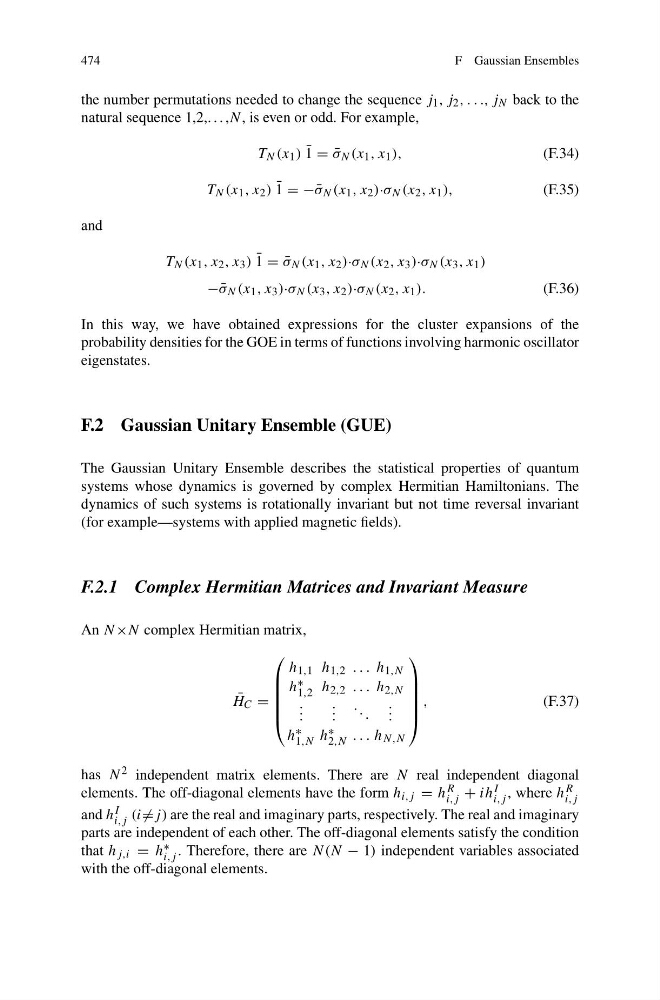
An N ×N complex Hermitian matrix,
¯
H C =
⎛
⎜
⎜
⎜
⎜
⎝
h 1,1 h 1,2 . . . h 1,N
h ∗
1,2 h 2,2 . . . h 2,N
. . .
. . .
. . .
. . .
h ∗
1,N h ∗
2,N . . . h N,N
⎞
⎟
⎟
⎟
⎟
⎠
,
(F.37)
has N 2 independent matrix elements. There are N real independent diagonal
elements. The off-diagonal elements have the form h i,j = h R
i,j + ih I
i,j , where h R
i,j
and h I
i,j (i =j ) are the real and imaginary parts, respectively. The real and imaginary
parts are independent of each other. The off-diagonal elements satisfy the condition
that h j,i = h ∗
i,j . Therefore, there are N(N − 1) independent variables associated
with the off-diagonal elements.
F Gaussian Ensembles
the number permutations needed to change the sequence j 1 , j 2 , . . ., j N back to the
natural sequence 1,2,. . . ,N, is even or odd. For example,
T N (x 1 ) ¯
1 = ¯
σ N (x 1 , x 1 ),
(F.34)
T N (x 1 , x 2 ) ¯
1 = − ¯
σ N (x 1 , x 2 )·σ N (x 2 , x 1 ),
(F.35)
and
T N (x 1 , x 2 , x 3 ) ¯
1 = ¯
σ N (x 1 , x 2 )·σ N (x 2 , x 3 )·σ N (x 3 , x 1 )
− ¯
σ N (x 1 , x 3 )·σ N (x 3 , x 2 )·σ N (x 2 , x 1 ).
(F.36)
In this way, we have obtained expressions for the cluster expansions of the
probability densities for the GOE in terms of functions involving harmonic oscillator
eigenstates.
F.2 Gaussian Unitary Ensemble (GUE)
The Gaussian Unitary Ensemble describes the statistical properties of quantum
systems whose dynamics is governed by complex Hermitian Hamiltonians. The
dynamics of such systems is rotationally invariant but not time reversal invariant
(for example—systems with applied magnetic fields).
F.2.1 Complex Hermitian Matrices and Invariant Measure
An N ×N complex Hermitian matrix,
¯
H C =
⎛
⎜
⎜
⎜
⎜
⎝
h 1,1 h 1,2 . . . h 1,N
h ∗
1,2 h 2,2 . . . h 2,N
. . .
. . .
. . .
. . .
h ∗
1,N h ∗
2,N . . . h N,N
⎞
⎟
⎟
⎟
⎟
⎠
,
(F.37)
has N 2 independent matrix elements. There are N real independent diagonal
elements. The off-diagonal elements have the form h i,j = h R
i,j + ih I
i,j , where h R
i,j
and h I
i,j (i =j ) are the real and imaginary parts, respectively. The real and imaginary
parts are independent of each other. The off-diagonal elements satisfy the condition
that h j,i = h ∗
i,j . Therefore, there are N(N − 1) independent variables associated
with the off-diagonal elements.