

472
F Gaussian Ensembles
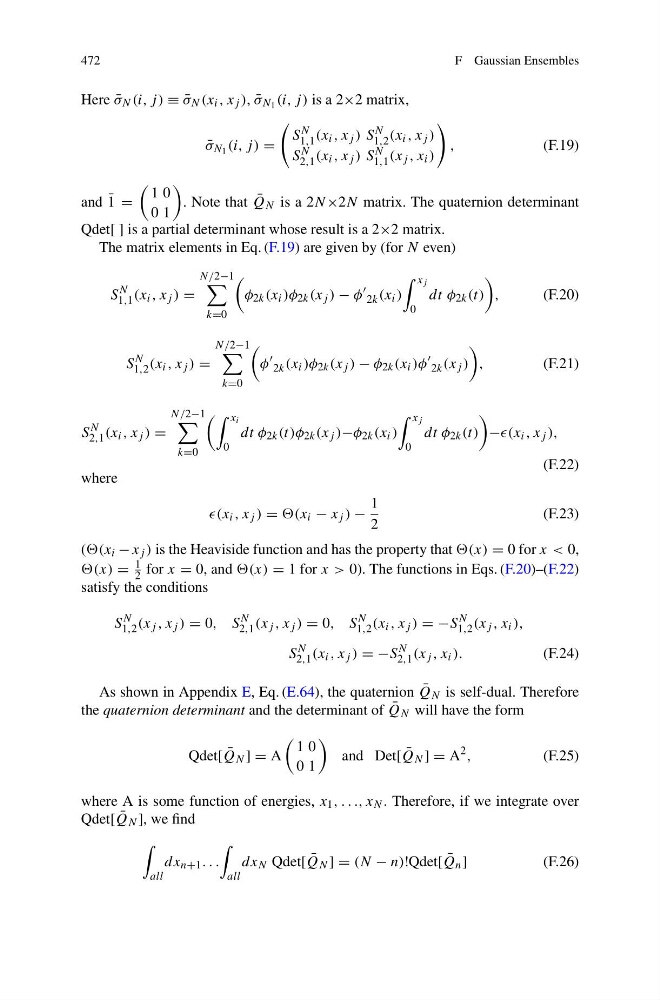
Here ¯
σ N (i, j ) ≡ ¯
σ N (x i , x j ), ¯
σ N 1 (i, j ) is a 2×2 matrix,
¯
σ N 1 (i, j ) =
S N
1,1 (x i , x j ) S N
1,2 (x i , x j )
S N
2,1 (x i , x j ) S N
1,1 (x j , x i )
,
(F.19)
and ¯
1 =
1 0
0 1
. Note that ¯
Q N is a 2N×2N matrix. The quaternion determinant
Qdet[ ] is a partial determinant whose result is a 2×2 matrix.
The matrix elements in Eq. (F.19) are given by (for N even)
S
N
1,1 (x i , x j ) =
N/2−1
k=0
φ 2k (x i )φ 2k (x j ) − φ
2k (x i )
x j
0
dt φ 2k (t)
,
(F.20)
S
N
1,2 (x i , x j ) =
N/2−1
k=0
φ
2k (x i )φ 2k (x j ) − φ 2k (x i )φ
2k (x j )
,
(F.21)
S
N
2,1 (x i , x j ) =
N/2−1
k=0
x i
0
dt φ 2k (t)φ 2k (x j )−φ 2k (x i )
x j
0
dt φ 2k (t)
− i , x j ),
(F.22)
where
i , x j ) = i − x j ) −
1
2
(F.23)
( i − x j ) is the Heaviside function and has the property that = 0 for x < 0,
=
1
2 for x = 0, and = 1 for x > 0). The functions in Eqs. (F.20)–(F.22)
satisfy the conditions
S
N
1,2 (x j , x j ) = 0, S
N
2,1 (x j , x j ) = 0, S
N
1,2 (x i , x j ) = −S
N
1,2 (x j , x i ),
S
N
2,1 (x i , x j ) = −S
N
2,1 (x j , x i ).
(F.24)
As shown in Appendix E, Eq. (E.64), the quaternion ¯
Q N is self-dual. Therefore
the quaternion determinant and the determinant of ¯
Q N will have the form
Qdet[ ¯
Q N ] = A
1 0
0 1
and Det[ ¯
Q N ] = A
2 ,
(F.25)
where A is some function of energies, x 1 , . . ., x N . Therefore, if we integrate over
Qdet[ ¯
Q N ], we find
all
dx n+1 . . .
all
dx N Qdet[ ¯
Q N ] = (N − n)!Qdet[ ¯
Q n ]
(F.26)
F Gaussian Ensembles
Here ¯
σ N (i, j ) ≡ ¯
σ N (x i , x j ), ¯
σ N 1 (i, j ) is a 2×2 matrix,
¯
σ N 1 (i, j ) =
S N
1,1 (x i , x j ) S N
1,2 (x i , x j )
S N
2,1 (x i , x j ) S N
1,1 (x j , x i )
,
(F.19)
and ¯
1 =
1 0
0 1
. Note that ¯
Q N is a 2N×2N matrix. The quaternion determinant
Qdet[ ] is a partial determinant whose result is a 2×2 matrix.
The matrix elements in Eq. (F.19) are given by (for N even)
S
N
1,1 (x i , x j ) =
N/2−1
k=0
φ 2k (x i )φ 2k (x j ) − φ
2k (x i )
x j
0
dt φ 2k (t)
,
(F.20)
S
N
1,2 (x i , x j ) =
N/2−1
k=0
φ
2k (x i )φ 2k (x j ) − φ 2k (x i )φ
2k (x j )
,
(F.21)
S
N
2,1 (x i , x j ) =
N/2−1
k=0
x i
0
dt φ 2k (t)φ 2k (x j )−φ 2k (x i )
x j
0
dt φ 2k (t)
− i , x j ),
(F.22)
where
i , x j ) = i − x j ) −
1
2
(F.23)
( i − x j ) is the Heaviside function and has the property that = 0 for x < 0,
=
1
2 for x = 0, and = 1 for x > 0). The functions in Eqs. (F.20)–(F.22)
satisfy the conditions
S
N
1,2 (x j , x j ) = 0, S
N
2,1 (x j , x j ) = 0, S
N
1,2 (x i , x j ) = −S
N
1,2 (x j , x i ),
S
N
2,1 (x i , x j ) = −S
N
2,1 (x j , x i ).
(F.24)
As shown in Appendix E, Eq. (E.64), the quaternion ¯
Q N is self-dual. Therefore
the quaternion determinant and the determinant of ¯
Q N will have the form
Qdet[ ¯
Q N ] = A
1 0
0 1
and Det[ ¯
Q N ] = A
2 ,
(F.25)
where A is some function of energies, x 1 , . . ., x N . Therefore, if we integrate over
Qdet[ ¯
Q N ], we find
all
dx n+1 . . .
all
dx N Qdet[ ¯
Q N ] = (N − n)!Qdet[ ¯
Q n ]
(F.26)