

F.1 Gaussian Orthogonal Ensemble (GOE)
469
2. Multiplying the determinant by a constant is equivalent to multiplying each
member of one row or each member of one column by that constant.
3. If Det[ ¯
B] is obtained from Det[ ¯
A] by interchanging a row (or column) of Det[ ¯
A],
then Det[ ¯
B] = −Det[ ¯
A].
4. If two rows (or two columns) of Det[ ¯
A] are identical, then Det[ ¯
A] = 0.
5. The value of a determinant is unchanged if a multiple of one row is added to
another row or if a multiple of one column is added to another column.
6. If Det[ ¯
B] is obtained from Det[ ¯
A] by adding to one row (column) of Det[ ¯
A]
a scalar multiple of the corresponding elements of another row (column), then
Det[ ¯
B] = Det[ ¯
A].
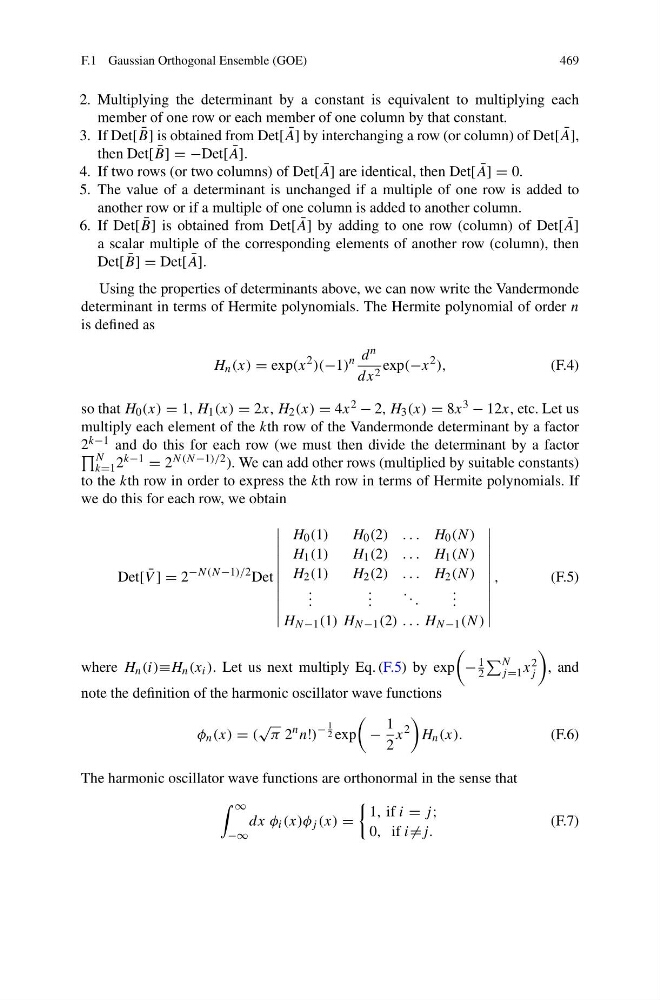
Using the properties of determinants above, we can now write the Vandermonde
determinant in terms of Hermite polynomials. The Hermite polynomial of order n
is defined as
H n (x) = exp(x
2 )(−1)
n d n
dx 2 exp(−x
2 ),
(F.4)
so that H 0 (x) = 1, H 1 (x) = 2x, H 2 (x) = 4x 2 − 2, H 3 (x) = 8x 3 − 12x, etc. Let us
multiply each element of the kth row of the Vandermonde determinant by a factor
2 k−1 and do this for each row (we must then divide the determinant by a factor
N
k=1 2 k−1 = 2 N(N−1)/2 ). We can add other rows (multiplied by suitable constants)
to the kth row in order to express the kth row in terms of Hermite polynomials. If
we do this for each row, we obtain
Det[ ¯
V ] = 2
−N(N−1)/2 Det
H 0 (1)
H 0 (2) ... H 0 (N)
H 1 (1)
H 1 (2) ... H 1 (N)
H 2 (1)
H 2 (2) ... H 2 (N)
. . .
. . .
. . .
. . .
H N −1 (1) H N −1 (2) . . . H N −1 (N)
,
(F.5)
where H n (i)≡H n (x i ). Let us next multiply Eq. (F.5) by exp
−
1
2
N
j =1 x 2
j
, and
note the definition of the harmonic oscillator wave functions
φ n (x) = (
√
π 2
n n!)
−
1
2 exp
−
1
2
x
2
H n (x).
(F.6)
The harmonic oscillator wave functions are orthonormal in the sense that
∞
−∞
dx φ i (x)φ j (x) =
1, if i = j ;
0, if i =j.
(F.7)
469
2. Multiplying the determinant by a constant is equivalent to multiplying each
member of one row or each member of one column by that constant.
3. If Det[ ¯
B] is obtained from Det[ ¯
A] by interchanging a row (or column) of Det[ ¯
A],
then Det[ ¯
B] = −Det[ ¯
A].
4. If two rows (or two columns) of Det[ ¯
A] are identical, then Det[ ¯
A] = 0.
5. The value of a determinant is unchanged if a multiple of one row is added to
another row or if a multiple of one column is added to another column.
6. If Det[ ¯
B] is obtained from Det[ ¯
A] by adding to one row (column) of Det[ ¯
A]
a scalar multiple of the corresponding elements of another row (column), then
Det[ ¯
B] = Det[ ¯
A].
Using the properties of determinants above, we can now write the Vandermonde
determinant in terms of Hermite polynomials. The Hermite polynomial of order n
is defined as
H n (x) = exp(x
2 )(−1)
n d n
dx 2 exp(−x
2 ),
(F.4)
so that H 0 (x) = 1, H 1 (x) = 2x, H 2 (x) = 4x 2 − 2, H 3 (x) = 8x 3 − 12x, etc. Let us
multiply each element of the kth row of the Vandermonde determinant by a factor
2 k−1 and do this for each row (we must then divide the determinant by a factor
N
k=1 2 k−1 = 2 N(N−1)/2 ). We can add other rows (multiplied by suitable constants)
to the kth row in order to express the kth row in terms of Hermite polynomials. If
we do this for each row, we obtain
Det[ ¯
V ] = 2
−N(N−1)/2 Det
H 0 (1)
H 0 (2) ... H 0 (N)
H 1 (1)
H 1 (2) ... H 1 (N)
H 2 (1)
H 2 (2) ... H 2 (N)
. . .
. . .
. . .
. . .
H N −1 (1) H N −1 (2) . . . H N −1 (N)
,
(F.5)
where H n (i)≡H n (x i ). Let us next multiply Eq. (F.5) by exp
−
1
2
N
j =1 x 2
j
, and
note the definition of the harmonic oscillator wave functions
φ n (x) = (
√
π 2
n n!)
−
1
2 exp
−
1
2
x
2
H n (x).
(F.6)
The harmonic oscillator wave functions are orthonormal in the sense that
∞
−∞
dx φ i (x)φ j (x) =
1, if i = j ;
0, if i =j.
(F.7)