

470
F Gaussian Ensembles
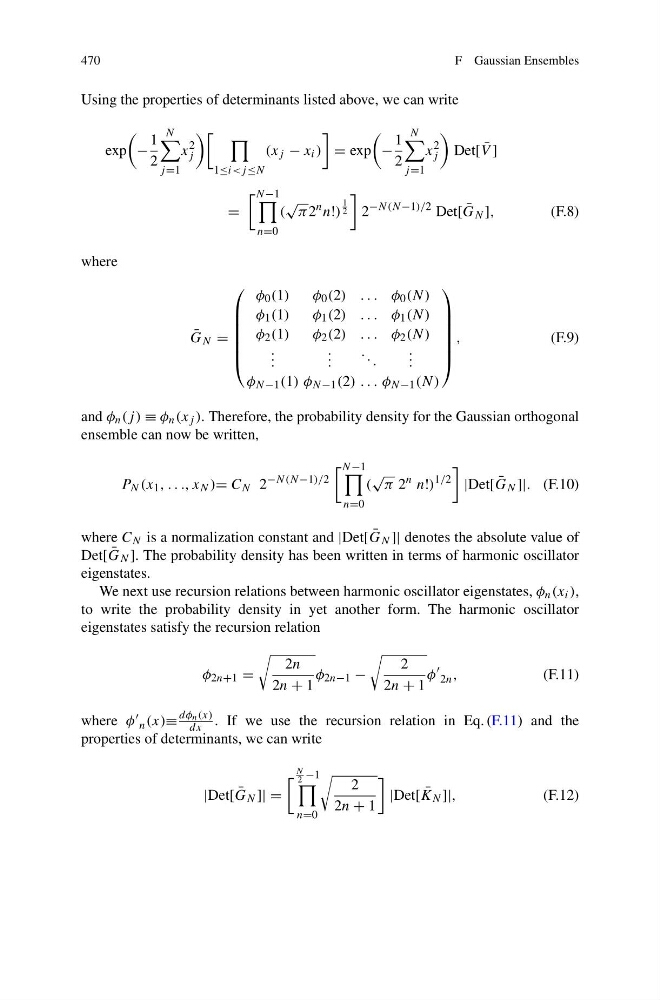
Using the properties of determinants listed above, we can write
exp
−
1
2
N
j =1
x
2
j
1≤i
= exp
−
1
2
N
j =1
x
2
j
Det[ ¯
V ]
=
N −1
n=0
(
√
π 2
n n!)
1
2
2
−N(N−1)/2 Det[ ¯
G N ],
(F.8)
where
¯
G N =
⎛
⎜
⎜
⎜
⎜
⎜
⎝
φ 0 (1)
φ 0 (2) ... φ 0 (N)
φ 1 (1)
φ 1 (2) ... φ 1 (N)
φ 2 (1)
φ 2 (2) ... φ 2 (N)
. . .
. . .
. . .
. . .
φ N −1 (1) φ N −1 (2) . . . φ N −1 (N)
⎞
⎟
⎟
⎟
⎟
⎟
⎠
,
(F.9)
and φ n (j ) ≡ φ n (x j ). Therefore, the probability density for the Gaussian orthogonal
ensemble can now be written,
P N (x 1 , . . ., x N )= C N 2
−N(N−1)/2
N −1
n=0
(
√
π 2
n n!)
1/2
|Det[ ¯
G N ]|. (F.10)
where C N is a normalization constant and |Det[ ¯
G N ]| denotes the absolute value of
Det[ ¯
G N ]. The probability density has been written in terms of harmonic oscillator
eigenstates.
We next use recursion relations between harmonic oscillator eigenstates, φ n (x i ),
to write the probability density in yet another form. The harmonic oscillator
eigenstates satisfy the recursion relation
φ 2n+1 =
2n
2n + 1
φ 2n−1 −
2
2n + 1
φ
2n ,
(F.11)
where φ
n (x)≡
dφ n (x)
dx . If we use the recursion relation in Eq. (F.11) and the
properties of determinants, we can write
|Det[ ¯
G N ]| =
N
2 −1
n=0
2
2n + 1
|Det[ ¯
K N ]|,
(F.12)
F Gaussian Ensembles
Using the properties of determinants listed above, we can write
exp
−
1
2
N
j =1
x
2
j
1≤i
= exp
−
1
2
N
j =1
x
2
j
Det[ ¯
V ]
=
N −1
n=0
(
√
π 2
n n!)
1
2
2
−N(N−1)/2 Det[ ¯
G N ],
(F.8)
where
¯
G N =
⎛
⎜
⎜
⎜
⎜
⎜
⎝
φ 0 (1)
φ 0 (2) ... φ 0 (N)
φ 1 (1)
φ 1 (2) ... φ 1 (N)
φ 2 (1)
φ 2 (2) ... φ 2 (N)
. . .
. . .
. . .
. . .
φ N −1 (1) φ N −1 (2) . . . φ N −1 (N)
⎞
⎟
⎟
⎟
⎟
⎟
⎠
,
(F.9)
and φ n (j ) ≡ φ n (x j ). Therefore, the probability density for the Gaussian orthogonal
ensemble can now be written,
P N (x 1 , . . ., x N )= C N 2
−N(N−1)/2
N −1
n=0
(
√
π 2
n n!)
1/2
|Det[ ¯
G N ]|. (F.10)
where C N is a normalization constant and |Det[ ¯
G N ]| denotes the absolute value of
Det[ ¯
G N ]. The probability density has been written in terms of harmonic oscillator
eigenstates.
We next use recursion relations between harmonic oscillator eigenstates, φ n (x i ),
to write the probability density in yet another form. The harmonic oscillator
eigenstates satisfy the recursion relation
φ 2n+1 =
2n
2n + 1
φ 2n−1 −
2
2n + 1
φ
2n ,
(F.11)
where φ
n (x)≡
dφ n (x)
dx . If we use the recursion relation in Eq. (F.11) and the
properties of determinants, we can write
|Det[ ¯
G N ]| =
N
2 −1
n=0
2
2n + 1
|Det[ ¯
K N ]|,
(F.12)