

468
F Gaussian Ensembles
P ( ¯
H R ) dd H R =
1
2πδ 2
N(N+1)/4
1≤i
×exp
−
1
2δ 2
N
j =1
e
2
j
de 1 ×. . .×de N δδ O .
(F.1)
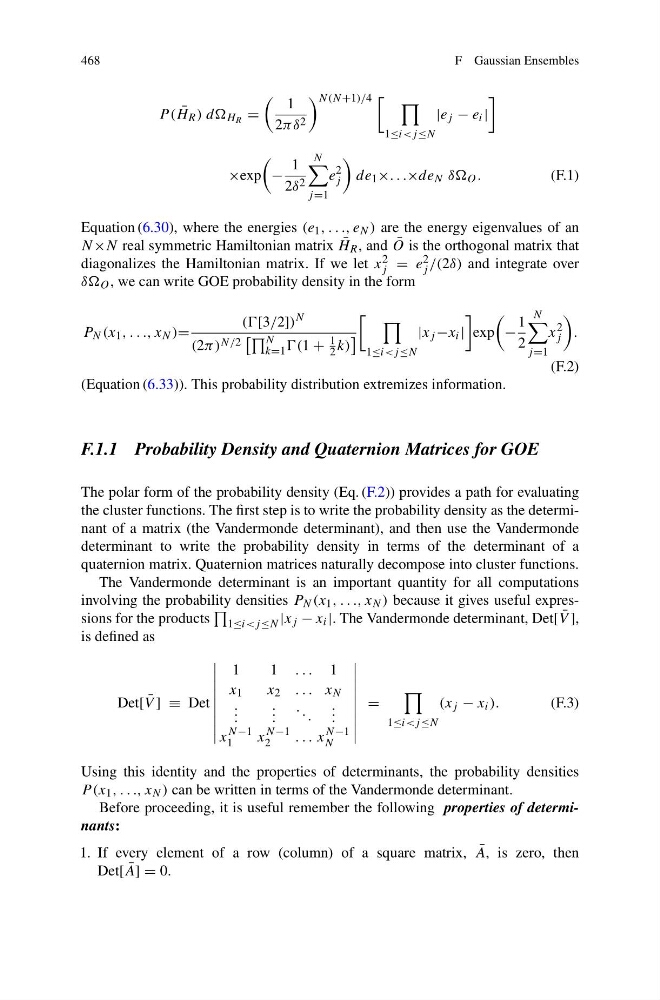
Equation (6.30), where the energies (e 1 , . . ., e N ) are the energy eigenvalues of an
N ×N real symmetric Hamiltonian matrix ¯
H R , and ¯
O is the orthogonal matrix that
diagonalizes the Hamiltonian matrix. If we let x 2
j = e 2
j /(2δ) and integrate over
δδ O , we can write GOE probability density in the form
P N (x 1 , . . ., x N )=
([3/2])
N
(2π) N/2
N
k=1 (1 +
1
2 k)
1≤i
exp
−
1
2
N
j =1
x
2
j
.
(F.2)
(Equation (6.33)). This probability distribution extremizes information.
F.1.1 Probability Density and Quaternion Matrices for GOE
The polar form of the probability density (Eq. (F.2)) provides a path for evaluating
the cluster functions. The first step is to write the probability density as the determinant of a matrix (the Vandermonde determinant), and then use the Vandermonde
determinant to write the probability density in terms of the determinant of a
quaternion matrix. Quaternion matrices naturally decompose into cluster functions.
The Vandermonde determinant is an important quantity for all computations
involving the probability densities P N (x 1 , . . ., x N ) because it gives useful expressions for the products
1≤i
is defined as
Det[ ¯
V ] ≡ Det
1
1 . . . 1
x 1
x 2 . . . x N
. . .
. . .
. . .
. . .
x
N −1
1
x
N −1
2
. . . x
N −1
N
=
1≤i
(F.3)
Using this identity and the properties of determinants, the probability densities
P (x 1 , . . ., x N ) can be written in terms of the Vandermonde determinant.
Before proceeding, it is useful remember the following properties of determinants:
1. If every element of a row (column) of a square matrix, ¯
A, is zero, then
Det[ ¯
A] = 0.
F Gaussian Ensembles
P ( ¯
H R ) dd H R =
1
2πδ 2
N(N+1)/4
1≤i
×exp
−
1
2δ 2
N
j =1
e
2
j
de 1 ×. . .×de N δδ O .
(F.1)
Equation (6.30), where the energies (e 1 , . . ., e N ) are the energy eigenvalues of an
N ×N real symmetric Hamiltonian matrix ¯
H R , and ¯
O is the orthogonal matrix that
diagonalizes the Hamiltonian matrix. If we let x 2
j = e 2
j /(2δ) and integrate over
δδ O , we can write GOE probability density in the form
P N (x 1 , . . ., x N )=
([3/2])
N
(2π) N/2
N
k=1 (1 +
1
2 k)
1≤i
exp
−
1
2
N
j =1
x
2
j
.
(F.2)
(Equation (6.33)). This probability distribution extremizes information.
F.1.1 Probability Density and Quaternion Matrices for GOE
The polar form of the probability density (Eq. (F.2)) provides a path for evaluating
the cluster functions. The first step is to write the probability density as the determinant of a matrix (the Vandermonde determinant), and then use the Vandermonde
determinant to write the probability density in terms of the determinant of a
quaternion matrix. Quaternion matrices naturally decompose into cluster functions.
The Vandermonde determinant is an important quantity for all computations
involving the probability densities P N (x 1 , . . ., x N ) because it gives useful expressions for the products
1≤i
is defined as
Det[ ¯
V ] ≡ Det
1
1 . . . 1
x 1
x 2 . . . x N
. . .
. . .
. . .
. . .
x
N −1
1
x
N −1
2
. . . x
N −1
N
=
1≤i
(F.3)
Using this identity and the properties of determinants, the probability densities
P (x 1 , . . ., x N ) can be written in terms of the Vandermonde determinant.
Before proceeding, it is useful remember the following properties of determinants:
1. If every element of a row (column) of a square matrix, ¯
A, is zero, then
Det[ ¯
A] = 0.