

456
E Quaternions
¯
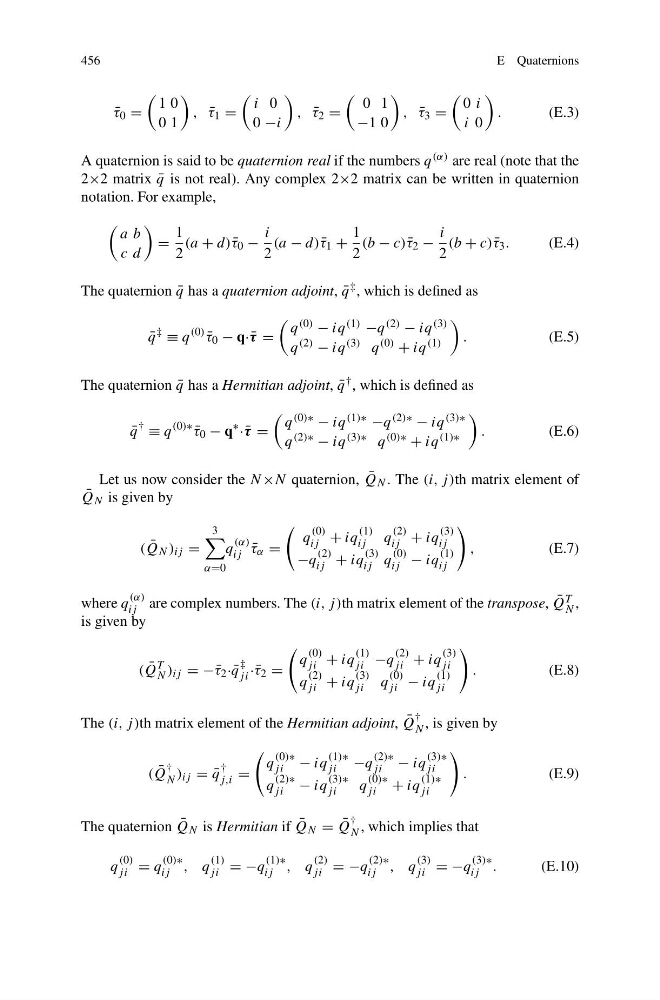
τ 0 =
1 0
0 1
, ¯
τ 1 =
i 0
0 −i
, ¯
τ 2 =
0 1
−1 0
, ¯
τ 3 =
0 i
i 0
.
(E.3)
A quaternion is said to be quaternion real if the numbers q (α) are real (note that the
2×2 matrix ¯
q is not real). Any complex 2×2 matrix can be written in quaternion
notation. For example,
a b
c d
=
1
2
(a + d) ¯
τ 0 −
i
2
(a − d) ¯
τ 1 +
1
2
(b − c) ¯
τ 2 −
i
2
(b + c) ¯
τ 3 .
(E.4)
The quaternion ¯
q has a quaternion adjoint, ¯
q ‡ , which is defined as
¯
q
‡
≡ q
(0)
¯
τ 0 − q· ¯
τ =
q (0) − iq (1) −q (2) − iq (3)
q (2) − iq (3) q (0) + iq (1)
.
(E.5)
The quaternion ¯
q has a Hermitian adjoint, ¯
q † , which is defined as
¯
q
†
≡ q
(0)∗
¯
τ 0 − q
∗
· ¯
τ =
q (0)∗ − iq (1)∗ −q (2)∗ − iq (3)∗
q (2)∗ − iq (3)∗ q (0)∗ + iq (1)∗
.
(E.6)
Let us now consider the N×N quaternion, ¯
Q N . The (i, j )th matrix element of
¯
Q N is given by
( ¯
Q N ) ij =
3
α=0
q
(α)
ij ¯
τ α =
q
(0)
ij + iq
(1)
ij
q
(2)
ij + iq
(3)
ij
−q
(2)
ij + iq
(3)
ij q
(0)
ij − iq
(1)
ij
,
(E.7)
where q
(α)
ij are complex numbers. The (i, j )th matrix element of the transpose, ¯
Q T
N ,
is given by
( ¯
Q
T
N ) ij = − ¯
τ 2 · ¯
q
‡
ji · ¯
τ 2 =
q
(0)
ji + iq
(1)
ji −q
(2)
ji + iq
(3)
ji
q
(2)
ji + iq
(3)
ji q
(0)
ji − iq
(1)
ji
.
(E.8)
The (i, j )th matrix element of the Hermitian adjoint, ¯
Q
†
N , is given by
( ¯
Q
†
N ) ij = ¯
q
†
j,i =
q
(0)∗
ji − iq
(1)∗
ji −q
(2)∗
ji − iq
(3)∗
ji
q
(2)∗
ji − iq
(3)∗
ji
q
(0)∗
ji + iq
(1)∗
ji
.
(E.9)
The quaternion ¯
Q N is Hermitian if ¯
Q N = ¯
Q
†
N , which implies that
q
(0)
ji = q
(0)∗
ij , q
(1)
ji = −q
(1)∗
ij , q
(2)
ji = −q
(2)∗
ij , q
(3)
ji = −q
(3)∗
ij .
(E.10)
E Quaternions
¯
τ 0 =
1 0
0 1
, ¯
τ 1 =
i 0
0 −i
, ¯
τ 2 =
0 1
−1 0
, ¯
τ 3 =
0 i
i 0
.
(E.3)
A quaternion is said to be quaternion real if the numbers q (α) are real (note that the
2×2 matrix ¯
q is not real). Any complex 2×2 matrix can be written in quaternion
notation. For example,
a b
c d
=
1
2
(a + d) ¯
τ 0 −
i
2
(a − d) ¯
τ 1 +
1
2
(b − c) ¯
τ 2 −
i
2
(b + c) ¯
τ 3 .
(E.4)
The quaternion ¯
q has a quaternion adjoint, ¯
q ‡ , which is defined as
¯
q
‡
≡ q
(0)
¯
τ 0 − q· ¯
τ =
q (0) − iq (1) −q (2) − iq (3)
q (2) − iq (3) q (0) + iq (1)
.
(E.5)
The quaternion ¯
q has a Hermitian adjoint, ¯
q † , which is defined as
¯
q
†
≡ q
(0)∗
¯
τ 0 − q
∗
· ¯
τ =
q (0)∗ − iq (1)∗ −q (2)∗ − iq (3)∗
q (2)∗ − iq (3)∗ q (0)∗ + iq (1)∗
.
(E.6)
Let us now consider the N×N quaternion, ¯
Q N . The (i, j )th matrix element of
¯
Q N is given by
( ¯
Q N ) ij =
3
α=0
q
(α)
ij ¯
τ α =
q
(0)
ij + iq
(1)
ij
q
(2)
ij + iq
(3)
ij
−q
(2)
ij + iq
(3)
ij q
(0)
ij − iq
(1)
ij
,
(E.7)
where q
(α)
ij are complex numbers. The (i, j )th matrix element of the transpose, ¯
Q T
N ,
is given by
( ¯
Q
T
N ) ij = − ¯
τ 2 · ¯
q
‡
ji · ¯
τ 2 =
q
(0)
ji + iq
(1)
ji −q
(2)
ji + iq
(3)
ji
q
(2)
ji + iq
(3)
ji q
(0)
ji − iq
(1)
ji
.
(E.8)
The (i, j )th matrix element of the Hermitian adjoint, ¯
Q
†
N , is given by
( ¯
Q
†
N ) ij = ¯
q
†
j,i =
q
(0)∗
ji − iq
(1)∗
ji −q
(2)∗
ji − iq
(3)∗
ji
q
(2)∗
ji − iq
(3)∗
ji
q
(0)∗
ji + iq
(1)∗
ji
.
(E.9)
The quaternion ¯
Q N is Hermitian if ¯
Q N = ¯
Q
†
N , which implies that
q
(0)
ji = q
(0)∗
ij , q
(1)
ji = −q
(1)∗
ij , q
(2)
ji = −q
(2)∗
ij , q
(3)
ji = −q
(3)∗
ij .
(E.10)