

E.1 General Properties of Quaternions
457
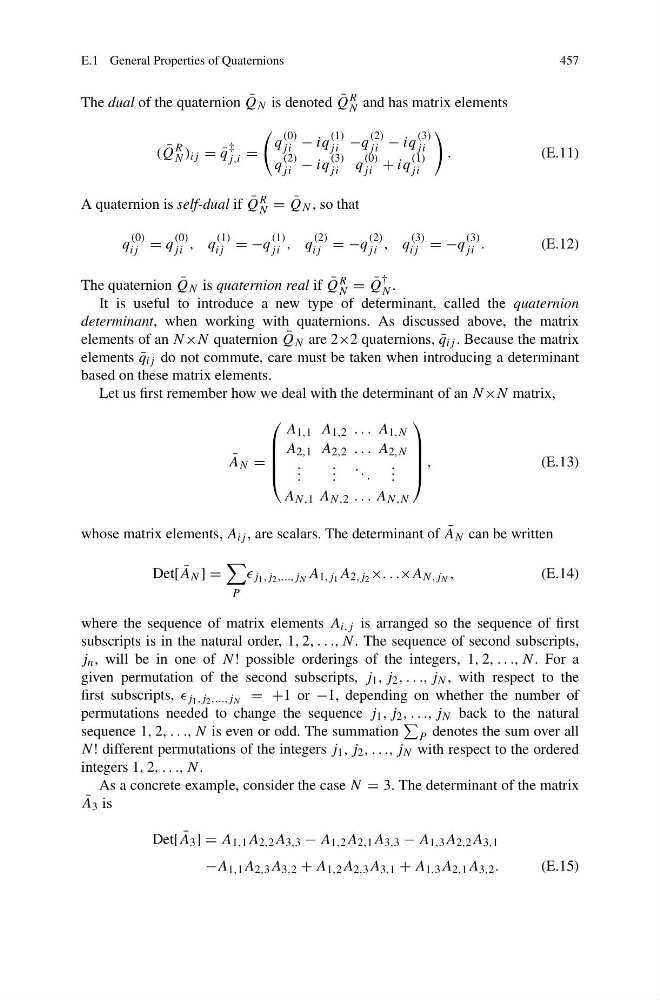
The dual of the quaternion ¯
Q N is denoted ¯
Q R
N and has matrix elements
( ¯
Q
R
N ) ij = ¯
q
‡
j,i =
q
(0)
ji − iq
(1)
ji −q
(2)
ji − iq
(3)
ji
q
(2)
ji − iq
(3)
ji q
(0)
ji + iq
(1)
ji
.
(E.11)
A quaternion is self-dual if ¯
Q R
N = ¯
Q N , so that
q
(0)
ij = q
(0)
ji , q
(1)
ij = −q
(1)
ji , q
(2)
ij = −q
(2)
ji , q
(3)
ij = −q
(3)
ji .
(E.12)
The quaternion ¯
Q N is quaternion real if ¯
Q R
N = ¯
Q
†
N .
It is useful to introduce a new type of determinant, called the quaternion
determinant, when working with quaternions. As discussed above, the matrix
elements of an N ×N quaternion ¯
Q N are 2×2 quaternions, ¯
q ij . Because the matrix
elements ¯
q ij do not commute, care must be taken when introducing a determinant
based on these matrix elements.
Let us first remember how we deal with the determinant of an N×N matrix,
¯
A N =
⎛
⎜
⎜
⎜
⎝
A 1,1 A 1,2 . . . A 1,N
A 2,1 A 2,2 . . . A 2,N
. . .
. . .
. . .
. . .
A N,1 A N,2 . . . A N,N
⎞
⎟
⎟
⎟
⎠
,
(E.13)
whose matrix elements, A ij , are scalars. The determinant of ¯
A N can be written
Det[ ¯
A N ] =
P
j 1 ,j 2 ,...,j N A 1,j 1 A 2,j 2 ×. . .×A N,j N ,
(E.14)
where the sequence of matrix elements A i,j is arranged so the sequence of first
subscripts is in the natural order, 1, 2, . . ., N. The sequence of second subscripts,
j n , will be in one of N! possible orderings of the integers, 1, 2, . . ., N. For a
given permutation of the second subscripts, j 1 , j 2 , . . ., j N , with respect to the
first subscripts, j 1 ,j 2 ,...,j N = +1 or −1, depending on whether the number of
permutations needed to change the sequence j 1 , j 2 , . . ., j N back to the natural
sequence 1, 2, . . ., N is even or odd. The summation
P denotes the sum over all
N ! different permutations of the integers j 1 , j 2 , . . ., j N with respect to the ordered
integers 1, 2, . . ., N.
As a concrete example, consider the case N = 3. The determinant of the matrix
¯
A 3 is
Det[ ¯
A 3 ] = A 1,1 A 2,2 A 3,3 − A 1,2 A 2,1 A 3,3 − A 1,3 A 2,2 A 3,1
−A 1,1 A 2,3 A 3,2 + A 1,2 A 2,3 A 3,1 + A 1,3 A 2,1 A 3,2 .
(E.15)
457
The dual of the quaternion ¯
Q N is denoted ¯
Q R
N and has matrix elements
( ¯
Q
R
N ) ij = ¯
q
‡
j,i =
q
(0)
ji − iq
(1)
ji −q
(2)
ji − iq
(3)
ji
q
(2)
ji − iq
(3)
ji q
(0)
ji + iq
(1)
ji
.
(E.11)
A quaternion is self-dual if ¯
Q R
N = ¯
Q N , so that
q
(0)
ij = q
(0)
ji , q
(1)
ij = −q
(1)
ji , q
(2)
ij = −q
(2)
ji , q
(3)
ij = −q
(3)
ji .
(E.12)
The quaternion ¯
Q N is quaternion real if ¯
Q R
N = ¯
Q
†
N .
It is useful to introduce a new type of determinant, called the quaternion
determinant, when working with quaternions. As discussed above, the matrix
elements of an N ×N quaternion ¯
Q N are 2×2 quaternions, ¯
q ij . Because the matrix
elements ¯
q ij do not commute, care must be taken when introducing a determinant
based on these matrix elements.
Let us first remember how we deal with the determinant of an N×N matrix,
¯
A N =
⎛
⎜
⎜
⎜
⎝
A 1,1 A 1,2 . . . A 1,N
A 2,1 A 2,2 . . . A 2,N
. . .
. . .
. . .
. . .
A N,1 A N,2 . . . A N,N
⎞
⎟
⎟
⎟
⎠
,
(E.13)
whose matrix elements, A ij , are scalars. The determinant of ¯
A N can be written
Det[ ¯
A N ] =
P
j 1 ,j 2 ,...,j N A 1,j 1 A 2,j 2 ×. . .×A N,j N ,
(E.14)
where the sequence of matrix elements A i,j is arranged so the sequence of first
subscripts is in the natural order, 1, 2, . . ., N. The sequence of second subscripts,
j n , will be in one of N! possible orderings of the integers, 1, 2, . . ., N. For a
given permutation of the second subscripts, j 1 , j 2 , . . ., j N , with respect to the
first subscripts, j 1 ,j 2 ,...,j N = +1 or −1, depending on whether the number of
permutations needed to change the sequence j 1 , j 2 , . . ., j N back to the natural
sequence 1, 2, . . ., N is even or odd. The summation
P denotes the sum over all
N ! different permutations of the integers j 1 , j 2 , . . ., j N with respect to the ordered
integers 1, 2, . . ., N.
As a concrete example, consider the case N = 3. The determinant of the matrix
¯
A 3 is
Det[ ¯
A 3 ] = A 1,1 A 2,2 A 3,3 − A 1,2 A 2,1 A 3,3 − A 1,3 A 2,2 A 3,1
−A 1,1 A 2,3 A 3,2 + A 1,2 A 2,3 A 3,1 + A 1,3 A 2,1 A 3,2 .
(E.15)