

32
2 Fundamental Concepts
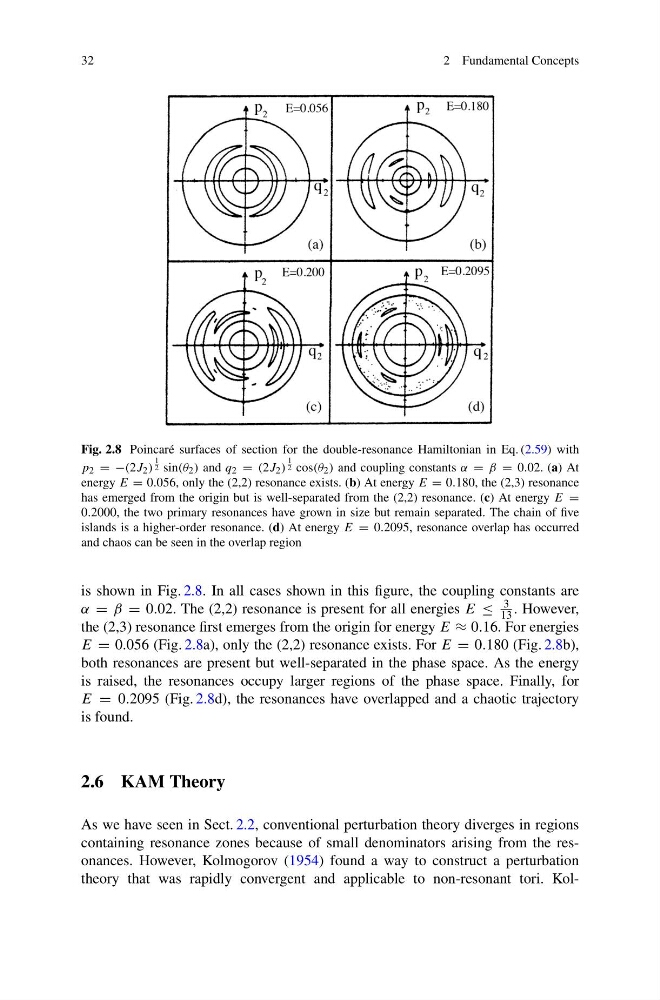
Fig. 2.8 Poincaré surfaces of section for the double-resonance Hamiltonian in Eq. (2.59) with
p 2 = −(2J 2 )
1
2 sin(θ 2 ) and q 2 = (2J 2 )
1
2 cos(θ 2 ) and coupling constants α = β = 0.02. (a) At
energy E = 0.056, only the (2,2) resonance exists. (b) At energy E = 0.180, the (2,3) resonance
has emerged from the origin but is well-separated from the (2,2) resonance. (c) At energy E =
0.2000, the two primary resonances have grown in size but remain separated. The chain of five
islands is a higher-order resonance. (d) At energy E = 0.2095, resonance overlap has occurred
and chaos can be seen in the overlap region
is shown in Fig. 2.8. In all cases shown in this figure, the coupling constants are
α = β = 0.02. The (2,2) resonance is present for all energies E ≤
3
13 . However,
the (2,3) resonance first emerges from the origin for energy E ≈ 0.16. For energies
E = 0.056 (Fig. 2.8a), only the (2,2) resonance exists. For E = 0.180 (Fig. 2.8b),
both resonances are present but well-separated in the phase space. As the energy
is raised, the resonances occupy larger regions of the phase space. Finally, for
E = 0.2095 (Fig. 2.8d), the resonances have overlapped and a chaotic trajectory
is found.
2.6 KAM Theory
As we have seen in Sect. 2.2, conventional perturbation theory diverges in regions
containing resonance zones because of small denominators arising from the resonances. However, Kolmogorov (1954) found a way to construct a perturbation
theory that was rapidly convergent and applicable to non-resonant tori. Kol-
2 Fundamental Concepts
Fig. 2.8 Poincaré surfaces of section for the double-resonance Hamiltonian in Eq. (2.59) with
p 2 = −(2J 2 )
1
2 sin(θ 2 ) and q 2 = (2J 2 )
1
2 cos(θ 2 ) and coupling constants α = β = 0.02. (a) At
energy E = 0.056, only the (2,2) resonance exists. (b) At energy E = 0.180, the (2,3) resonance
has emerged from the origin but is well-separated from the (2,2) resonance. (c) At energy E =
0.2000, the two primary resonances have grown in size but remain separated. The chain of five
islands is a higher-order resonance. (d) At energy E = 0.2095, resonance overlap has occurred
and chaos can be seen in the overlap region
is shown in Fig. 2.8. In all cases shown in this figure, the coupling constants are
α = β = 0.02. The (2,2) resonance is present for all energies E ≤
3
13 . However,
the (2,3) resonance first emerges from the origin for energy E ≈ 0.16. For energies
E = 0.056 (Fig. 2.8a), only the (2,2) resonance exists. For E = 0.180 (Fig. 2.8b),
both resonances are present but well-separated in the phase space. As the energy
is raised, the resonances occupy larger regions of the phase space. Finally, for
E = 0.2095 (Fig. 2.8d), the resonances have overlapped and a chaotic trajectory
is found.
2.6 KAM Theory
As we have seen in Sect. 2.2, conventional perturbation theory diverges in regions
containing resonance zones because of small denominators arising from the resonances. However, Kolmogorov (1954) found a way to construct a perturbation
theory that was rapidly convergent and applicable to non-resonant tori. Kol-