

C.1 Space-Time Symmetries
423
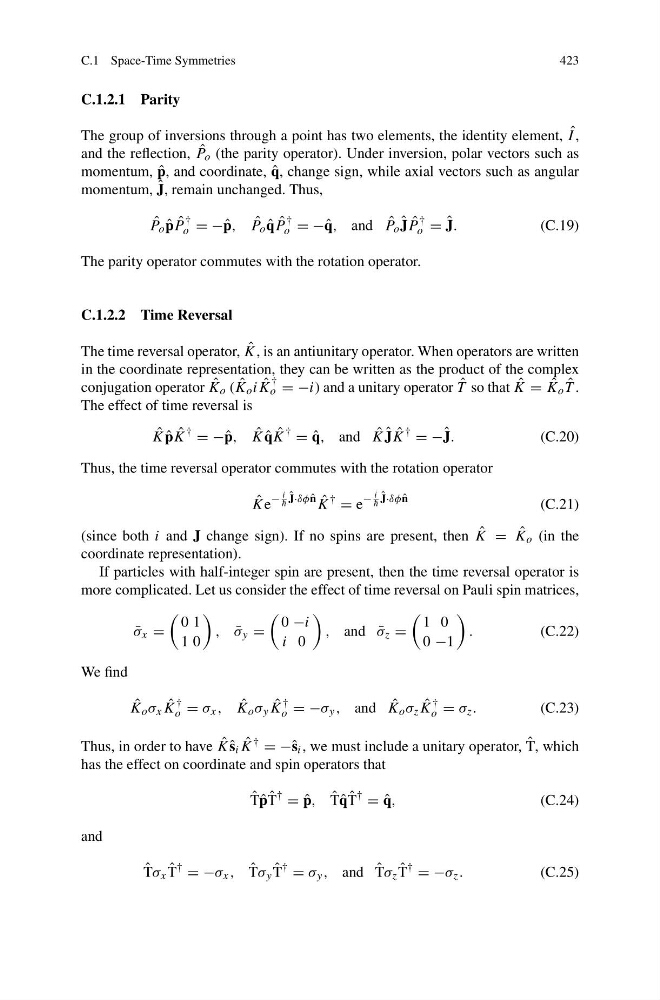
C.1.2.1 Parity
The group of inversions through a point has two elements, the identity element, ˆ
I ,
and the reflection, ˆ
P o (the parity operator). Under inversion, polar vectors such as
momentum, ˆ
p, and coordinate, ˆ
q, change sign, while axial vectors such as angular
momentum, ˆ
J, remain unchanged. Thus,
ˆ
P o ˆ
p ˆ
P
†
o = −ˆ p, ˆ
P o ˆ
q ˆ
P
†
o = −ˆ q, and ˆ
P o ˆ
J ˆ
P
†
o = ˆ
J.
(C.19)
The parity operator commutes with the rotation operator.
C.1.2.2 Time Reversal
The time reversal operator, ˆ
K, is an antiunitary operator. When operators are written
in the coordinate representation, they can be written as the product of the complex
conjugation operator ˆ
K o ( ˆ
K o i ˆ
K
†
o = −i) and a unitary operator ˆ
T so that ˆ
K = ˆ
K o ˆ
T .
The effect of time reversal is
ˆ
K ˆ
p ˆ
K
†
= −ˆ p, ˆ
K ˆ
q ˆ
K
†
= ˆ
q, and ˆ
K ˆ
J ˆ
K
†
= − ˆ
J.
(C.20)
Thus, the time reversal operator commutes with the rotation operator
ˆ
Ke
−
i
¯
h
ˆ
J·δφ ˆ
n ˆ
K
†
= e
−
i
¯
h
ˆ
J·δφ ˆ
n
(C.21)
(since both i and J change sign). If no spins are present, then ˆ
K = ˆ
K o (in the
coordinate representation).
If particles with half-integer spin are present, then the time reversal operator is
more complicated. Let us consider the effect of time reversal on Pauli spin matrices,
¯
σ x =
0 1
1 0
, ¯
σ y =
0 −i
i 0
, and ¯
σ z =
1 0
0 −1
.
(C.22)
We find
ˆ
K o σ x ˆ
K
†
o = σ x , ˆ
K o σ y ˆ
K
†
o = −σ y , and ˆ
K o σ z ˆ
K
†
o = σ z .
(C.23)
Thus, in order to have ˆ
K ˆ
s i ˆ
K † = −ˆ s i , we must include a unitary operator, ˆ
T, which
has the effect on coordinate and spin operators that
ˆ
T ˆ
p ˆ
T
†
= ˆ
p, ˆ
T ˆ
q ˆ
T
†
= ˆ
q,
(C.24)
and
ˆ
Tσ x ˆ
T
†
= −σ x , ˆ
Tσ y ˆ
T
†
= σ y , and ˆ
Tσ z ˆ
T
†
= −σ z .
(C.25)
423
C.1.2.1 Parity
The group of inversions through a point has two elements, the identity element, ˆ
I ,
and the reflection, ˆ
P o (the parity operator). Under inversion, polar vectors such as
momentum, ˆ
p, and coordinate, ˆ
q, change sign, while axial vectors such as angular
momentum, ˆ
J, remain unchanged. Thus,
ˆ
P o ˆ
p ˆ
P
†
o = −ˆ p, ˆ
P o ˆ
q ˆ
P
†
o = −ˆ q, and ˆ
P o ˆ
J ˆ
P
†
o = ˆ
J.
(C.19)
The parity operator commutes with the rotation operator.
C.1.2.2 Time Reversal
The time reversal operator, ˆ
K, is an antiunitary operator. When operators are written
in the coordinate representation, they can be written as the product of the complex
conjugation operator ˆ
K o ( ˆ
K o i ˆ
K
†
o = −i) and a unitary operator ˆ
T so that ˆ
K = ˆ
K o ˆ
T .
The effect of time reversal is
ˆ
K ˆ
p ˆ
K
†
= −ˆ p, ˆ
K ˆ
q ˆ
K
†
= ˆ
q, and ˆ
K ˆ
J ˆ
K
†
= − ˆ
J.
(C.20)
Thus, the time reversal operator commutes with the rotation operator
ˆ
Ke
−
i
¯
h
ˆ
J·δφ ˆ
n ˆ
K
†
= e
−
i
¯
h
ˆ
J·δφ ˆ
n
(C.21)
(since both i and J change sign). If no spins are present, then ˆ
K = ˆ
K o (in the
coordinate representation).
If particles with half-integer spin are present, then the time reversal operator is
more complicated. Let us consider the effect of time reversal on Pauli spin matrices,
¯
σ x =
0 1
1 0
, ¯
σ y =
0 −i
i 0
, and ¯
σ z =
1 0
0 −1
.
(C.22)
We find
ˆ
K o σ x ˆ
K
†
o = σ x , ˆ
K o σ y ˆ
K
†
o = −σ y , and ˆ
K o σ z ˆ
K
†
o = σ z .
(C.23)
Thus, in order to have ˆ
K ˆ
s i ˆ
K † = −ˆ s i , we must include a unitary operator, ˆ
T, which
has the effect on coordinate and spin operators that
ˆ
T ˆ
p ˆ
T
†
= ˆ
p, ˆ
T ˆ
q ˆ
T
†
= ˆ
q,
(C.24)
and
ˆ
Tσ x ˆ
T
†
= −σ x , ˆ
Tσ y ˆ
T
†
= σ y , and ˆ
Tσ z ˆ
T
†
= −σ z .
(C.25)