

422
C Symmetries and the Hamiltonian Matrix
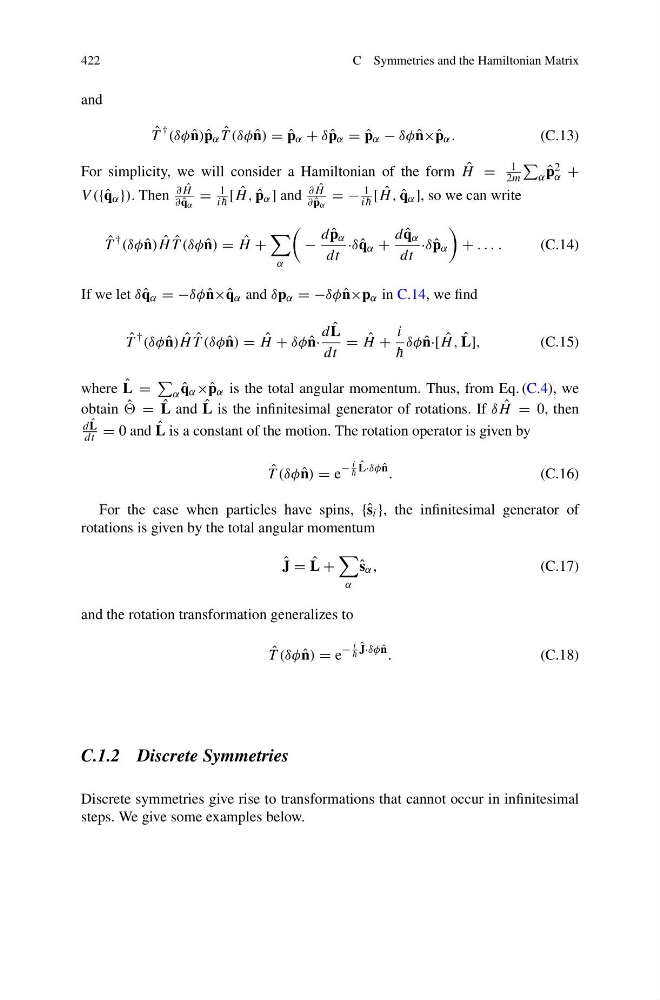
and
ˆ
T
† (δφ ˆ
n) ˆ
p α ˆ
T (δφ ˆ
n) = ˆ
p α + δ ˆ
p α = ˆ
p α − δφ ˆ
n× ˆ
p α .
(C.13)
For simplicity, we will consider a Hamiltonian of the form ˆ
H =
1
2m
α ˆ
p 2
α +
V ({ ˆ
q α }). Then
∂ ˆ
H
∂ ˆ
q α
=
1
i ¯
h [ ˆ
H , ˆ
p α ] and
∂ ˆ
H
∂ ˆ
p α
= −
1
i ¯
h [ ˆ
H , ˆ
q α ], so we can write
ˆ
T
† (δφ ˆ
n) ˆ
H ˆ
T (δφ ˆ
n) = ˆ
H +
α
−
d ˆ
p α
dt
·δ ˆ
q α +
d ˆ
q α
dt
·δ ˆ
p α
+ . . . .
(C.14)
If we let δ ˆ
q α = −δφ ˆ
n× ˆ
q α and δp α = −δφ ˆ
n×p α in C.14, we find
ˆ
T
† (δφ ˆ
n) ˆ
H ˆ
T (δφ ˆ
n) = ˆ
H + δφ ˆ
n·
d ˆ
L
dt
= ˆ
H +
i
¯
h
δφ ˆ
n·[ ˆ
H , ˆ
L],
(C.15)
where ˆ
L =
α ˆ
q α × ˆ
p α is the total angular momentum. Thus, from Eq. (C.4), we
obtain ˆ
= ˆ
L and ˆ
L is the infinitesimal generator of rotations. If δ ˆ
H = 0, then
d ˆ
L
dt = 0 and ˆ
L is a constant of the motion. The rotation operator is given by
ˆ
T (δφ ˆ
n) = e
−
i
¯
h
ˆ
L·δφ ˆ
n .
(C.16)
For the case when particles have spins, {ˆ s i }, the infinitesimal generator of
rotations is given by the total angular momentum
ˆ
J = ˆ
L +
α
ˆ
s α ,
(C.17)
and the rotation transformation generalizes to
ˆ
T (δφ ˆ
n) = e
−
i
¯
h
ˆ
J·δφ ˆ
n .
(C.18)
C.1.2 Discrete Symmetries
Discrete symmetries give rise to transformations that cannot occur in infinitesimal
steps. We give some examples below.
C Symmetries and the Hamiltonian Matrix
and
ˆ
T
† (δφ ˆ
n) ˆ
p α ˆ
T (δφ ˆ
n) = ˆ
p α + δ ˆ
p α = ˆ
p α − δφ ˆ
n× ˆ
p α .
(C.13)
For simplicity, we will consider a Hamiltonian of the form ˆ
H =
1
2m
α ˆ
p 2
α +
V ({ ˆ
q α }). Then
∂ ˆ
H
∂ ˆ
q α
=
1
i ¯
h [ ˆ
H , ˆ
p α ] and
∂ ˆ
H
∂ ˆ
p α
= −
1
i ¯
h [ ˆ
H , ˆ
q α ], so we can write
ˆ
T
† (δφ ˆ
n) ˆ
H ˆ
T (δφ ˆ
n) = ˆ
H +
α
−
d ˆ
p α
dt
·δ ˆ
q α +
d ˆ
q α
dt
·δ ˆ
p α
+ . . . .
(C.14)
If we let δ ˆ
q α = −δφ ˆ
n× ˆ
q α and δp α = −δφ ˆ
n×p α in C.14, we find
ˆ
T
† (δφ ˆ
n) ˆ
H ˆ
T (δφ ˆ
n) = ˆ
H + δφ ˆ
n·
d ˆ
L
dt
= ˆ
H +
i
¯
h
δφ ˆ
n·[ ˆ
H , ˆ
L],
(C.15)
where ˆ
L =
α ˆ
q α × ˆ
p α is the total angular momentum. Thus, from Eq. (C.4), we
obtain ˆ
= ˆ
L and ˆ
L is the infinitesimal generator of rotations. If δ ˆ
H = 0, then
d ˆ
L
dt = 0 and ˆ
L is a constant of the motion. The rotation operator is given by
ˆ
T (δφ ˆ
n) = e
−
i
¯
h
ˆ
L·δφ ˆ
n .
(C.16)
For the case when particles have spins, {ˆ s i }, the infinitesimal generator of
rotations is given by the total angular momentum
ˆ
J = ˆ
L +
α
ˆ
s α ,
(C.17)
and the rotation transformation generalizes to
ˆ
T (δφ ˆ
n) = e
−
i
¯
h
ˆ
J·δφ ˆ
n .
(C.18)
C.1.2 Discrete Symmetries
Discrete symmetries give rise to transformations that cannot occur in infinitesimal
steps. We give some examples below.