

C.1 Space-Time Symmetries
421
C.1.1.1 Time Translation
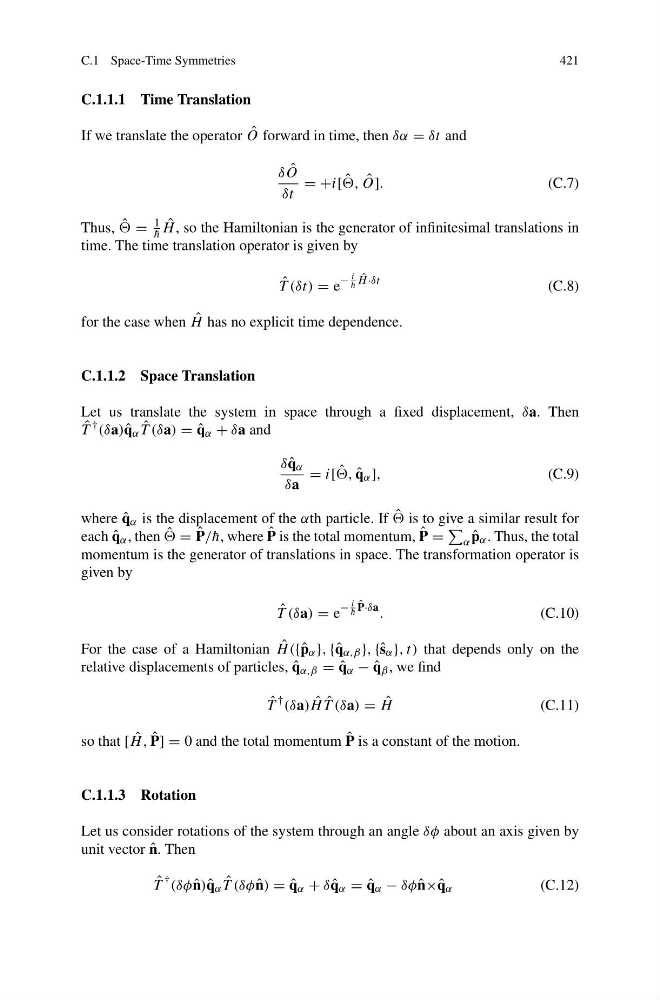
If we translate the operator ˆ
O forward in time, then δα = δt and
δ ˆ
O
δt
= +i[ ˆ
, ˆ
O].
(C.7)
Thus, ˆ
=
1
¯
h
ˆ
H , so the Hamiltonian is the generator of infinitesimal translations in
time. The time translation operator is given by
ˆ
T (δt) = e
−
i
¯
h
ˆ
H ·δt
(C.8)
for the case when ˆ
H has no explicit time dependence.
C.1.1.2 Space Translation
Let us translate the system in space through a fixed displacement, δa. Then
ˆ
T † (δa) ˆ
q α ˆ
T (δa) = ˆ
q α + δa and
δ ˆ
q α
δa
= i[ ˆ
, ˆ
q α ],
(C.9)
where ˆ
q α is the displacement of the αth particle. If ˆ
is to give a similar result for
each ˆ
q α , then ˆ
= ˆ
P/ ¯
h, where ˆ
P is the total momentum, ˆ
P =
α ˆ
p α . Thus, the total
momentum is the generator of translations in space. The transformation operator is
given by
ˆ
T (δa) = e
−
i
¯
h
ˆ
P·δa .
(C.10)
For the case of a Hamiltonian ˆ
H ({ ˆ
p α }, { ˆ
q α,β }, {ˆ s α }, t) that depends only on the
relative displacements of particles, ˆ
q α,β = ˆ
q α − ˆ
q β , we find
ˆ
T
† (δa) ˆ
H ˆ
T (δa) = ˆ
H
(C.11)
so that [ ˆ
H , ˆ
P] = 0 and the total momentum ˆ
P is a constant of the motion.
C.1.1.3 Rotation
Let us consider rotations of the system through an angle δφ about an axis given by
unit vector ˆ
n. Then
ˆ
T
† (δφ ˆ
n) ˆ
q α ˆ
T (δφ ˆ
n) = ˆ
q α + δ ˆ
q α = ˆ
q α − δφ ˆ
n× ˆ
q α
(C.12)
421
C.1.1.1 Time Translation
If we translate the operator ˆ
O forward in time, then δα = δt and
δ ˆ
O
δt
= +i[ ˆ
, ˆ
O].
(C.7)
Thus, ˆ
=
1
¯
h
ˆ
H , so the Hamiltonian is the generator of infinitesimal translations in
time. The time translation operator is given by
ˆ
T (δt) = e
−
i
¯
h
ˆ
H ·δt
(C.8)
for the case when ˆ
H has no explicit time dependence.
C.1.1.2 Space Translation
Let us translate the system in space through a fixed displacement, δa. Then
ˆ
T † (δa) ˆ
q α ˆ
T (δa) = ˆ
q α + δa and
δ ˆ
q α
δa
= i[ ˆ
, ˆ
q α ],
(C.9)
where ˆ
q α is the displacement of the αth particle. If ˆ
is to give a similar result for
each ˆ
q α , then ˆ
= ˆ
P/ ¯
h, where ˆ
P is the total momentum, ˆ
P =
α ˆ
p α . Thus, the total
momentum is the generator of translations in space. The transformation operator is
given by
ˆ
T (δa) = e
−
i
¯
h
ˆ
P·δa .
(C.10)
For the case of a Hamiltonian ˆ
H ({ ˆ
p α }, { ˆ
q α,β }, {ˆ s α }, t) that depends only on the
relative displacements of particles, ˆ
q α,β = ˆ
q α − ˆ
q β , we find
ˆ
T
† (δa) ˆ
H ˆ
T (δa) = ˆ
H
(C.11)
so that [ ˆ
H , ˆ
P] = 0 and the total momentum ˆ
P is a constant of the motion.
C.1.1.3 Rotation
Let us consider rotations of the system through an angle δφ about an axis given by
unit vector ˆ
n. Then
ˆ
T
† (δφ ˆ
n) ˆ
q α ˆ
T (δφ ˆ
n) = ˆ
q α + δ ˆ
q α = ˆ
q α − δφ ˆ
n× ˆ
q α
(C.12)